
Would You Fly with a Pilot Who Isn’t on the Plane?

Strange question, right? But it’s the whole idea behind Nassim Nicholas Taleb’s Skin in the Game, and it’s the reason a bunch of Indian market rules quietly changed over the last five years.
And then quietly changed back.
After a crisis, India wrote rules forcing fund managers and founders to keep their own money at risk alongside yours. Then, once the crisis faded, some of those rules got softened. The question worth asking of anyone handling your money is the same question worth asking of the regulator.
Go back far enough and you’ll find a Babylonian king named Hammurabi writing down a set of laws. One of them was brutal. If a builder built a house, and it collapsed and killed the person living inside, the builder was put to death.
Harsh. But there’s a simple idea sitting inside that rule.
Whoever makes the call should be the one who feels it if the call goes wrong.
Having a stake isn’t the same as having skin in the game
Most people hear the phrase and assume it means owning shares in the company you work for. Having “a stake” in it.
That’s part of it. It’s the easy half.
The half that matters is this: if you enjoy the upside when something works out, you should also feel it in your pocket when it doesn’t.
Now flip it around. Someone gives you advice, charges a fee or takes a commission for it, and if that advice turns out to be terrible, nothing happens to them.
If someone risks nothing to give you an opinion, that opinion probably isn’t worth much either.
It’s a design flaw. Any system where the people making decisions never feel the consequences will, sooner or later, stop caring whether those decisions are any good.
When Franklin Templeton froze ₹25,000 crore overnight
In April 2020, something strange happened. Franklin Templeton, one of India’s oldest fund houses, shut down six debt funds overnight. Roughly ₹25,000 crore of investor money got frozen, with almost no warning.
Fund managers had been parking money in riskier, harder-to-sell bonds to squeeze out slightly better returns. When a lot of investors tried pulling their money out at the same time, there wasn’t enough cash to pay everyone.
So the funds froze.
But the fund managers’ own pay had nothing to do with whether that bet worked out. They weren’t the ones who had to live with the fallout.
A year later, SEBI brought in a rule that read almost like it was lifted straight out of Taleb’s book.
SEBI’s mutual fund rule, April 2021
- At least 20% of a fund manager’s pay, and other key employees’, had to come as units of the same schemes they managed
- Those units stayed locked in for three years, with no early exit
- If fraud or serious lapses turned up later, the units could be clawed back entirely
- Fund houses also had to put their own money into every new scheme, scaled to size and risk, replacing a flat ₹50 lakh per scheme
In plain terms: if a fund manager wanted your savings in a scheme, their own money had to sit right there next to yours, for years, with no quick way out.
Note the tense. We’ll come back to it.
Founders sell the street, but have to keep living on it
Here’s the same problem wearing a different outfit.
A founder takes their company public, sells some shares at a nice fat valuation, and is technically free to sell the rest the very next morning. If the stock crashes a few months later, it’s the retail investors left holding the bag.
SEBI’s IPO lock-in rule
- At least 20% of promoter shareholding stays locked in after an IPO
- That 20% stays locked for 18 months, trimmed down from three years in 2021
- Promoter shares above that 20%, and shares held by pre-IPO investors who aren’t promoters, get a six-month lock-in
There’s a simple idea underneath it. If you built the house, you’ve got to live in it a little while longer, even after you’ve sold off the rest of the street.
Worth noticing, though, that this rule was already being loosened in 2021. Three years became eighteen months. The direction of travel was visible even then.
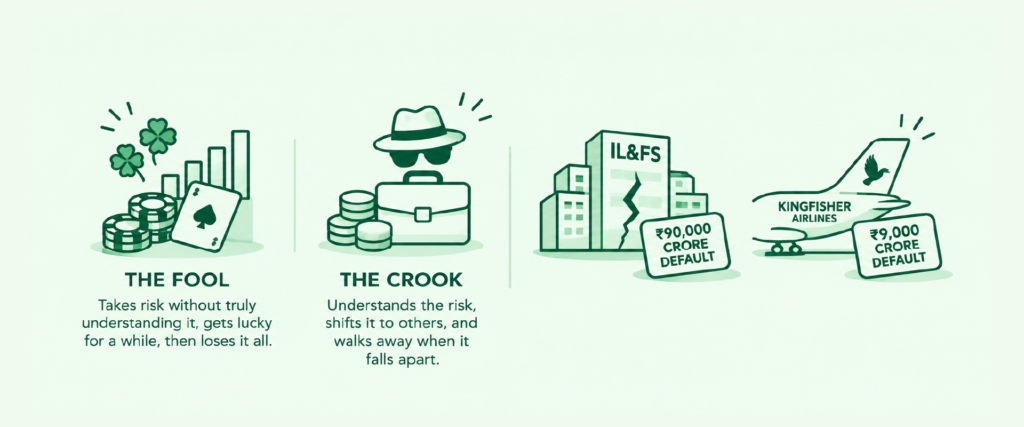
The fool and the crook both lose your money, differently
The fool doesn’t really understand the risk he’s taking. He gets lucky a few times and mistakes it for skill. When the bet finally blows up, it surprises him as much as everyone else.
The crook understands the risk perfectly well. He just makes sure someone else ends up holding it, and walks away clean when it falls apart. It’s never a surprise for him.
India’s NBFC sector managed to hand us both, a couple of years apart.
IL&FS, 2018. Carried an AAA rating for years, handed out by agencies that were being paid by IL&FS itself. Then it defaulted on more than ₹90,000 crore of debt once the cracks showed. The fallout froze credit across the entire NBFC sector and helped pull down companies like DHFL soon after.
Kingfisher Airlines. Borrowed heavily, at one point carrying debt worth many multiples of its own capital. Eventually defaulted on close to ₹9,000 crore owed to a group of 17 banks. Vijay Mallya left India in 2016, a day before banks moved to seize his assets, and was later declared India’s first fugitive economic offender.
This is basically what Taleb means by “ruin.” Most of life runs on ordinary cost-benefit maths, a little risk for a little reward, evened out across many tries. But once there’s a real chance of total, irreversible collapse, averages stop meaning anything.
There’s no averaging your way out of a bankruptcy.
Talking about a good game is free. Betting on it isn’t.
You’ve probably seen both types on finance Twitter or YouTube.
There’s the person who’s “called” ten multibaggers this year across ten different videos and never once shows an actual portfolio. And then there’s the quieter investor who posts a real profit-and-loss screenshot, including the trades that went badly.
Taleb’s point isn’t that predictions are useless. It’s that what matters isn’t how often you sound right. It’s how much you actually make or lose when it’s your own money on the table.
Being wrong costs nothing if nobody’s keeping score against your bank balance.
What happened to the rule
Here’s the part that makes this whole thing more interesting, and slightly less comfortable.
On 1 April 2025, SEBI replaced that flat 20% requirement with a slab system based on cost to the company.
|
Slab |
Annual CTC |
Must be invested in managed schemes |
|
0 |
Below ₹25 lakh |
Nothing |
|
1 |
₹25 to 50 lakh |
10%, or 12.5% excluding ESOPs |
|
2 |
₹50 lakh to ₹1 crore |
14%, or 17.5% excluding ESOPs |
|
3 |
Above ₹1 crore |
18%, or 22.5% excluding ESOPs |
Alongside it: the lock-in is waived entirely for employees retiring at superannuation age, except for closed-ended schemes. Shorter lock-ins for those who resign or retire early. Certain insider trading restrictions no longer apply to the mandatory investments. And liquid fund managers can now place up to 75% of their required investment in higher-risk schemes rather than the ones they run.
SEBI’s stated reason was ease of doing business. Industry had argued, with some justification, that a flat 20% with a three-year lock-in was genuinely harsh on junior employees, who have mortgages and school fees and limited disposable income.
That argument isn’t unreasonable. A junior analyst earning ₹20 lakh having a fifth of it locked away for three years is a real hardship, and it isn’t obvious that it made anyone’s money safer.
But look at what the slab system actually does.
Anyone below ₹25 lakh now has no skin in the game at all. Only the top slab approaches the original figure. And the people most likely to be running a fund when the next Franklin Templeton situation arrives, senior managers near retirement, can now redeem freely at superannuation.
The rule was written in 2021, one year after ₹25,000 crore got frozen. It was softened in 2025, five years after, when nobody was angry any more.
Taleb’s point generalises further than he probably intended. Rules that make decision-makers feel consequences are written immediately after someone feels them. They get relaxed once the memory fades, and they get relaxed by people responding to pressure from the exact group the rules constrain.
The regulator has skin in the game too. The question is just whose.
None of which means the 2025 version is wrong. It may well be a sensible correction of an overcorrection. The point is narrower: a rule is not a permanent fact, and a protection you’re relying on may not be the one that was written.
The one question worth asking before you trust anyone with your money
SEBI’s mutual fund rule, the IPO lock-in, and the collapse of IL&FS and Kingfisher are taught in four different ways. A system only stays honest when the people running it can’t walk away from their own mistakes.
And systems drift, because the pressure to loosen a rule is constant while the pressure to keep it only shows up after something breaks.
So the next time a fund manager, a founder, or a finance influencer tells you where to put your money, there’s one question worth asking first.
What do they actually lose if they’re wrong?
If the honest answer is nothing, that tells you most of what you need to know.
And it’s worth asking the same thing about whichever rule you were assuming would protect you.
Disclaimer:
This article is for informational and educational purposes only. It is not investment advice. Regulatory provisions described are as of the dates stated and are subject to change; verify current requirements with SEBI directly. Companies and individuals are named as documented historical examples. Please consult a SEBI-registered investment adviser before making financial decisions.