
The Retail Investor’s Bias Towards ‘Cheap’ Stocks: Why Low Prices Can Be Costly
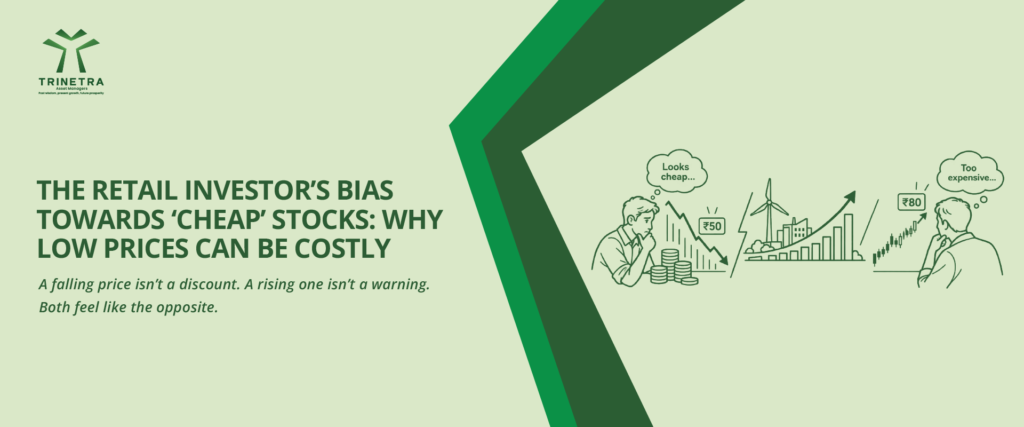
A falling price isn’t a discount. A rising one isn’t a warning. Both feel like the opposite.
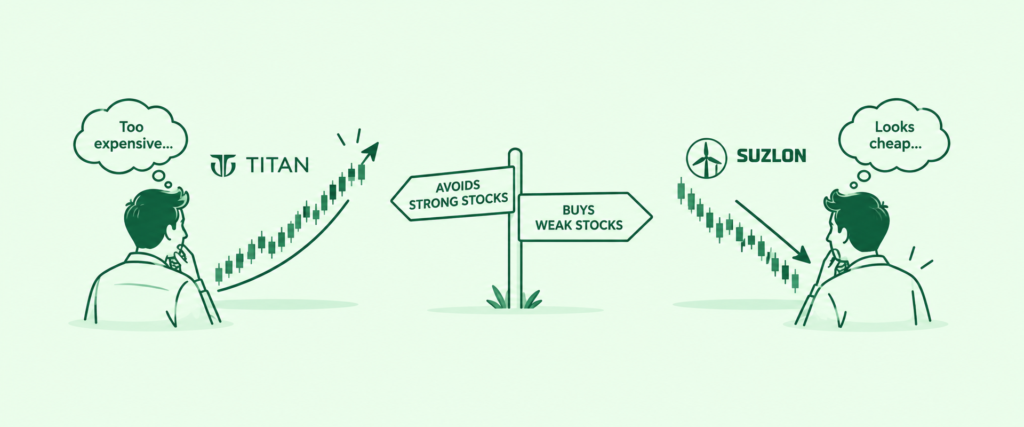
Retail investors chase stocks that have fallen and avoid stocks that have risen, for the same underlying reason: anchoring to a price rather than assessing a business. Suzlon shows why both halves of that instinct cost money, because the same stock punished one group of buyers and rewarded another entirely.
One of the most common behavioural biases among retail investors is equating a low share price with a good investment opportunity.
Buying products at discounted prices is rational in everyday life. The same logic does not transfer to financial markets.
A shirt discounted from ₹2,000 to ₹800 is the same product at a lower price. A stock is not a product. It’s a claim on the future earnings of a business. When fundamentals deteriorate, a declining share price may be reflecting worsening prospects rather than an attractive entry point.
The misconception that “cheap” means undervalued
Many investors assume a stock that has fallen 50%, 60% or 80% must now represent value. The reasoning is intuitive: if it once traded higher, it should eventually return there.
Markets don’t work that way.
A stock trading at a fraction of its previous price isn’t necessarily undervalued. It may simply be reflecting a weaker business. Revenue growth may have stalled. Profitability may be under pressure. Debt may have increased. Management quality may have deteriorated. Industry dynamics may have permanently changed.
The question isn’t “how much has the stock fallen?” It’s “why has it fallen, and has anything changed since?”
Consider a used car. If one that originally sold for ₹8 lakh is available today for ₹3 lakh, most buyers would first ask why. They’d inspect the engine, the accident history, the maintenance record and the likely repair costs before deciding.
A sharp decline may be caused by temporary pessimism. It may also indicate deteriorating earnings, governance concerns, rising debt or structural change. Without understanding which, buying because something looks inexpensive is guesswork.
Stocks can always fall further
Another common misconception is that a stock which has already declined significantly can’t fall much more.
A stock that falls from ₹100 to ₹30 can still go to ₹10. One that falls from ₹500 to ₹100 can keep falling if fundamentals keep weakening.
The market doesn’t set future returns based on the magnitude of past declines. It prices businesses on expectations of future cash flows.
This is why experienced investors focus on business quality, balance sheet strength, competitive position and long-term earnings potential rather than past price movements. A stock becomes attractive when its intrinsic value exceeds its market price, not when it has simply fallen a long way.
Suzlon: one stock, three lessons
Most articles on this topic use Suzlon as a cautionary tale and stop there. The full story is considerably more useful, because the same company demonstrates the bias running in both directions.
Phase one: the falling knife, 2008 to 2020
Suzlon peaked around ₹469 in 2008 before entering a prolonged decline driven by heavy leverage, debt-funded overseas acquisitions, foreign exchange losses and execution problems.
As the price fell to ₹100, many investors considered it a bargain. The same perception persisted at ₹50, at ₹20, and lower still.
The decline continued because the business kept deteriorating. By FY20 the company carried over ₹13,000 crore of debt. By 2020 the stock traded between ₹1.58 and ₹2.
Anyone who bought at ₹100 thinking it was cheap lost roughly 98% of their money. Anyone who bought at ₹20 thinking the same lost about 90%. The price was never the signal. The balance sheet was.
Phase two: the turnaround nobody wanted, 2020 to 2024
Then the business actually changed.
Suzlon restructured, converted debt to equity, sold assets, cut costs, introduced new turbine platforms and prioritised profitable execution over market share. Debt fell from over ₹13,000 crore in FY20 to effectively nil by FY24. The company returned to profitability, and India’s renewable energy push arrived at the right moment.
|
Figure |
|
|
COVID low, 2020 |
₹1.58 to ₹2 |
|
Peak, September 2024 |
~₹83 to ₹84 |
|
Return from the low |
Roughly 25 to 37 times |
Note what the recovery was not. It wasn’t the price reverting to its old level because it had fallen far. It was a genuine change in the underlying business, visible in the debt figures long before the stock responded.
Suzlon’s market capitalisation now exceeds the roughly ₹60,000 crore peak it commanded in 2008, even though the share price remains a fraction of that era’s level, because the share count expanded enormously through those debt-to-equity conversions. That detail alone explains why “it used to trade at ₹400” was never a meaningful anchor.
Phase three: the same bias, running forward, 2024 to now
And then the story repeated, with the roles reversed.
After the debt-free announcement triggered a re-rating, retail investors piled in on the turnaround narrative. Suzlon reached around ₹83 in September 2024.
It closed at ₹37.40 in late October 2026, roughly 55% below that peak, and touched a 52-week low near ₹36 earlier that month.
Investors who bought at ₹80 on the strength of a story about a transformed company are now in the same position as those who bought at ₹100 in 2010 on the strength of a story about a recovery that hadn’t happened yet.
What the three phases together establish: a low price told you nothing in 2012. A low price told you something very different in 2020, because the business had changed. And a high price after a successful turnaround still didn’t protect buyers in 2024.
In each case the useful question was identical. Not what the price was, but what the business was doing.
Why investors avoid strong stocks
Here’s the half of this bias that gets far less attention, and it costs just as much.
While many investors are eager to buy declining stocks, they hesitate to buy companies making new highs. The phrases are familiar. “I’ve missed the rally.” “It’s become too expensive.” “I’ll wait for a correction.”
But a rising share price often reflects improving fundamentals rather than excessive valuation.
Companies that consistently grow revenues, expand margins, gain market share and generate superior returns on capital frequently keep creating shareholder wealth over long periods. The high price is a consequence of the business working, not evidence that it’s about to stop.
Titan is the standard Indian illustration. For years the stock traded near all-time highs, and many investors avoided it precisely because it appeared expensive on conventional metrics. Sustained earnings growth, expansion across jewellery, watches and eyewear, and consistent execution allowed the company to justify higher valuations over time.
The asymmetry is the point. The investor who refuses to buy Titan at an all-time high and the investor who buys Suzlon at ₹20 are making the identical error. Both are anchored to a past price instead of assessing a present business. One anchor says “this is cheap relative to where it was.” The other says “this is expensive relative to where it was.”
Neither sentence contains any information about the company.
Some of the market’s biggest wealth creators looked expensive throughout their journey, because the underlying businesses kept getting stronger. And some of the market’s biggest destroyers of capital looked cheap the entire way down, for exactly the same reason in reverse.
Averaging down: a different form of leverage
Traders lose money through excessive financial leverage. Investors destroy capital by repeatedly averaging down into fundamentally weak companies.
Buying more shares simply because the price has fallen increases exposure to the same investment without improving the thesis. The position gets larger. The reasoning doesn’t get better.
Averaging down works when the business is sound and the decline is driven by sentiment. It compounds the damage when the business is in genuine trouble.
The test is whether you’d buy the stock today at this price if you owned none of it. If the honest answer is no, you’re not averaging down. You’re rescuing a decision.
When retail participation peaks during declines
The behaviour shows up clearly in shareholding data.
PC Jeweller delivered exceptional returns between 2016 and 2017. The company then announced that its board would consider a share buyback, which generated considerable optimism and encouraged retail buying in anticipation of price support.
The proposed buyback was never approved. By then, retail participation had already increased sharply even as the share price was falling.
|
Quarter |
Number of shareholders |
|
December 2017 |
29,578 |
|
March 2018 |
67,236 |
|
June 2018 |
1,81,243 |
|
September 2018 |
2,03,229 |
The shareholder count rose nearly sevenfold while the stock declined. Retail participation accelerated after prices started falling, not while the company was creating wealth.
A comparable pattern appeared in Sun Pharma. The stock appreciated strongly through the first half of the 2010s, then entered a significant correction. Retail participation increased substantially during the decline rather than during the uptrend. Many investors who ignored it during its strongest years became interested only after prices had corrected, assuming it had become inexpensive.
What makes Sun Pharma instructive is what follows. The business remained fundamentally strong, worked through its regulatory and integration issues, and the stock subsequently recovered well beyond its earlier highs.
So the investors who bought during that correction were ultimately right, but not for the reason most of them thought. They were right because the business was sound, not because the price had fallen. The same instinct applied to Suzlon in 2012 produced the opposite outcome.
That’s the whole argument in one comparison. Identical behaviour, opposite results, and the variable that decided it was never the price.
The pattern underneath all of it
Suzlon, Titan, PC Jeweller and Sun Pharma reveal one recurring behavioural pattern.
Strong businesses get ignored because they appear expensive after delivering sustained gains. Companies facing genuine difficulty attract retail interest because their prices have fallen sharply.
Both reflect price anchoring rather than analysis.
|
The anchor |
What it sounds like |
What it actually tells you |
|
Fallen a long way |
“It was ₹400, now it’s ₹20” |
Nothing about the business |
|
Risen a long way |
“It’s at an all-time high, too expensive” |
Nothing about the business |
Successful investing requires evaluating business quality, management execution, competitive position, balance sheet strength and long-term earnings potential. Not comparing the current price with a historical one.
Conclusion
A falling share price does not automatically create value. A rising share price does not automatically imply overvaluation.
The market rewards ownership of businesses that keep compounding earnings. It has no mechanism for returning a stock to a price it once held, and no mechanism for preventing a good business from getting better.
Shift the question from “how much has this fallen?” to “has the underlying business become stronger or weaker?”
Suzlon answered that question differently in 2012, in 2021 and in 2026, which is exactly why the price alone never answered it at all.
Price attracts attention. Business quality determines outcomes. The most successful investors don’t buy stocks because they look cheap. They buy businesses whose future value is likely to exceed what the market currently recognises.
Disclaimer:
This article is for informational and educational purposes only. It is not investment advice, and nothing here is a recommendation to buy or sell any security. Companies are named as illustrations of investor behaviour. Share prices and financial data are as of the dates stated and change continuously. Past performance does not indicate future results. Please consult a SEBI-registered investment adviser before making financial decisions.