
The Paradox That Confused Mathematicians
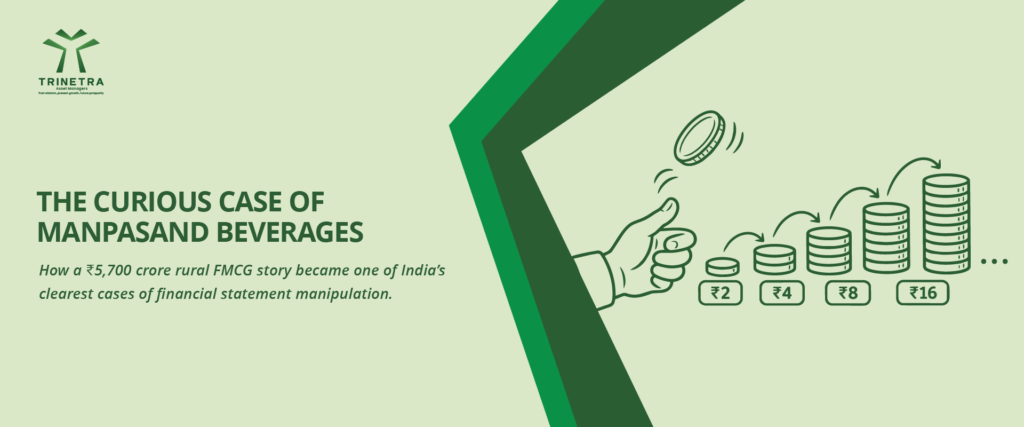
A coin-toss game worth infinite money that nobody will pay ₹500 to play. The gap between those two facts built modern behavioural finance.
Classical economics says people maximize expected value. They don’t, and not because they’re stupid. They weigh losses roughly twice as heavily as gains, sort identical money into incompatible mental buckets, and reverse their decisions entirely based on how a question is worded. Markets are built on top of all of it.
The game nobody will pay for
In the early 1700s, some of the brightest mathematicians in Europe were stumped by a coin toss. We know it now as the St. Petersburg Paradox.
A coin is flipped repeatedly. The rules:
Outcome
Payout
Tails on the first toss
₹2
One head, then tails
₹4
Two heads, then tails
₹8
Three heads, then tails
₹16
The payout doubles for every consecutive head. Because the probability halves each time while the payout doubles, the expected value is infinite.
Expected Value = (1/2 × ₹2) + (1/4 × ₹4) + (1/8 × ₹8) + (1/16 × ₹16) + …
= ₹1 + ₹1 + ₹1 + ₹1 + … = ∞
By classical economic theory, a rational person should be willing to pay every rupee they own to play once.
Ask a real person for ₹500 and they’ll decline.
They’re right, and here’s why.
Humans don’t play games on infinite timelines. Look at what a single round actually delivers:
Probability
You walk away with
50%
₹2
75%
₹4 or less
87.5%
₹8 or less
93.75%
₹16 or less
Pay ₹500 to enter and you face a 93.75% chance of losing more than ₹484 on your first attempt.
The payouts that drag the expectation to infinity live in astronomically improbable territory. To win over ₹1 crore you’d need 23 heads in a row followed by a tail, which happens roughly once in 16.8 million attempts.
And there’s a second impossibility hiding in the maths. The infinite expected value assumes a casino with infinite money. In reality, casinos, governments and banks have finite capital. Cap the house at ₹100 crore and the doubling stops there, which collapses the true expected value to something modest.
Real people instinctively understand that they’re being asked to risk actual cash for a microscopic chance at a payout from a house that couldn’t honour it anyway.
[Image here]
Bernoulli’s answer
The gap between maths and ordinary human judgment pushed the Swiss mathematician Daniel Bernoulli to rethink the problem in 1738.
His insight was that people don’t value money in a straight line.
The first ₹10,000 you earn changes your life. It buys food and pays rent. The next ₹10,000 doesn’t deliver the same amount of satisfaction, and the ten-thousandth increment barely registers.
Bernoulli called this utility: the actual satisfaction derived from money rather than the raw number. Each additional unit of wealth produces less psychological benefit than the one before.
That single idea sat largely unchallenged for 250 years, with much of academic economics built on top of it.
The psychologists who changed finance
Then two Israeli psychologists took a different approach.
In the 1970s, Daniel Kahneman and Amos Tversky set out to study how people actually make choices under risk. Not how they should behave according to equations, but how they do behave.
Their findings overturned the assumptions underneath standard economics. People are emotional, systematically biased, inconsistent, and highly sensitive to how information is presented. The work created the field of behavioural finance and earned Kahneman the Nobel in Economics in 2002. Tversky had died in 1996 and so could not share it. Kahneman died in March 2024.
And there is nowhere this psychology reveals itself more clearly, or more expensively, than in markets.
Loss aversion
In a logical world, a gain of a given size would feel as good as a loss of the same size feels bad.
Brains don’t work that way.
Loss aversion means the pain of losing something you own is roughly twice as powerful as the pleasure of gaining the same thing. We are wired to avoid downside far more than we’re motivated to chase equivalent upside.
The asymmetry is evolutionary. Avoiding a predator was life or death. Finding an extra berry bush was a bonus. Our ancestors survived by prioritising loss avoidance.
The experiment
Tversky and Kahneman’s 1981 paper in Science put the following pair of choices to subjects.
Decision one:
Option
Result
A sure gain of $240
84% chose this
25% chance to gain $1,000, 75% chance of nothing
16%
Facing gains, people become risk-averse. They lock in the win.
Decision two:
Option
Result
A sure loss of $750
13%
75% chance to lose $1,000, 25% chance to lose nothing
87% chose this
Facing losses, the crowd flips entirely.
And here’s the part that makes this finding genuinely remarkable.
Tversky and Kahneman designed those numbers deliberately. Subjects faced both decisions simultaneously, so the combinations matter.
Choosing A and D together produces: a 25% chance of winning $240 and a 75% chance of losing $760.
Choosing B and C together produces: a 25% chance of winning $250 and a 75% chance of losing $750.
The second combination is better in every single outcome. It’s not a close call, a matter of taste, or a different attitude to risk. It dominates.
A substantial proportion of subjects chose the dominated combination anyway, because they evaluated each decision in isolation rather than together.
That’s the real finding. Not that people are inconsistent, but that framing each choice separately leads them to pick an option that is strictly worse no matter what happens.
LTCM and the loss spiral
Risk-seeking during losses is precisely how sophisticated funds destroy themselves.
Long-Term Capital Management, run by Wall Street veterans and Nobel laureates, used mathematical models to arbitrage small price differences in global bonds. For years it worked beautifully.
When Russia defaulted in 1998, the models broke. LTCM began losing hundreds of millions a day.
Rational theory says cut the position. Instead, leadership doubled down on losing trades and increased leverage, desperate to avoid locking in a defeat.
A bad quarter became a systemic threat requiring a $3.6 billion rescue organised by the Federal Reserve Bank of New York across fourteen banks.
When professionals run significant losses, they stop looking at the maths. They chase momentum, buy speculation, and take extreme risks to clear the red from the screen. The behaviour is identical to the retail investor averaging down into a collapsing stock. Only the scale differs.
The sunk cost fallacy
You buy shares at ₹1,000. A year later they traded at ₹400.
Meanwhile the landscape has shifted. Competitors have launched a better product, management has taken on expensive debt, and the main revenue streams are shrinking.
The only question that matters is: knowing what I know today, is this the best home for my remaining capital?
Almost nobody thinks that way. Instead:
“I’ve put too much into this to quit now.”
“Selling at ₹400 means throwing away ₹600 a share.”
“I’ll wait until it gets back to my buying price, then exit clean.”
This is the sunk cost fallacy. Past investments of money, time or energy, which are gone and unrecoverable, irrationally dictate future choices.
The blizzard
Richard Thaler posed a version of this that cuts to the mechanism.
Two sports fans plan to drive 40 kilometres through a dangerous snowstorm to a basketball game. One paid a lot for their ticket. The other received theirs free from a friend.
As the storm worsens, which one is more likely to risk the drive?
The one who paid.
Logically, this makes no sense. The money is gone either way, whether they sit safely at home or end up in a ditch. The only variable that should matter is the danger of the driver.
But wasting an investment feels unbearable, so we make bad future decisions to justify past spending.
Nokia
For years Nokia dominated mobile phones, built on its Symbian operating system. When the iPhone arrived in 2007 and Android followed, the industry shifted from hardware to software.
Nokia’s engineers knew Symbian wasn’t built for a touch-screen, app-driven world. Rather than abandoning it, the company spent years and billions trying to patch and extend it.
Sunk cost was part of this. A decade of engineering hours and corporate identity were tied up in that platform.
But the better-documented cause is more uncomfortable. Research by Timo Vuori and Quy Huy, published in Administrative Science Quarterly, found that shared organisational fear meant middle managers were reluctant to deliver bad news upward. Senior leadership received a systematically distorted picture of where Nokia actually stood technologically.
So the company didn’t just struggle to abandon a sunk investment. It struggled to find out the investment was sunk, because the people who knew were afraid to say so.
By the time the platform was finally dropped, Apple and Samsung had taken the market.
Concorde
In the 1960s, Britain and France jointly developed a supersonic passenger jet. Partway through development, the data made clear it would never be commercially viable.
Neither government pulled the plug. Too much national pride, time and money had already gone in.
They continued funding it for decades, digging deeper purely because admitting the loss was unacceptable. The sunk cost fallacy is sometimes called the Concorde fallacy for exactly this reason.
Ordinary investors repeat it constantly. A stock bought at ₹100 falls to ₹40, the business is broken, the industry has moved. A rational actor sells and redeploys. Instead, people hold corporate ghosts for a decade, or average down, putting fresh capital into a sinking position purely to avoid accepting the loss as real.
The framing effect
People don’t react to facts. They react to how facts are packaged.
Kahneman and Tversky demonstrated this with a hypothetical disease outbreak expected to kill 600 people. Participants chose between two programmes, with the choice presented two different ways.
Version one, framed as gains:
Programme
Description
Chose it
A
200 people will be saved
72%
B
One-third chance 600 are saved, two-thirds chance nobody is saved
28%
Version two, framed as losses:
Programme
Description
Chose it
C
400 people will die
22%
D
One-third chance nobody dies, two-thirds chance 600 die
78%
Look at what the options actually say.
Saving 200 of 600 is 400 dying. Programme A and Programme C are identical. So are B and D.
Mathematically indistinguishable. Yet framing the choice around saving lives makes people risk-averse, and framing the same choice around deaths makes them risk-seeking.
How this works in financial advice
Frame A: “If we keep your money in this equity portfolio, there’s a 10% chance you could lose ₹5,00,000 over the next twelve months.”
Frame B: “Based on historical data, this portfolio has a 90% probability of protecting your principal or growing your wealth over the next year.”
The risk profile is identical. Frame A triggers a visceral survival response. The client pictures money vanishing, panics, and asks to move to cash. Frame B produces confidence and long-term focus.
Neither sentence is dishonest. That’s what makes the effect difficult to defend against.
Mental accounting
In economics, money is fungible. Every rupee is identical and interchangeable. ₹1,000 earned from an eight-hour shift has exactly the same purchasing power as ₹1,000 won on a bet or received as a gift.
The brain rejects this.
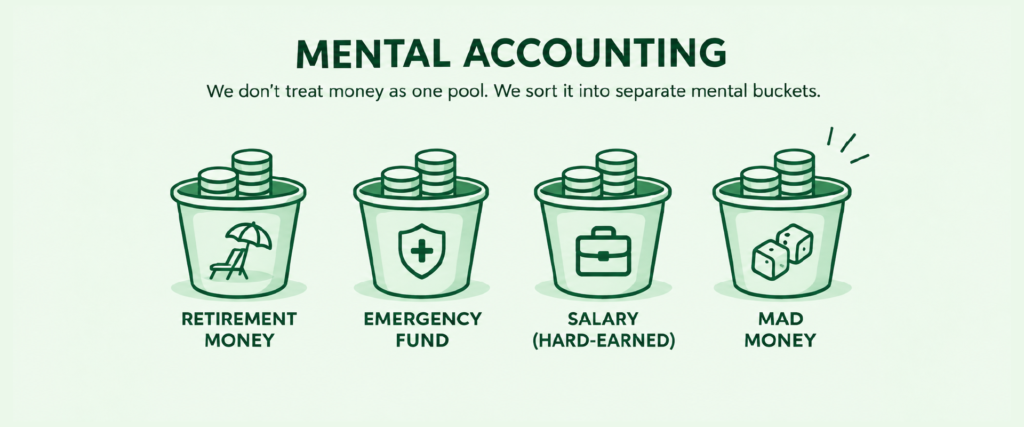
Rather than treating money as one pool, we run an internal bookkeeping system that Richard Thaler named mental accounting, sorting cash into separate emotional buckets based on where it came from or what it’s for.
Sacred retirement money. The emergency fund. Hard-earned salary. And the dangerous one: mad money.
Because we treat these buckets as operating under different rules, we make serious errors. We agonise over a ₹100 overcharge on the grocery bill while watching thousands disappear from a speculative trading account without the same distress.
Separating wealth into emotional jars strips money of its neutrality. We let the backstory of how we acquired cash dictate how carelessly we spend it.
House money, 2021
An investor puts ₹50,000 of savings into a speculative token. They treat that deposit carefully.
Three weeks of social media hype later, the position is worth ₹5,00,000.
That ₹5,00,000 is entirely theirs. It can buy assets, repay a loan, or sit in a deposit.
Instead the brain reclassifies. The ₹4,50,000 profit becomes house money.
Once it’s categorised as free rather than real, risk management stops. Leveraged bets on riskier tokens follow, on the reasoning that losing it only means losing the market’s money.
When central banks raised rates, those tokens fell 90% to 99% within months. Millions of retail investors lost real wealth because of a labelling error. All money is real, regardless of how quickly it arrives.
Hedonic editing
We’re natural editors of our own reality. Through a process Thaler called hedonic editing, we package financial information to maximise emotional comfort.
The most effective version converts a painful loss into a predictable cost.
Consider two identical outcomes:
- A gamble with a 10% chance to win $9,500 and a 90% chance to lose $500
- A lottery ticket costing $500, offering a 10% chance to win $10,000 and a 90% chance of nothing
The payoff matrices are the same. People overwhelmingly prefer the second, because a $500 entry fee registers as a cost of participation while a $500 loss registers as a defeat.
Why insurance works
This is the mechanism the entire insurance industry runs on.
Say the annual probability of your house burning down is 0.1%, and the damage would cost ₹50 lakh.
Expected annual loss = 0.001 × ₹50,00,000 = ₹5,000
To cover claims, staff, overheads and profit, the insurer charges perhaps ₹7,000.
Which means you are knowingly paying more than your mathematically expected loss. Insurance is, by design, a negative expected value transaction for the buyer. It has to be, or insurers would go bankrupt.
Millions of rational people write that cheque every year anyway.
They do it because the real product isn’t financial compensation after a disaster. It’s the removal of a particular kind of anxiety.
The buyer’s mind performs the edit: better a small, certain, predictable cost today than a small probability of catastrophic destruction tomorrow.
Framed that way, the premium becomes a lifestyle expense rather than a loss. It’s a reverse lottery ticket. Nobody says “I accepted a guaranteed ₹7,000 loss to an insurance company.” They say “I protected my family.”
This works because we overweight small probabilities of vivid, extreme events. Plane crashes, diagnoses, fires. The emotional weight of those outcomes is so large that paying a premium feels rational even when the odds favour the insurer.
Insurance performs a psychological conversion: it turns an unpredictable catastrophe into a small, scheduled cost. And because people will always prefer predictable small pain to unpredictable large pain, we hand the money over gladly.
The disciplined edge: broadening the frame
Markets aren’t driven by the equations of physics. They’re driven by what Thaler calls supposedly irrelevant factors: the wording, the emotional triggers, the mental buckets that shape how we process reality.
The investors who survive across decades aren’t the ones with the most complex models. They’re the ones with the discipline to notice when a cognitive illusion is operating on them.
You can’t eliminate these biases. They’re not bugs in the system, they’re the system. Loss aversion kept your ancestors alive.
What you can do is widen the frame deliberately.
Before a decision, ask what the choice looks like stated the other way round. Ask whether you’d make the same call if you held no existing position. Ask whether the money you’re risking would feel different had you earned it differently, and recognise that if the answer is yes, the difference is in you rather than in the money.
Tversky and Kahneman’s subjects chose an option that was worse in every outcome, not through stupidity but because they looked at two decisions separately instead of together.
That’s the whole lesson. Master the maths, know the numbers backwards, and keep enough distance to see the frame you’re being handed.
Disclaimer:
This article is for informational and educational purposes only. It is not investment advice, and nothing here is a recommendation to buy or sell any security. Research findings are cited as published. Please consult a SEBI-registered investment adviser before making financial decisions.
Sources:
Daniel Bernoulli (1738) on utility; Kahneman & Tversky, “Prospect Theory” (1979); Tversky & Kahneman, “The Framing of Decisions and the Psychology of Choice,” Science (1981); Richard Thaler on mental accounting and hedonic editing; Vuori & Huy, Administrative Science Quarterly (2016) on Nokia.