The Mathematics of Value and Growth
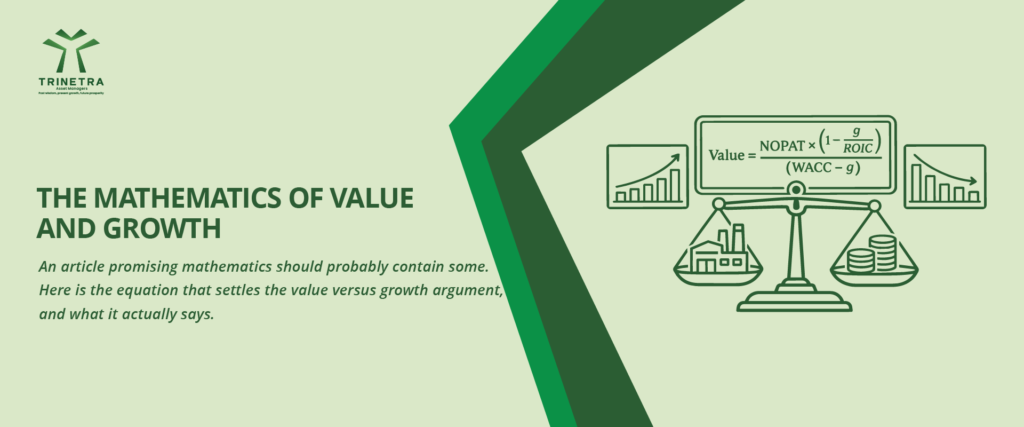
An article promising mathematics should probably contain some. Here is the equation that settles the value versus growth argument, and what it actually says.
Growth creates value only when returns on new capital exceed the cost of that capital. Below that line, faster growth makes a company worse. There’s a formula that proves it, and once you’ve seen it the value-versus-growth distinction stops making much sense.
A long-standing debate in investing revolves around a deceptively simple question. Are you a value investor or a growth investor?
Investors get sorted into one of these camps as though they represent genuinely different philosophies.
The distinction is far less meaningful than it appears. Every stock, whatever label it carries, is ultimately worth the present value of the cash it will generate over its lifetime. The factors determining that value are identical for every business. What differs is the assumptions about growth, capital allocation and risk.
Understanding those drivers matters considerably more than attaching labels to companies.
The false divide between value and growth
Conventional wisdom says value investors seek inexpensive stocks with low multiples, while growth investors pay higher multiples for companies expanding rapidly.
But multiples like price-to-earnings or price-to-book are outcomes, not explanations. They’re the output of expectations about future earnings, profitability and risk, compressed into a single number.
A business trading at 40 times earnings isn’t necessarily expensive. One trading at eight times isn’t necessarily cheap. Before concluding anything, you have to understand why the market assigned those figures.
Every valuation method, whether discounted cash flow, earnings multiples or asset-based, is attempting to answer the same question: what are this company’s future cash flows worth today?
Growth does not always create value
Growth is treated as self-evidently desirable. It isn’t.
Growth creates value only when it generates returns above the cost of capital. Below that line, growth actively destroys value, and faster growth destroys it faster.
Consider two businesses.
The first reinvests aggressively, opening new locations and reporting impressive revenue growth. Every new investment earns a return below the company’s cost of capital. Sales keep climbing. Each additional rupee invested makes shareholders poorer.
The second expands more slowly but consistently earns returns well above its cost of capital on every incremental investment. Despite the slower headline growth, each rupee reinvested creates economic value.
Over a long enough period, the slower-growing business generates substantially greater shareholder wealth.
Growth makes a business larger. It creates value only when returns on incremental investment exceed the cost of financing that investment.
The equation that settles it
This isn’t a matter of judgment. It’s arithmetic, and the arithmetic has a standard form.
Tim Koller, Marc Goedhart and David Wessels of McKinsey call it the key value driver formula:
Value = NOPAT × (1 − g / ROIC) ÷ (WACC − g)
Where NOPAT is net operating profit after tax, g is the long-run growth rate, ROIC is the return on invested capital, and WACC is the weighted average cost of capital.
Look at what the numerator does.
The term (1 − g / ROIC) is the reinvestment adjustment. It subtracts the portion of profit that must be ploughed back to achieve growth g at a return of ROIC.
When ROIC is high, achieving a given growth rate consumes little capital, so most of the profit flows to owners. When ROIC is low, the same growth consumes most of the profit, and very little reaches anyone.
Work through three cases at a fixed growth rate.
|
ROIC versus WACC |
What growth does to value |
|
ROIC above WACC |
Growth increases value. More growth, more value |
|
ROIC equal to WACC |
Growth has no effect. Value is identical whether the company grows at 2% or 10% |
|
ROIC below WACC |
Growth reduces value. More growth, less value |
That middle row is the one most investors have never properly absorbed. When returns exactly match the cost of capital, growth is neither good nor bad. It’s irrelevant. The company can double in size and be worth exactly the same.
And the bottom row is the one that costs money. A company growing revenue 25% a year while earning 8% on capital it raises at 12% is not a growth story with execution problems. It is a value-destruction machine, and every quarter of successful expansion makes it worse.
Published illustrations of this formula show the effect plainly. A company valued at $1.5 billion with a positive ROIC-WACC spread drops to $1 billion when ROIC is reduced to equal WACC, and falls further to $851 million when ROIC drops below it. In the last case, raising the growth rate pushes the value down rather than up.
Growth is a multiplier with a sign. The sign is set by the spread between ROIC and WACC, and nothing in the growth rate itself tells you which way it points.
Why return on incremental capital matters more than return on capital
Which leads to the metric most retail investors have never heard of.
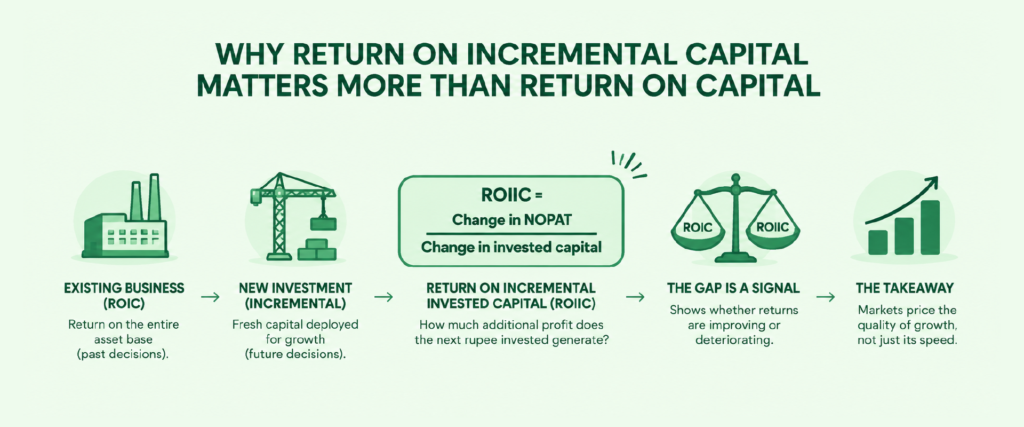
Standard ROIC measures returns generated by the entire existing asset base, which reflects decisions made years or decades ago. For a company deploying substantial new capital, that average tells you about history.
Return on incremental invested capital measures the return on the new capital, and the formula is straightforward:
ROIIC = Change in NOPAT ÷ Change in invested capital
In practice, take the increase in net operating profit after tax over a period and divide it by the increase in invested capital over the preceding period.
It answers one question: how much additional profit does the next rupee invested actually generate?
This matters because future value depends on future capital allocation rather than past decisions. Two companies can report identical revenue growth and produce completely different shareholder outcomes if one consistently earns superior returns on newly deployed capital.
The gap between ROIC and ROIIC is itself a signal. A company with 25% ROIC and 8% ROIIC is coasting on past investments while making poor new ones, and the reported average will deteriorate as the new capital grows as a share of the base. A company with 12% ROIC and 30% ROIIC is doing the opposite, and its average is heading up.
One practical warning: ROIIC is volatile over short periods. A single year’s figure can swing wildly, including into negative territory, because of timing mismatches between when capital is deployed and when it produces profit. Use a three to five year calculation, not a single year.
This is also why companies growing at similar rates trade at materially different valuations. Markets are pricing the quality of growth, not just its speed.
Why high-quality businesses trade at premium valuations
Many investors instinctively avoid high earnings multiples, assuming overvaluation.
But a premium valuation often reflects exceptional economics rather than excessive optimism.
Run it back through the formula. A company that can reinvest capital at returns far above its cost of capital needs very little of its profit to fund growth, so a large share flows to owners, and the multiple rises accordingly. It deserves a premium because every incremental investment creates substantial value.
Conversely, a business earning modest returns on incremental capital deserves a lower multiple no matter how cheap it looks on conventional metrics, because it has to keep feeding capital into the machine to stand still.
A low multiple doesn’t indicate value. A high multiple doesn’t indicate overvaluation. Both are conclusions the market has already reached about future economics, and your job is to assess whether that conclusion is correct.
Why growth stocks experience sharp corrections
Growth companies show greater share price volatility because a substantial portion of their valuation rests on profits expected many years out.
When investors anticipate sustained high growth, they’re valuing a long stream of future earnings. A modest reduction in expected growth, compounded across many years, materially reduces those cash flows.
Small changes in growth expectations therefore produce disproportionately large changes in valuation.
Mature companies derive more of their value from near-term cash flows, which makes their valuations less sensitive to shifts in long-term assumptions. The cash is closer, so less of it depends on assumptions about a distant future.
The influence of interest rates
The other variable in the formula is the discount rate.
Future cash flows are worth less than cash today, because investors require compensation for waiting and for bearing risk. Interest rates feed directly into that discount rate, which is the WACC in the denominator.
When rates decline, future cash flows become more valuable, supporting higher valuations. The effect is largest for companies whose earnings sit furthest in the future.
Rising rates do the reverse, reducing the present value of distant cash flows and disproportionately affecting high-growth businesses.
Which is why technology and other long-duration growth companies tend to outperform when monetary policy loosens and underperform when it tightens, often with no change whatsoever in the underlying businesses.
Competitive advantages are rarely permanent
A common mistake is assuming exceptional businesses will keep earning extraordinary returns indefinitely.
Sustained high returns attract competition. New entrants, technological disruption, shifting consumer preferences and evolving industry structure all erode competitive advantage over time. ROIC tends to revert toward the cost of capital, because that’s what competition does.
Market history offers many examples of dominant companies whose growth slowed as competitive intensity rose, and the pattern is more reliable than any individual exception to it.
The most valuable businesses aren’t necessarily those growing fastest today. They’re the ones capable of sustaining high returns on incremental capital over extended periods while defending their position.
For a long-term investor, the durability of returns matters more than the magnitude of current growth. Duration is the variable the formula is most sensitive to and the one investors spend the least time estimating.
What actually determines value
Despite the labels markets use, every business is valued on the same underlying principles.
Three variables largely determine intrinsic value:
The company’s ability to grow earnings. The returns it generates on incremental capital. And the discount rate applied to future cash flows.
Those three explain why some companies deserve premium valuations and others don’t. They also explain why the value-versus-growth framing is a category error rather than a choice. Both camps are estimating the same three numbers. They simply disagree about what they are.
A stock isn’t attractive because it trades at a low multiple, nor unattractive because it trades at a premium. The question is whether the business can keep creating value through profitable reinvestment over a long period.
Rather than sorting companies into value or growth, focus on what actually drives long-term wealth creation: sustainable growth, superior returns on incremental capital, and competitive advantages that last.
And remember the middle row of that table. A company growing fast at returns equal to its cost of capital is not creating anything. It’s just getting bigger.
Disclaimer:
This article is for informational and educational purposes only. It is not investment advice, and nothing here is a recommendation to buy or sell any security. Formulas described are standard valuation frameworks and are simplified for illustration. Please consult a SEBI-registered investment adviser before making financial decisions.
Sources:
Tim Koller, Marc Goedhart and David Wessels, Valuation: Measuring and Managing the Value of Companies (McKinsey); Michael Mauboussin and Dan Callahan, Return on Invested Capital, Counterpoint Global Insights, Morgan Stanley.