
The Long Ascent: Why Wealth Building Follows the Laws of the Mountain
What Everest, Netflix, Cisco and a 25-year recovery teach about surviving long enough to compound.
“Most people overestimate what they can do in one year and underestimate what they can do in ten years.”
The summit is the photograph. The ascent is the work. Markets reward preparation, emotional conditioning and the patience to let compounding run, and they punish the people who try to sprint.
The mountain nobody saw being climbed
In May 1953, two men stood at the edge of what many believed was impossible. One was a former beekeeper from New Zealand. The other is an experienced Sherpa from Nepal. Together, Edmund Hillary and Tenzing Norgay became the first humans known to stand on the summit of Mount Everest.
But the summit was only the final visible moment of a journey that had begun years earlier.
Before Everest was ever climbed, decades of expeditions had failed brutally. Brilliant climbers suffered severe frostbite, complete exhaustion, fatal avalanches, and the mind-altering effects of low oxygen. To finally make it work, teams spent months studying weather patterns, mapping routes across shifting ice, calculating oxygen usage, and managing nutrition under extreme physiological stress.
Every successful climb depended not just on courage, but on a punishing regime of preparation, discipline, teamwork, patience, and a profound respect for the mountain’s power.
The summit looked glamorous in a single newspaper photograph. The actual process was a gruelling, invisible, daily test of endurance.
Long-term investing works the exact same way.
The world celebrates summits, not ascents
When people look at successful investors, they see the summit: the net worth, the portfolios, the financial freedom, the beautiful hockey-stick charts.
What they miss is the ascent. The years of steady, disciplined investing. The nerve required to resist panic during crashes. The willpower to ignore the crowd during bubbles. The quiet emotional control needed to sit still while compounding does its work in total silence.
In the markets, as on a mountain, the visible triumph is merely the final chapter of a long, invisible process.
Most people enter the financial world expecting immediate rewards. They approach investing like impatient tourists trying to sprint up Everest in an afternoon. They chase momentum, rely on short-term predictions, take random tips, use dangerous leverage, and hunt for excitement.
Mountains punish impatience. Markets do exactly the same thing.
Long-term investing is never about reaching the peak at record speed. It’s about surviving long enough to eventually reach meaningful heights.
Base camp: building your foundation
No climber begins at the summit. Every ascent starts at base camp.
In the financial world, base camp is your structural foundation. Before chasing returns, you establish your footing with:
- Solid emergency savings
- Stable cash flow
- Manageable debt levels
- Financial discipline
- Realistic expectations
Without a strong base camp to return to, even a minor correction feels like a life-threatening emergency. Investing with borrowed money, poor liquidity or an unstable mindset is like a climber attempting Everest without oxygen. When you lack a baseline of safety, small problems become catastrophic failures at altitude.
Investing success never starts with picking the perfect stock. It starts with the unglamorous work of personal financial preparation.
Emotional conditioning: learning to handle volatility
One of the biggest dangers in climbing is altitude sickness. Climbers cannot suddenly jump to extreme heights. The body must slowly adapt to lower oxygen.
Investors face an identical hurdle with volatility. You cannot skip the process of conditioning yourself to the emotional highs and lows.
A portfolio falling 20% sounds manageable in theory. Experiencing it is entirely different. During declines, fear increases, confidence disappears, news channels amplify panic, and investors question decisions they were certain about weeks earlier.
Good investors gradually build tolerance to uncertainty. They learn that temporary declines are not necessarily permanent losses. Just as climbers acclimatise to altitude, investors must acclimatise to fluctuation.
The illusion of a dying giant: Netflix, 2011
In the summer of 2011, Netflix was the darling of Wall Street, trading near an all-time high of roughly $300 a share.
Then management made a badly communicated decision. They unbundled the unlimited DVD-by-mail plan from the newer streaming service, which effectively forced customers who wanted both into a 60% price increase. Worse, they announced a plan to split the company and rename the DVD business “Qwikster.”
The backlash was swift. Around 800,000 subscribers cancelled within months. Analysts claimed the brand was permanently broken.
Over roughly 90 days, the share price fell from about $304 to under $75, a 75% collapse that wiped out billions in market value.
Looking at the chart alone, a panicked investor would have sold at the bottom.
But the business underneath was intact. Even after the cancellations, Netflix had lost roughly 5% of its total customer base. And the split was fundamentally the right move. It forced the company to stop subsidising DVDs and focus entirely on building the world’s most powerful streaming library.
The fundamentals were quietly adjusting for an exponential future even while the stock was being eviscerated. Investors who equated short-term price volatility with business failure locked in enormous losses. Those who looked past the noise saw Netflix compound by thousands of percent over the following decade.
Prices here are as quoted at the time, before Netflix’s subsequent stock splits.
Volatility is temporary uncertainty in price. Risk is the possibility of permanent damage to your capital. They are not the same thing, and confusing them is expensive.
The weather cannot be controlled
Even the most talented climbers have zero control over weather. If a blizzard rolls in, they adapt.
As an investor, you have no control over recessions, global conflicts, inflation, interest rates, political events or shifts in sentiment. Yet many investors spend enormous mental energy trying to forecast short-term movements, as though a perfect prediction were the secret to building wealth.
The illusion of prediction: the consensus miss of 2023
Heading into 2023, Wall Street’s economic forecasters were close to unanimous. A painful recession was unavoidable after rapid rate hikes. Models, institutional forecasts and media pundits advised moving to cash and defensive assets.
The recession never arrived. The economy stayed resilient, and driven partly by a breakthrough in artificial intelligence, the S&P 500 gained over 24% on the year.
Investors who paid for expert predictions sat on the sidelines. Those who focused on their own asset allocation stayed invested and were rewarded.
Successful climbers don’t conquer mountains by controlling the sky. They succeed because they’re prepared for whatever the sky throws at them.
Veteran investors direct their focus inward: asset allocation, diversification, the quality of businesses they own, steady cash flows, disciplined valuations. The future will always be uncertain, which means preparation matters more than prediction.
The death zone of investing
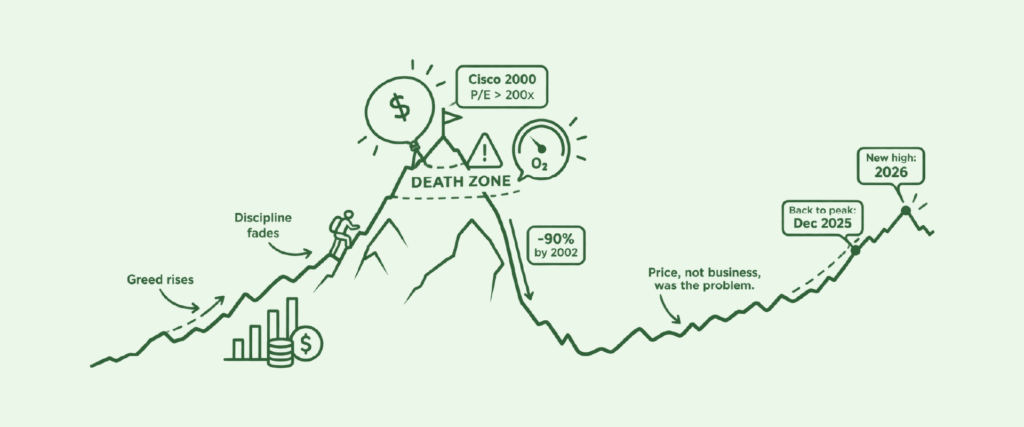
Above 8,000 metres on Everest lies a region known as the death zone. Oxygen levels drop so low that the human body begins to deteriorate. Decision-making degrades, minds cloud, and small errors become fatal.
Markets have their own psychological death zones. The periods when greed becomes extreme, valuations detach from reality, borrowing to speculate becomes normal, making money feels easy, and caution is openly mocked.
Investors become most careless near peaks and most fearful near bottoms. Many fortunes are destroyed not because investors lack intelligence, but because they lose discipline in emotionally extreme environments.
The peak of insanity: Cisco, 2000
At the peak of the dot-com bubble, Cisco Systems briefly became the most valuable company on Earth, overtaking Microsoft. It sat at the centre of the internet build-out, making the routers and switches that physically connected the web.
On 27 March 2000, the stock closed at a record $80.06, touching roughly $82 intraday, with a market value above $500 billion.
At that level it traded at a price-to-earnings ratio above 200x. Investors were paying more than $200 for every dollar of annual profit, on the assumption that telecom companies would keep buying networking hardware at that pace indefinitely.
When demand turned out to have been heavily overestimated, the collapse was brutal. The stock fell roughly 90%, hitting an intraday low of $8.12 on 8 October 2002.
Here is the part that makes this story genuinely instructive, and it only became clear recently.
Cisco finally got back to its 2000 peak on 10 December 2025. It closed at $80.25, 25 years and nine months after the record. It then kept climbing, reaching an all-time high above $120 in May 2026, driven by demand for AI infrastructure.
So the stock recovered. And a peak buyer is still behind.
|
Measure |
Position today |
|
Time to break even in nominal terms |
25 years, 9 months |
|
Inflation-adjusted value of the 2000 peak |
$80 today ≈ $42 in 2000 money |
|
Market capitalisation vs bubble peak |
Still roughly 40% below |
|
Forward P/E then vs now |
Above 200x, versus about 19x |
Cisco remained a genuinely good business throughout. It generated billions in real profit for decades. The company was never the problem.
The price was. And paying the wrong price for the right business cost an investor a quarter of a century, and in purchasing-power terms, they still haven’t got back to even.
Your team matters
No climber has reached the top of Everest entirely alone. Behind every historic ascent is a support system: guides, weather experts, climbing partners, logistics teams, medical professionals.
Your investing journey is just as influenced by the environment you choose. The people around us shape how we think, our patience, our willingness to take foolish risks, our daily discipline.
Surround yourself with speculators hunting overnight riches and you’ll become impatient. Surround yourself with thoughtful long-term thinkers and you’ll find yourself calmer and more rational.
Wise investors curate the books they read, the mentors they learn from, the information they consume and the conversations they engage in. A healthy intellectual environment compounds your wisdom the way capital compounds your wealth.
The subprime echo chamber, 2006
Inside Wall Street’s largest investment banks, a corporate echo chamber formed. Intelligent analysts and highly educated executives were surrounded entirely by peers making enormous sums buying, packaging and selling subprime mortgage products.
Because home prices had risen for decades, executives assumed housing was safe. They bundled high-risk loans into complex products and sold them worldwide. Anyone who questioned the stability of those assets was labelled a pessimist, mocked, and pushed aside.
Short-term gains and annual bonuses blinded the industry to fundamental risk.
The breaking point came in September 2008. Lehman Brothers, a firm that had survived 158 years including civil wars and world wars, filed for bankruptcy. It was the largest bankruptcy filing in US history, with roughly $613 billion in debt against $639 billion in assets.
The collapse triggered a global credit freeze, wiped out trillions in market value worldwide, and forced a $700 billion US government rescue programme to stabilise institutions including AIG and Citigroup.
Nobody in that echo chamber was stupid. They were surrounded.
The summit is only half the journey
One of the most dangerous misconceptions in climbing is that reaching the summit is the goal. A substantial share of mountaineering accidents happen during the descent, when climbers are exhausted, supplies are low, and focus slips.
Investing has a parallel trap. Building wealth matters. Preserving it across the rest of your life matters equally. Some investors spend decades building capital only to lose it through excessive leverage, overconfidence, concentration, speculation or lifestyle inflation.
The fragility of paper fortunes: Masayoshi Son, 2000
Masayoshi Son, founder of SoftBank, had a vision to own a large piece of the internet. Through the late 1990s he poured money into hundreds of young web companies, and the bets paid off spectacularly.
For a brief period his net worth grew by around $10 billion a week. At his peak in 2000, his wealth reached roughly $76 billion. For three days, that made him the richest person on the planet, briefly overtaking Bill Gates.
He had reached the summit.
But his portfolio was hyper-concentrated in speculative internet startups. SoftBank held stakes in Yahoo!, alongside companies with no real earnings or sustainable models.
When the bubble burst in March 2000, the descent was brutal. SoftBank’s market value fell from roughly $180 billion to around $1.1 billion, a collapse of more than 99%.
Son personally lost an estimated $70 billion, one of the largest individual wealth destructions in history. Many portfolio companies went bankrupt and were written off entirely.
Looking rich on paper during a bull market is not the same as building lasting wealth. Without balance, fundamentals and risk management, a shift in the weather can erase decades of work in weeks.
The purpose of long-term investing isn’t to maximise returns. It’s to sustainably improve quality of life across decades. True financial success isn’t reaching a number. It’s creating freedom, resilience, peace of mind and the ability to live intentionally.
Compounding looks slow until it doesn’t
When climbers begin an ascent, the summit appears impossibly far away. Progress feels slow. Every step looks insignificant.
Compounding behaves identically. For years, results may appear ordinary. Then growth accelerates dramatically, because compounding isn’t linear. It’s exponential.
The hardest part of long-term investing is surviving the period where effort feels disconnected from visible reward. Most people quit during that phase.
The secret of Warren Buffett’s wealth
The financial world marvels at Buffett’s fortune. What most people ignore is the timeline.
He bought his first stock at 11. But the striking fact is that over 99% of his wealth was generated after he turned 50, and the vast majority of it after 65.
Compounding works like a snowball rolling down a long hill. At first it stays small and doesn’t seem to grow. But if the hill is long enough, it eventually becomes massive, gaining more size in the final stretch than during the entire run before it.
Buffett’s superpower isn’t only intelligence. It’s duration. He has been investing consistently for more than eighty years. Had he started in his thirties and retired in his sixties like most people, the world would likely never have heard his name.
His wealth didn’t come from a few dramatic bets. It came from surviving long enough to let exponential maths do the heavy lifting.
The descent
Mountains teach humility. They remind climbers that success is earned through preparation, patience, discipline, adaptability and respect for uncertainty.
Markets teach the same lessons.
Long-term investing is not about excitement. It is not about predicting every move. It is not about becoming rich overnight. It is about steadily ascending while avoiding catastrophic mistakes.
The investor who succeeds over decades is usually not the one with the highest IQ, the fastest predictions or the boldest opinions. More often it’s the person who stays rational, remains disciplined, controls their emotions, keeps learning, and continues climbing patiently while others give up.
Because in investing, as in mountain climbing, extraordinary outcomes rarely come from dramatic leaps. They come from thousands of careful steps taken consistently over time.
Disclaimer:
This article is for informational and educational purposes only. It is not investment advice, and nothing here is a recommendation to buy or sell any security. Companies are named as historical illustrations. Share prices and financial data are as of the dates stated and change continuously. Past performance does not indicate future results. Please consult a SEBI-registered investment adviser before making financial decisions.