
The Golden Playbook
Three brands, two hundred years of combined history, and the same handful of ideas every marketing podcast is still selling you.
Sit through enough marketing content and you’ll notice the same five or six ideas on repeat. The question is whether they hold up anywhere older than twenty years. Amul, Nike and Coca-Cola suggest they do, with one important caveat about what happens when a brand decides craft is too expensive.
When you sit through enough marketing podcasts, you start noticing the same five or six ideas on repeat, just wearing different clothes each time.
One week it’s an airline. The next is a gaming app. Then a SaaS company, then a food delivery brand. Same tricks, different industry, different logo.
That’s a fun pattern to spot. Here’s the catch: most of these companies are barely twenty years old. If a pattern is really true, it should hold up somewhere much older. Somewhere with nowhere left to hide.
So let’s test it on three brands that have been playing this game for fifty, sixty, even a hundred years. Amul, Nike and Coca-Cola.
None of the founders set out to be marketers
Verghese Kurien, the man credited with building Amul, trained as a mechanical engineer. He was sent to a small dairy creamery in Anand, Gujarat, in 1949, on a government posting he never wanted in the first place.
Phil Knight, who co-founded what became Nike, started out as an accountant at Coopers & Lybrand and Price Waterhouse, and taught accounting part-time at Portland State University.
Neither man set out to build a brand. Both ended up creating two of the most recognisable ones in the world.
Kurien looked at India’s dairy supply chain with an engineer’s eyes and spotted the real problem. Middlemen were quietly pocketing most of what should have gone to farmers. He fixed that, long before anyone at Amul thought about a tagline.
Knight looked at running shoes the way an accountant looks at a spreadsheet, and saw an inefficiency. Cheaper, better-made Japanese shoes could undercut the German brands that ruled the market.
In both cases the marketing came much later. These companies were built on top of a problem each man solved with tools that had nothing to do with advertising.
Selling a feeling
In 1966, Amul hired an ad agency to give the cooperative a face. What they got was a polka-dotted, butter-loving little girl and a tagline about taste.
That same campaign is still running today, still poking fun at the week’s news with the same wink it started with sixty years ago.
Nobody at Amul was trying to talk about fat content or shelf life. They were selling a sense of humour that millions of Indians recognised every morning over chai.
Bill Bowerman, the running coach who became Knight’s partner and shoe designer, spent years studying what made athletes feel fast rather than what made a shoe last longer.
In 1966 he wrote a book called Jogging. It had almost nothing to do with the shoe business. It simply argued that running was good for ordinary people, not just trained athletes.
The book sold well. Slowly, running stopped being a strange habit for a small group and became something ordinary people wanted in on.
Coca-Cola learnt a version of this the hard way in India. While Coke was absent from the market, Thums Up, the spicier, fizzier local cola, became the drink everyone reached for. Its tagline, “Taste the Thunder,” and its bold, massy advertising made it feel like the drink for a confident, new India. A very different vibe from Coca-Cola’s polished global image.
Even global giants keep relearning that local isn’t optional
When Coca-Cola returned to India in 1993 after sixteen years away, it bought Thums Up along with a few other Parle brands, largely to keep them out of a rival’s hands.
Its first move was to quietly starve Thums Up of advertising spend and production, assuming loyal drinkers would simply switch to Coke.
They didn’t. They switched to Pepsi.
Coca-Cola eventually stopped trying to sideline the brand and started investing in it again. Today Thums Up outsells Coca-Cola in India and has grown into a billion-dollar brand in its own right.
It’s a strange position for the world’s most widely distributed drink. Having to admit that its global identity couldn’t replace a taste and an attitude built for one specific market.
Smaller companies usually learn this while expanding into a handful of new countries. Coca-Cola learned it at enormous scale, inside a market it thought it already understood.
Even a hundred-year-old brand can get AI wrong
If you want to see how legacy brands are handling AI right now, Coca-Cola’s recent history is a useful and slightly awkward case study.
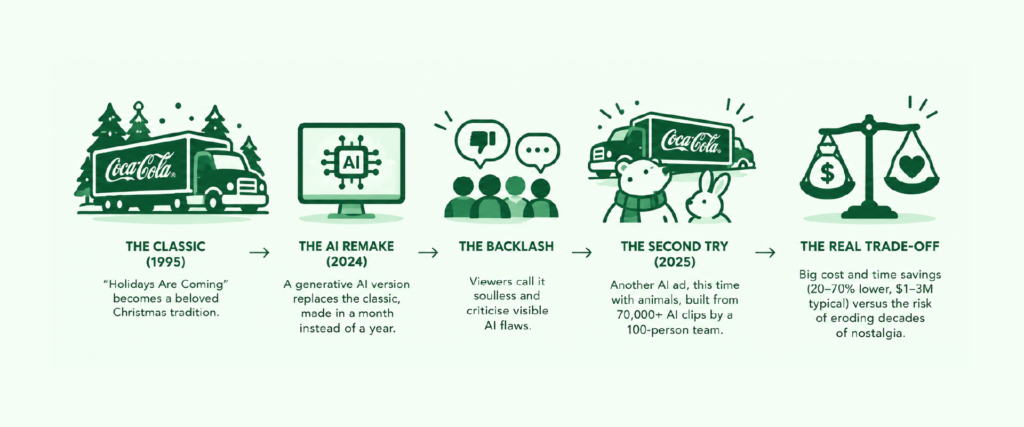
- The company replaced its 1995 “Holidays Are Coming” Christmas ad, the one with red trucks, snowy roads and a tune that basically announces the start of the festive season, with an AI-generated remake.
The model combined GPT-4 and DALL-E, trained on Coca-Cola’s own creative archive built over 138 years. CMO Javier Meza described the brief as bringing “Holidays Are Coming” into the present. Tellingly, the AI version omitted Santa’s face entirely.
Viewers called it soulless, and pointed out the irony of running it under the tagline “Real Magic.” Coca-Cola’s own marketing chief later noted the AI version took a month to make instead of a year, which was really the whole problem. Decades of accumulated nostalgia, squeezed into a shortcut.
- They did it again.
Released on 3 November, with the same AI studio, this time swapping humans for animals. Polar bears, sloths, rabbits, meerkats in sweaters, all gazing at passing trucks. Reportedly assembled from over 70,000 AI-generated clips, refined by five specialists and a team of around 100.
The reception was familiar. Viewers spotted trucks whose wheel arrangements changed between shots and animals that looked part shiny and part plastic. The top-voted comment on YouTube called it the most profitable commercial in Pepsi’s history.
And here’s the part that makes this more interesting than a simple mistake.
Coca-Cola defended it. The company maintained that the 2024 campaign performed exceptionally well in private consumer testing despite the online backlash. Pratik Thakar, its head of generative AI, told The Hollywood Reporter that the company needed to keep moving forward and pushing the envelope.
So this isn’t a brand that tripped over a new tool. It’s a brand that looked at the trade and decided to take it twice.
And you can see why. A large-scale holiday production typically costs somewhere between $1 million and $3 million. Depending on whose estimate you believe, generative AI can cut that by anywhere from 20% to 70%. The “month instead of a year” line is the same incentive measured in time rather than money.
That’s the actual lesson for anyone sitting in a marketing meeting right now, and it’s less comfortable than “Coca-Cola got it wrong.”
The savings are real. The backlash is also real. What Coca-Cola bet is that the backlash is loud but narrow, concentrated among people online who were never going to stop buying Coke anyway, while the savings land on the balance sheet every year.
They may be right. The question each brand has to answer is whether the asset being economised on is replaceable. Coca-Cola’s Christmas ad isn’t a campaign. It’s thirty years of people associating a tune with the start of December. That’s the thing being spent, and unlike a production budget, it doesn’t refill.
The brand was always bigger than the advertising
Strip away Amul’s mascot and what’s left is a cooperative structure that pays dairy farmers directly, cutting out the middlemen who used to take most of the margin.
That structure is the real brand experience for the millions of farmers who supply Amul. It’s why the cheeky ads have had something solid to stand on for over seventy years.
Bowerman’s running clubs and his book turned jogging into a shared identity long before there was much of a shoe business to sell into. By the time Nike existed as a brand, it already had a community gathered around the idea it stood for.
In both cases, what the public sees is a mascot, a swoosh, a slogan. All of it sitting on top of a structural foundation that took years to build and had very little to do with advertising.
Hiring well matters as much as founding
In 1979, Kurien set up the Institute of Rural Management in Anand, specifically to train professional managers for rural cooperatives. His reasoning was that India needed more people equipped to solve real problems.
Knight’s first full-time hire at Blue Ribbon Sports, Jeff Johnson, turned out to be the person who came up with the name “Nike” in the first place.
A good reminder that some of a brand’s biggest decisions come from the second or third person in the room, not just the founder.
Neither story fits the image of a lone genius guarding a big idea. Both are about leaders who spent real energy thinking about who else needed to be in the building, before they thought about branding and taglines.
What sixty years adds to the picture
All of these stories suggest a pattern that has nothing to do with era, platform or industry.
An engineer working in 1949 and an accountant working in 1964 were running on instincts a marketing head building an enterprise software brand in 2024 would recognise instantly.
We have AI in the mix now, lock-screen ads, food delivery apps that didn’t exist ten years ago. But if three of the most enduring brands on the planet are any proof, the judgment behind good brand building hasn’t changed nearly as much as the tools around it.
The Amul girl has been commenting on the news since 1966. The tools she’s drawn with have changed completely. The instinct behind her hasn’t changed at all.
That’s the whole playbook, really. New tools, old judgment. The trouble starts when a brand mistakes one for the other.
Disclaimer:
This article references publicly reported company history and contemporaneous media coverage. Brands and campaigns are named for illustrative purposes.