
The Curious Case of Manpasand Beverages
How a ₹5,700 crore rural FMCG story became one of India’s clearest cases of financial statement manipulation.
Manpasand sold a 65-paise mango drink to India that Coca-Cola ignored. Institutions bought it, analysts rated it a Buy, and the stock tripled. Then Deloitte walked out mid-audit, GST officers found fake units, executives went into judicial custody, and SEBI’s forensic audit found the financials had been manipulated. The signals were in the cash flow statement the whole time.
There’s a particular pull only a fast-growing consumer brand can exert on an investor. The product is visible, the story is simple, and spotting it at a railway station or village kirana shop makes it feel real in a way a software or financial services company never quite manages.
Mango Sip had exactly that pull. A 65-paise drink sold in a tin can to children across rural Uttar Pradesh and Gujarat, going straight after the hundreds of millions of Indians that Coca-Cola and Parle had largely ignored.
Between 2015 and 2018, Manpasand Beverages was one of the most celebrated small-cap FMCG names on Dalal Street. Institutions held it. Sell-side analysts carried buy ratings. Retail investors backed it with real conviction. Founder Dhirendra Singh was hailed as the man who’d cracked rural India’s beverage market.
By 2019, executives were in judicial custody, the auditor had walked away mid-audit, and the stock had crashed 89% from its peak.
SEBI would later find that the financial statements were manipulated and significantly misstated, presenting what its order described as a false picture of the company’s financial health to investors.
The rise: a drink built for Bharat, not India
Dhirendra Singh founded Manpasand Beverages in 1998 in Vadodara, Gujarat, spending its early years quietly building a presence in rural and semi-urban markets while most FMCG companies stayed fixated on metro consumers.
The flagship product, Mango Sip, was priced aggressively for Tier 2 and Tier 3 towns. By FY2014 the company had revenues of roughly ₹294 crore, with Mango Sip contributing around 87% of net sales.
Worth pausing on that number. It was a single-product, single-season business, with sales concentrated between February and May.
The distribution story had real substance. The company worked with 73 consignee agents and 654 distributors across 24 states, held a direct tie-up with IRCTC to sell at railway stations, and by 2018 claimed presence across 600,000 outlets nationwide.
It expanded with Fruits Up (a premium carbonated fruit drink), Coco Sip, Manpasand ORS and Pure Sip, adding manufacturing capacity across Vadodara, Varanasi and Sri City.
Private equity noticed early. The company raised ₹116 crore between 2011 and 2015, with SAIF Partners becoming one of its largest institutional backers, eventually holding around 17.57%.
In June 2015, Manpasand listed through a ₹400 crore IPO at ₹320 a share, billing itself as “India’s only pure play listed beverages company.”
Why investors fell for the story
|
Metric |
FY2014 |
FY2016 |
Growth |
|
Revenue (₹ crore) |
~294 |
557 |
~90% |
|
Net profit (₹ crore) |
~20 |
~51 |
~155% |
|
Manufacturing units |
2 |
3+ |
Scaling |
Fruits Up, launched in 2014, reportedly crossed ₹180 crore in turnover by FY2017.
The stock more than tripled from its bonus-adjusted IPO price, touching a 52-week high of ₹511.83 in September 2017 and a peak market cap of roughly ₹5,700 crore.
Motilal Oswal initiated coverage with a Buy and a ₹750 target, building the thesis around margins holding near 20% as Fruits Up scaled. Analysts compared it to Parle Agro’s Appy Fizz, a heavily advertised brand it was supposedly already outselling despite barely any marketing spend of its own.
Taapsee Pannu signed on as Fruits Up’s brand ambassador in December 2016, signalling urban ambitions.
For retail investors, every box seemed ticked. A genuine rural consumption boom. An asset-light model. Promoter conviction. A credible institutional name on the cap table.
The warning signs
Cracks ran through the story from early on, papered over by bull market optimism.
Cash flow told a different story than reported profits. The clearest tell of accounting manipulation is a gap between reported profit and actual operating cash flow. Manpasand reported strong profits while operating cash flow stayed persistently weak relative to earnings.
A business supposedly turning away demand should show solid receivables turnover, not struggle to convert profit into cash. Multiple brokerages flagged negative free cash flows at the IPO stage itself. These flags sat in plain sight and were largely ignored.
Receivables ballooned faster than revenue, unusual for a business selling an affordable beverage to distributors who typically pay quickly. SEBI’s later forensic audit confirmed a portion of these debtors were suspicious or fictitious.
The Fruits Up numbers didn’t add up. Launched in 2014, largely confined to Gujarat and Maharashtra until mid-2015, with no meaningful national advertising, against a decade-old heavily marketed competitor. Leapfrogging a category leader in two years on almost no ad spend was implausible on its face.
Big claims went unverified. Stock-out commentary and outlet counts were accepted at face value, with few ground-level channel checks run to confirm them.
Related party structures raised flags that went unexamined, with group entities reporting losses that were noted at IPO time but never meaningfully probed.
May 2018: Deloitte walks away
On 26 May 2018, days before Manpasand’s board was set to announce FY2018 results, Deloitte Haskins & Sells resigned as statutory auditor, stating in its letter that significant information requested for the purposes of the audit had not been provided.
The board meeting was cancelled. The company called the timing “purely coincidental” and described it as a “minor hiccup.”
Markets disagreed. The stock hit its lower circuit three sessions running, losing 42% in three days. Kotak Institutional Equities suspended coverage, citing a lack of comfort in rating the company given the absence of disclosure about the reasons for the resignation.
A Big Four firm does not walk out of a listed audit lightly. When a global auditor cannot obtain information, evidence and explanations from a mid-sized beverage company, that is not a procedural disagreement. It is a four-alarm fire.
The replacement auditor, Mehra Goel & Co., also resigned in July 2019, citing the ongoing GST investigations and an inability to continue. The stock was at ₹38.85 that day.
Two auditors, fourteen months apart, both unwilling to sign.
May 2019: GST raids, arrests and the full unravelling
On 23 May 2019, CGST officers carried out search and seizure operations across Manpasand’s premises.
According to the CGST Commissionerate, the company had been running fake units to fraudulently avail input tax credit, allegedly enabling roughly ₹40 crore of tax evasion through circular transactions worth about ₹300 crore.
On 24 May, three people were taken into judicial custody: whole-time director Abhishek Singh, his brother Harshvardhan Singh, and CFO Paresh Thakkar. Bail was denied.
The stock fell over 53% across five sessions, closing at ₹57.15 on 30 May, its one-year low and a lower circuit, down roughly 89% from its peak. Multiple directors resigned in rapid succession.
By September 2019 the stock had fallen to around ₹11.65, nearly 98% below its all-time high. SAIF Partners’ 17.57% stake had effectively turned to dust.
SEBI’s findings
SEBI opened an investigation in September 2019 following a complaint from the company’s own audit committee chairman, appointing Chokshi & Chokshi LLP to conduct a forensic audit of the financial statements for 2018-19 and 2019-20.
The findings, as summarised in SEBI’s order, were that the statements were manipulated and significantly misstated, presenting a false picture of the company’s financial health to investors.
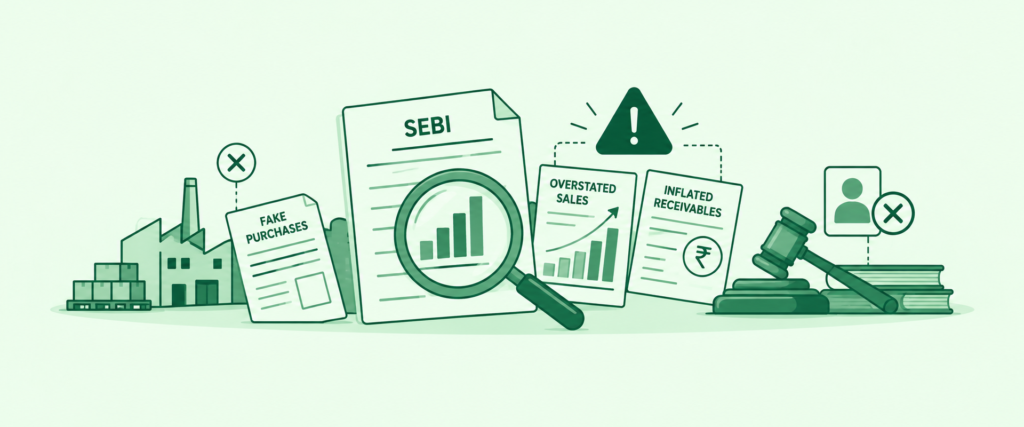
The audit identified:
- Purchases from unregistered dealers used to manufacture fake entries
- Overstated purchases and sales, inflating both sides of transactions
- Dealings with non-GST-compliant and possibly fictitious parties
- Inflated receivables and fixed assets
This wasn’t a single year. A separate SEBI order addressed misstatement of the FY2017-18 financials, levying ₹33 lakh in penalties across the company and six individuals, and finding that the audit committee had failed to monitor the utilisation of issue proceeds in violation of listing regulations. A further finding concerned the misuse of proceeds from the 2016 Qualified Institutional Placement, with funds meant for disclosed purposes diverted into debentures.
The sanctions. On 1 May 2024, SEBI barred Manpasand Beverages, Dhirendra Singh, Abhishek Singh and Paresh Thakkar from accessing the securities markets for three years, with penalties totalling ₹68 lakh, ₹17 lakh each.
The more significant sanction is easy to miss: the three individuals were separately restrained from holding any position as director or key managerial personnel in any listed company or SEBI-registered intermediary for five years.
The monetary penalty is modest set against the wealth destroyed. The regulatory finding, deliberate manipulation rather than carelessness, carries the real weight.
The collapse in numbers
|
Milestone |
Share price (approx.) |
|
IPO, June 2015 |
₹320 (₹160 bonus-adjusted) |
|
Peak, September 2017 |
₹511.83 |
|
Deloitte resignation, May 2018 |
₹344 to ₹248 in three days |
|
GST arrests, May 2019 |
₹110 to ₹57 in five days |
|
September 2019 |
~₹11 to 12 |
|
Peak to trough |
~98% |
Anyone who bought at the September 2017 peak lost nearly every rupee. Even IPO buyers who held through faced a near-total wipeout.
What investors missed, and why
Fraud inside a bull market unfolds slowly, hiding behind genuine macro trends and real, if exaggerated, momentum.
The rural India narrative was genuinely true, which made it easy to attribute implausible growth to an unstoppable tailwind rather than question it. When a company fits neatly into a powerful macro theme, investors often mistake the quality of the story for the quality of the business underneath it.
Institutional ownership created false comfort. Sophisticated investors like SAIF Partners can be misled by manipulated financials just as easily as anyone else, especially when management is cooperative and convincing in person.
High growth makes fraud harder to spot. Everything appears to be moving and expanding at once, and the noise of growth drowns out the signal of manipulation.
The cash flow signal was there the whole time. Operating cash flow lagging profit, receivables building without explanation. Textbook signs of revenue recognition trouble, sitting in public filings that very few people read closely.
Auditors didn’t ring the alarm early enough, with clean sign-offs for years before Deloitte’s resignation.
Key lessons for investors
An auditor’s resignation is a four-alarm fire. When a Big Four firm walks off an audit mid-process citing an inability to get information, don’t wait for further confirmation. In this case the market got fourteen months of additional warning when the replacement auditor also quit.
Read the cash flow statement, not just the P&L. Profit without cash is fiction. If operating cash flow consistently lags reported profit over several years, demand a better explanation or assume the worst.
Implausible growth deserves scepticism, not admiration. If a brand with no advertising claims to have outsold a heavily marketed competitor within two years, verify it independently or discount it entirely.
Governance isn’t a peripheral concern. Mass director resignations, weak oversight of fund utilisation, and murky related party structures are the story, not footnotes to it.
Smart money owning a stock isn’t due diligence on your behalf. Institutional ownership and analyst coverage didn’t mean the company was clean. Sophisticated investors get fooled too.
In a bull market, frauds survive longer than they should. A rising market gave Manpasand’s manipulation cover for years. Once the cycle turns, cracks surface fast.
A great macro theme doesn’t validate every company riding it. Rural India’s consumption story was real. That didn’t make every business claiming to serve it real.
Where it stands now
Manpasand Beverages remains inactive and under severe financial and regulatory strain. Insolvency proceedings have been before the NCLT, with multiple related matters and appeals filed by the suspended directors running through 2024.
Today it stands as one of the more significant corporate governance failures in recent Indian markets, and a cautionary example about trusting a high-growth narrative without testing what sits underneath it.
The market eventually tells the truth
Markets can be deceived for years, but they eventually punish manipulation.
Manpasand shows how a compelling narrative, rural India, affordable FMCG, expanding distribution, can keep a fraud alive well past its natural expiry date. The macro story was real. Part of the business was real too.
But a meaningful share of the reported growth was manufactured, through fake entities and manipulated statements that a regulator eventually found to be untrue and misleading.
The cash flow statement knew first. It usually does.
Disclaimer:
This article is based on publicly available information including SEBI orders, exchange filings and contemporaneous news reporting. SEBI has issued findings and sanctions in this matter, which are described above as recorded in those orders. This article is for informational and educational purposes only, is not investment advice, and is not a recommendation regarding any security. Please consult a SEBI-registered investment adviser before making financial decisions.