Pouring Decisions: Why India’s Liquor Business Is Harder to Run Than It Looks
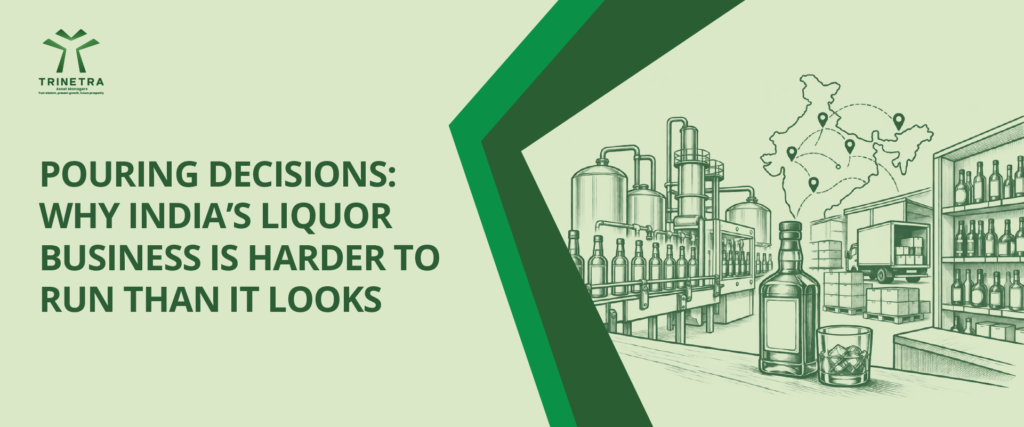
How the world’s biggest whisky market became one of its toughest places to run a drinks company.
India drinks nearly half the world’s whisky. Alcohol is a state subject, so 28 states write 28 rulebooks. Companies pay rising excise, sit outside GST while their inputs sit inside it, and in many states don’t set their own prices. The only reliable way to make money here is premiumisation.
The paradox in one number
Here’s a number that should make you sit up. India drinks nearly half the whisky consumed on the planet. Not a quarter. Not a third. Almost half, more than three times any other country in the world. And yet the companies making and selling all that whisky have spent years struggling to turn a genuinely good profit.
How does the world’s biggest whisky market end up being one of the toughest businesses to run? Let’s dig in.
India’s alcohol market is among the largest in the world by value, with the USDA putting annual sales at roughly $44 billion. Around half of all whisky consumed globally is drunk here, even though only about 30% of Indians drink alcohol at all. That’s the scale we’re dealing with.
From molasses to your glass
The journey starts with raw material, molasses, grain, or barley malt, which goes into a distillery and comes out as either ENA (Extra Neutral Alcohol, the base for most Indian spirits) or malt spirit. From there it gets bottled, branded, and pushed out through government-controlled distribution channels. Every leg has friction built in. But the last leg, distribution, is where things really get complicated.
Here’s a small but telling detail. Over 70% of India’s ENA comes from molasses, a byproduct of sugar manufacturing. Globally that figure is around 4%. Everyone else uses grain. This matters because molasses prices move with the sugar cycle, which is seasonal, volatile, and completely outside any alcohol company’s control.
A market bigger than it looks
Between 2006 and 2018, the Indian alcohol industry grew volumes at 8% annually and value at 11%. Volume climbed from 2.3 billion litres to 5.8 billion litres. Value went from ₹853 billion to ₹3,013 billion.
Notice that value grew faster than volume. That’s premiumisation, people trading up to more expensive drinks. It’s the single most important trend running through this entire industry, and we’ll come back to it.
Who actually runs the bar
United Spirits (Diageo India) is India’s largest spirits company, built on McDowell’s No 1, Johnnie Walker, Black Dog, VAT 69 and Director’s Special.
Pernod Ricard India runs Royal Stag, Blenders Pride and 100 Pipers alongside imported premium labels like Chivas Regal, Ballantine’s, The Glenlivet and Absolut. It sells fewer cases than USL but makes considerably more money per case.
In July 2025 Pernod agreed to sell Imperial Blue, its mass-market whisky and one of the largest Indian whisky brands by volume, to Tilaknagar Industries for an enterprise value of €412.6 million, roughly ₹4,150 crore. The deal completed in December 2025 and is the biggest acquisition in Indian alcobev in over a decade. Imperial Blue sold around 22.4 million nine-litre cases in FY25.
That transaction is worth pausing on, because it’s this whole article in miniature. Pernod walked away from enormous volume to focus on brands that actually make money. Tilaknagar, a brandy specialist built on Mansion House, bought its way into whisky overnight.
United Breweries dominates beer through Kingfisher, with AB InBev the clear second and Carlsberg India third.
Beyond the big names, Radico Khaitan and Allied Blenders are now significant listed players, and the Imperial Blue deal makes Tilaknagar a serious third force in spirits.
The state-by-state headache
Alcohol is a state subject under India’s constitution, which means every state government essentially writes its own rulebook. The result is a regulatory patchwork, and running one clean nationwide strategy is close to impossible.
|
Model |
States |
What it means for companies |
|
Relatively open market |
Maharashtra, Rajasthan |
Pay for a licence, keep reasonable control over pricing |
|
Annual auction |
Various |
Right to sell auctioned yearly, far less company control |
|
State corporation monopoly |
Tamil Nadu, Andhra Pradesh, Telangana, Kerala |
Government is sole wholesaler, strict price control |
|
Prohibition |
Gujarat, Bihar, parts of the Northeast |
No market at all |
A 750ml bottle of McDowell’s No 1, the exact same product with the exact same label, can cost well over twice as much in one state as in another, purely because of local excise policy.
The real problem: you don’t set your own prices
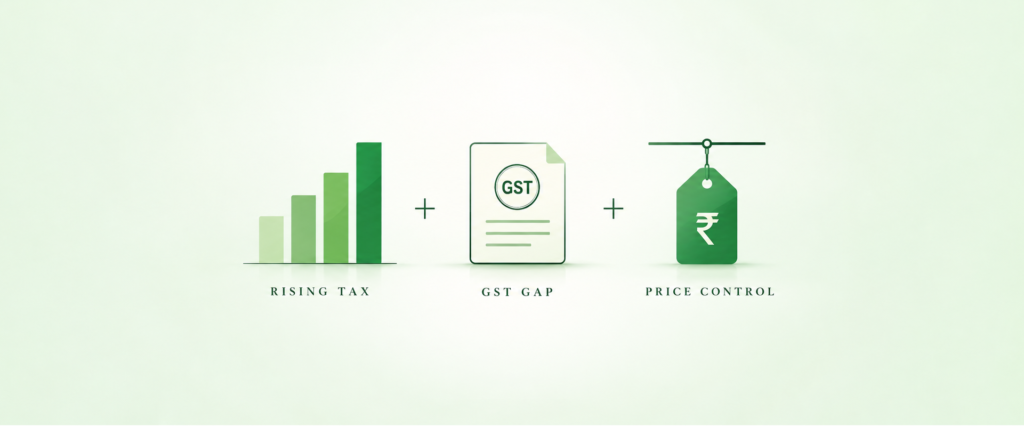
This is the heart of the matter. Companies here face pressure from three directions at once.
Excise duty climbs every year, whether a company likes it or not. Between 2006 and 2019, excise duty per case grew at roughly 17% annually for United Breweries’ beer business and 13% for United Spirits.
The GST quirk. Alcohol sits outside GST, but most inputs that go into making it, packaging and raw materials, are taxed under GST. Companies pay GST going in and can’t claim input tax credit coming out. It’s a structural disadvantage baked into the tax code.
State-approved pricing. Price revisions need state approval, and approvals routinely lag cost inflation.
Picture running a restaurant where ingredient costs rise 13% a year, your landlord raises rent 17% a year, and the state government decides what you’re allowed to charge, and isn’t in a generous mood.
The numbers tell it plainly. Between FY15 and FY20, USL’s gross revenue per case grew at 9% a year while gross profit per case managed only 4%. Revenue climbs, margins get squeezed.
What Maharashtra did in 2025
If you want to see this dynamic in its purest form, look at what happened in June 2025.
Maharashtra approved a roughly 50% increase in excise duty on IMFL. Industry estimates put the resulting decline in sales to the state at 10 to 15%, with Goldman Sachs expecting consumer price increases of 20 to 30% and a sharp volume drop. Maharashtra is one of the largest volume states for both USL and Pernod.
No negotiation. No phase-in. One budget decision, and a fifth of the market reprices overnight.
Note what companies can and cannot do in that situation. They cannot absorb a hike that size. They cannot raise prices freely. What they can do is watch consumers trade down into cheaper brands within their own portfolios, which hurts realisations even when volumes hold.
That is the business, compressed into a single quarter.
What good management actually looks like
Before Diageo picked up a controlling stake in United Spirits in 2013, the company was a mess. Vijay Mallya had loaded it with debt and pulled cash out to fund other ventures. The numbers back then were genuinely ugly.
What followed was a real turnaround: debt cleared, the low-end portfolio pruned, and the mix pushed relentlessly upmarket.
And yet a well-run USL has historically still trailed Pernod Ricard India on profitability, with Pernod running meaningfully higher EBITDA and gross margins. The gap comes down to portfolio mix, what each company is actually selling. Pernod’s decision to sell Imperial Blue and concentrate on premium is that same logic taken to its conclusion.
The one strategy that works: trading up
This is the most important structural story in the industry. As incomes rise, drinkers move up the ladder, from country liquor to IMFL, and within IMFL from cheaper brands toward pricier ones.
USL’s share of Prestige & Above volumes went from 22% in 2012 to around half by 2019, and its P&A mix now sits near 90% of net sales. Sell fewer cheap bottles, sell more expensive ones, and make dramatically more per case.
The margin logic is stark. Premium and prestige products command several times the margin of the mass segment. In a business where you don’t control price and can’t control excise, mix is the one lever that’s genuinely yours.
Pernod got ahead of this curve early, which explains its healthier margins. Everyone else is now following.
Beer plays a different game
Beer grows on a different set of drivers: a lower price point, lighter alcohol content, hot Indian summers, the microbrewery boom, changing urban lifestyles, and notably its growing popularity among women consumers.
South India alone accounts for around 35% of beer consumption, which makes sense given the weather. Kingfisher holds a commanding share of the market, with AB InBev second and Carlsberg India third.
One structural quirk separates beer from spirits: packaging is the single biggest input cost, making up roughly 60% of raw materials and a quarter to a third of revenue. The glass bottle is nearly as expensive as the beer inside it.
Beer is also more exposed to state policy swings than spirits, because its thinner margins leave less room to absorb a duty hike.
A reality check for investors
Here’s a number worth sitting with, and it’s not the one you’d expect.
In July 2014, Diageo bought additional shares in United Spirits from public shareholders at a valuation of roughly ₹43,900 crore. For years afterwards, despite a genuinely successful operational turnaround, the market valued USL at well below that figure.
Then, in July 2024, USL crossed ₹1 trillion in market capitalisation for the first time. It currently sits near ₹1,00,000 crore, roughly two and a half times what Diageo paid.
So the turnaround did eventually get paid for. It just took the better part of a decade, and it required the premiumisation story to become undeniable before the market would price it in.
That’s the honest investor lesson here, and it’s more useful than either extreme. The structural constraints don’t disappear because management improves. Regulated pricing, rising excise, state-by-state complexity and a complete ban on direct alcohol advertising are permanent features of this sector, not temporary obstacles. But a company that executes the mix shift patiently, through a decade of state-level shocks like Maharashtra’s, can be rewarded eventually.
The demand side genuinely supports it. Young population, rising incomes, growing urbanisation, and per capita consumption still around 6 litres a year, which leaves plenty of room. Turning that demand into investor returns just means navigating a maze most consumer businesses never have to deal with, and being willing to wait while you do it.
The industry is a bit like a good aged Scotch. Worth being patient with, but only if you actually understand what’s sitting inside the bottle.
Disclaimer:
This article is for informational purposes only and is not investment advice. Company valuations and market data referenced are as of the publication date and change continuously. Nothing here is a recommendation to buy or sell any security. Please consult a SEBI-registered investment adviser before making financial decisions.