
Lessons on Investing, Life and Inner Growth: Insights from Manish Chokhani
Drawn from his conversation on The One Percent Show with Vishal Khandelwal.
Chokhani’s argument is that external learning without internal understanding leaves you knowledgeable but directionless. The frameworks that make someone a good investor, self-awareness, resilience, process and patience, are the same ones that make for a well-lived life.
Who he is
Manish Chokhani is a Director at Enam Holdings, a multi-billion dollar family office managing the wealth of some of India’s leading business families. He previously served as MD and CEO of Enam Securities, which he led through a roughly $400 million merger with Axis Bank to create Axis Capital, and then headed as Managing Director and CEO.
A qualified Chartered Accountant, he was among the youngest MBAs to graduate from London Business School, and sits on the governing board of FLAME University. He has spent over three decades across investment banking, asset management and private equity.
What makes him worth listening to beyond the record is a habit of treating investment frameworks and life frameworks as the same thing. The reflections below are drawn from his conversation with Vishal Khandelwal on The One Percent Show.
Growth needs looking outward and inward at the same time
There’s a common assumption that learning means reading more, watching more, absorbing more about the outside world.
That’s partly true. Understanding globalisation, technology and how the world keeps shifting matters, because these forces shape markets, careers and opportunity. Ignoring them isn’t wisdom, it’s blindness.
But external knowledge alone doesn’t get you very far. Chokhani’s framing is that at the outer level you widen your lens, and at the inner level you sharpen your focus, going deeper into yourself to find your actual purpose.
Knowing what’s happening in the world means little without knowing what you want from your own life. Understanding a market cycle means little without understanding your own emotional cycles alongside it.
The useful question isn’t only “what’s happening out there.” It’s also “who am I, and what actually matters to me.”
Discovering purpose isn’t a single moment of clarity. It’s an ongoing process, and the way to find it is by paying attention to what energises you, what drains you, what feels meaningful and what feels hollow.
The most meaningful growth happens when external learning and internal understanding develop together. One without the other leaves you either knowledgeable but directionless, or self-aware but disconnected from the world around you.
The power of being present
Chokhani is a practitioner of Vipassana, and speaks about it less as a spiritual ritual than as a practical tool whose lessons extend well beyond the meditation cushion.
Four ideas sit at its centre:
Concentration. Training the mind to stay with one thing without constantly drifting. Genuinely rare in an age built around infinite distraction, where most people are thinking about five things while attempting one.
Awareness. Noticing what’s actually happening, in a market, a conversation, or your own mind, without filtering it through assumptions you’ve already formed.
Objectivity. Seeing reality as it is rather than as you’d prefer it to be. Harder than it sounds, because most people unconsciously notice only what confirms what they already believe.
Equanimity. Staying stable. Not cold or unfeeling, but not swept away by every wave of euphoria or fear either.
A calm mind processes information better and sees options a panicked mind misses. When markets turn volatile, when life turns uncertain, when the stakes climb, the person who has trained their attention holds a real advantage, because they see more clearly.
The quality of a decision often traces straight back to the quality of the attention behind it.
Finding work that feels meaningful
Most people don’t figure out what they love by sitting quietly and thinking about it. They figure it out by doing things, paying attention to what feels genuinely alive, and following that thread.
Chokhani’s own pull toward investing didn’t arrive as a revelation. It emerged gradually, through experience and the right mentors. What drew him in wasn’t money or status. It was the learning itself, sustained across three decades.
Investing, done properly, is an endless education. Every business studied teaches something about human behaviour, incentives and how industries actually function. Every management team meeting reveals something about leadership. Every market cycle teaches something new about fear, greed and time.
That’s a useful lens for anyone thinking about a career. The question isn’t only “what pays well” or even “what am I good at.” The deeper question is what you find genuinely interesting, and what you could keep learning about for decades without running out of curiosity.
Curiosity is fuel. Careers built around genuine curiosity tend to hold up better, and feel more satisfying, than careers built purely around external reward. The best ones sit at the intersection of curiosity and continuous learning.
Investing styles have to evolve
Plenty of investors spend years hunting for a permanent formula, a fixed set of rules meant to work in every market at every point in time.
Markets don’t stay static. Cycles shift, geopolitical conditions change, and what worked in one decade often stops working in the next.
Chokhani uses the idea of swadharma, a concept from the Bhagavad Gita meaning adherence to one’s own nature or duty.
That isn’t rigidity. It means understanding who you are as an investor, your strengths, your temperament, your actual tolerance for risk, and building an approach on that foundation while staying willing to adapt as conditions shift. As he puts it, this isn’t prescriptive. What is a no-go or a miserable path for one person may be joyful for another.
The common mistake runs the other way: watching someone else make money with a particular strategy and copying it without asking whether it suits your own nature. A patient, long-term investor who suddenly starts chasing momentum because “that’s what’s working now” isn’t adapting. They’re abandoning the very thing that gave them an edge.
True adaptability isn’t copying whoever happens to be winning today. It’s updating your read of the environment while staying anchored to your own strengths and values.
Resilience matters more than optimisation
India’s 1991 balance of payments crisis, when foreign reserves fell to weeks of import cover and the country was forced into liberalisation. Covid, three decades later.
Both were stress tests, revealing which systems, businesses and people were built to survive real disruption and which were only built to perform under ideal conditions. And with technology and change accelerating, disruption is a recurring feature of the landscape rather than an exception to it.
That raises a fundamental question for investors and individuals alike: are you optimising for maximum efficiency, or maximum resilience?
|
Optimised system |
Resilient system |
|
|
Designed for |
Performance under normal conditions |
Absorbing shocks |
|
Slack and buffers |
None, by design |
Deliberately maintained |
|
In good times |
Outperforms |
Looks inefficient |
|
In a shock |
Breaks |
Keeps functioning |
A highly optimised system works brilliantly when things go well and breaks the moment they don’t. A resilient one accepts some inefficiency in exchange for the ability to absorb a shock. It isn’t flashy, and it won’t post the highest returns in a strong bull market. It survives the crashes that wipe out the optimisers.
Life follows the same pattern. People who take on maximum debt to chase maximum returns, who carry no savings buffer, who’ve built their entire identity around a single income source, are optimised for good times and fragile the moment things turn.
A five-part framework for better decisions
Several of these ideas have well-known origins, noted where relevant.
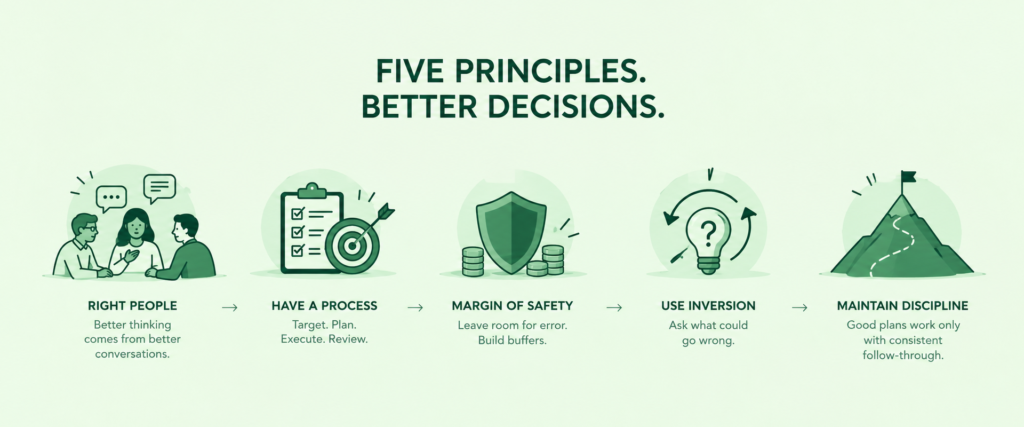
Surround yourself with the right people. The quality of the people around you shapes the quality of your own thinking. Thoughtful, honest, curious people challenge your assumptions and help you see what you’re missing. This applies to mentors, colleagues, partners and advisors alike.
Have a process. Disciplined thinking follows a simple arc: target, plan, execute, review. Know what you’re trying to achieve, build a structured plan, execute consistently, then step back and honestly review what worked. Without that structure, most decisions become reactions to whatever feels urgent. A process turns reactive thinking into intentional thinking and makes real learning possible.
Build a margin of safety. Benjamin Graham’s idea, applied beyond the portfolio. Leave room for error rather than assuming everything goes to plan. Build buffers into your finances, your schedule, your health. That margin is what separates a recoverable mistake from a catastrophic one.
Use inversion. Charlie Munger’s favourite mental tool, borrowed from the mathematician Jacobi. Most people ask how to succeed. Flipping the question produces sharper answers: what are the most likely ways this goes wrong? Eliminating the obvious failure modes often gets you closer to success than piling on more positive thinking.
Maintain discipline. Even a great plan fails without follow-through. Discipline isn’t glamorous and isn’t interesting to talk about, but it’s what separates people who achieve their goals from people who merely discuss them.
The trap of chasing money, fame and power
There’s a version of success built entirely around money, fame and power. None of these is wrong in isolation. The trouble starts when they become the entire scorecard, when a life is measured by how much external validation it collects.
Chokhani leans on the idea of an inner scorecard, a concept associated with Warren Buffett and popularised by Alice Schroeder’s biography The Snowball.
The question isn’t what others think of you. It’s whether you’re living in a way that feels right to you, and whether you’re building something you can genuinely stand behind.
External achievements are real, but unstable. Market conditions shift, reputations turn, power gets taken away, and none of it is fully within your control. What you can control, at least partly, is the quality of your attention, your values, and the decisions you make day to day.
An inner scorecard measures exactly that, unmoved by the size of a portfolio or how many people recognise your name. Held alongside the reminder that this, too, shall pass, it keeps both success and failure in proportion.
Nature doesn’t move in straight lines
One of the mistakes people make is expecting linear progress. Invest consistently and the portfolio should grow consistently. Work hard and a career should improve steadily. Make good decisions and good outcomes should follow in a predictable line.
Nature doesn’t work that way. Seasons cycle. Tides rise and fall. Economic booms give way to contractions. Markets move in waves. Careers often carry long stretches of stagnation followed by sudden leaps.
Expecting linear growth and then hitting a plateau feels like something has gone wrong. Understanding cycles turns that same stretch into a recognisable, natural phase rather than a crisis.
It also changes behaviour at the extremes. When things are exceptionally good, you stop assuming the good stretch is permanent. When things are genuinely hard, you stop assuming the difficulty lasts forever.
Understanding cycles is largely what builds patience and perspective.
What investing and life have in common
The two turn out to share the same underlying principles:
- Adaptability: updating your beliefs as conditions change without abandoning your core values
- Resilience: the capacity to absorb a setback and keep going
- Discipline: following through even when it’s inconvenient
- Self-awareness: knowing your own temperament, biases, strengths and blind spots
- Long-term thinking: trading short-term comfort for a better long-term outcome
- Continuous learning: staying curious, staying humble, staying genuinely open to being wrong
Closing thoughts
A handful of ideas keep resurfacing.
Learn continuously, because the world keeps changing and so should you, but remember that learning outward is only half the work. Learning inward matters just as much.
Understand yourself. Know what you want, what you fear, what you value, and how you behave under real pressure, because that’s the foundation beneath every good decision.
Stay adaptable. What works today may stop working tomorrow, and holding too tightly to any single formula, in investing or in life, is a bet against the future.
Build resilience rather than optimising purely for performance, because the systems that endure are rarely the ones that were most efficient to begin with.
Follow a process. Discipline and structure aren’t obstacles to good outcomes, they’re what make good outcomes repeatable.
Think independently and use an inner scorecard, measuring your life by what genuinely matters to you rather than by what looks impressive to everyone else.
Respect cycles. Nature doesn’t move in straight lines and neither does a life well lived, and patience comes from understanding how progress actually unfolds.
And focus on the long term. The droplet becomes the river, and the river eventually reaches the sea, not by forcing the journey, but simply by moving.
Investing success and a well-lived life tend to trace back to the same source: thoughtful decisions, made consistently, over long stretches of time.
Disclaimer:
This article summarises publicly available remarks by Manish Chokhani for informational and educational purposes. It is a paraphrase rather than a verbatim record, and any interpretation is the author’s. It is not investment advice, and nothing here is a recommendation to buy or sell any security. Please consult a SEBI-registered investment adviser before making financial decisions.
Source:
The One Percent Show with Vishal Khandelwal, Episode 1, featuring Manish Chokhani, Director, Enam Holdings. Transcript publicly available via vishalkhandelwal.com.