
Investing in Holding Companies: Genuinely Undervalued?
Why Indian holding companies trade well below what they own, and when that gap is an opportunity rather than a warning.
A holding company’s shares almost always trade below the value of the stakes it owns. In India that gap often exceeds 50%. Some of it is justified by tax, governance and structural friction. The question isn’t how wide the discount is, but whether anything will ever close it.
Picture stumbling across a shop that holds ₹100 worth of goods on its shelves, yet you could buy the entire shop for ₹60.
On paper, you’re getting ₹100 of assets for ₹60. That’s essentially the pitch behind holding companies in India, and it sounds like an obvious opportunity.
Let’s look a bit more closely.
What a holding company actually is
A holding company exists to own stakes in other businesses rather than to manufacture anything or serve customers directly. Its entire value flows from the companies sitting underneath it.
Picture someone named Aman who loves the restaurant business but has no interest in cooking. Instead of opening his own place, he buys ownership stakes in three thriving food businesses: a pizza chain, a café and a biryani brand.
His company, Aman Holdings, never fries a single samosa or hires a single chef. Its worth comes entirely from what those three restaurants are doing. If they grow and turn healthy profits, Aman Holdings becomes more valuable alongside them, and when they pay dividends, that cash flows up to Aman too.
But if any of those restaurants start bleeding customers or shut their doors, Aman Holdings takes the hit just as directly, since its fortunes are tied completely to businesses it doesn’t run day to day.
Holding companies make money in two ways. They collect dividends when the businesses they own turn a profit and distribute some of it. And they can book capital gains by eventually selling a stake for more than they paid.
The two flavours in India
Pure holding companies mainly own stakes without running anything major of their own. Bajaj Holdings & Investment is the classic example, drawing its value almost entirely from stakes in Bajaj Auto and Bajaj Finserv.
Operating holding companies run a real business while also holding stakes elsewhere, the way Mahindra & Mahindra manufactures vehicles while holding investments across finance, EVs and other ventures.
A handful of well known names illustrate the structure:
|
Holding company |
Major holdings |
|
Bajaj Holdings & Investment |
Bajaj Finserv, Bajaj Auto, Maharashtra Scooters |
|
Tata Investment Corporation |
Trent, TCS, Titan, Tata Consumer, Voltas, Tata Chemicals |
|
Maharashtra Scooters |
Bajaj Holdings, Bajaj Finserv, Bajaj Auto |
|
Pilani Investment and Industries |
Grasim, UltraTech Cement, Aditya Birla Capital, Hindalco |
|
Kama Holdings |
SRF Ltd |
|
Kalyani Investment Company |
Bharat Forge, BF Utilities, Hikal |
|
Bengal & Assam Company |
JK Lakshmi Cement, JK Tyre, JK Paper |
|
JSW Holdings |
JSW Steel, JSW Energy, JSW Infrastructure |
|
Balmer Lawrie Investments |
Balmer Lawrie & Co |
|
TVS Holdings |
TVS Motor, Sundaram-Clayton |
|
Sundaram Finance Holdings |
Sundaram Clayton, Wheels India, Brakes India |
|
Rane Holdings |
Rane Engine Valve, Rane Brake Lining, Rane Madras |
Understanding the holding company discount
Even when a holding company sits on genuinely valuable stakes, its own share price almost always trades below the combined worth of everything it owns.
This gap is the holding company discount. A company might own stakes worth more than ₹100 on paper, yet the market prices it at ₹60 or ₹70.
In India these discounts tend to run considerably deeper than in most global markets, sometimes exceeding 50 to 60%, particularly where investors harbour real doubts about management quality or capital allocation.
Why the discount exists
Tax leakage along the chain. When an underlying company earns a profit, it pays corporate tax, then distributes part of what remains as dividends to the holding company. Section 80M allows the holding company to deduct that dividend income from its own taxable income, but only to the extent it passes the dividend onward to its own shareholders.
Which means the leakage depends heavily on behaviour. A holding company that passes dividends straight through avoids most of the cascading. One that retains the cash is taxed on it, and then the eventual distribution gets taxed in shareholders’ hands anyway.
That distinction matters, because it ties directly to the next point.
Capital allocation is where trust gets tested. Buying into a holding company means trusting management’s judgment on where money goes next, and that judgment doesn’t always hold up.
Some holding companies sit on large cash piles for years without deploying them productively. Others pour capital into weak or unrelated businesses that never pay off. In the more troubling cases, cash generated by a genuinely strong business gets funnelled into propping up a struggling one elsewhere in the group.
Investors dislike watching value created by a good business get eroded by a weak one, and it shows up in the valuation.
Capital gains create a second layer. When a holding company sells an investment at a profit, it typically owes capital gains tax before the proceeds reach shareholders, and any later distribution can trigger further tax. This matters more for a company like Tata Investment Corporation, which actively trades positions, and less for Bajaj Holdings, which mostly holds long term strategic stakes.
Governance concerns run deep in India. Many Indian holding companies exist primarily as vehicles for promoter families to retain control over a broader group structure, and that creates natural tension. Promoters focus on preserving control, public shareholders focus on returns, and when those incentives don’t line up the market applies a steeper discount.
Owning something indirectly is less appealing than owning it directly. Most investors would rather hold Bajaj Auto shares outright than get exposure through Bajaj Holdings. A holding structure adds a layer between the investor and the business, with no direct control. That distance alone depresses the price investors will pay.
Bundled businesses rarely suit everyone. A holding company typically spans multiple sectors, and few investors want exposure to all of them at once. Someone might love the automobile story while feeling uncomfortable with a finance arm’s valuation, so they discount the combined package rather than valuing each piece on its own.
Running the structure isn’t free. Even without an operating business, a holding company carries salaries, audit fees, legal costs and compliance expenses. Rarely large in absolute terms, but they chip away steadily.
When discounts actually close: the Equitas and Ujjivan story
Here’s the part most writing on this topic skips. Discounts can persist for decades. So what actually closes them?
The clearest recent Indian example is Equitas and Ujjivan.
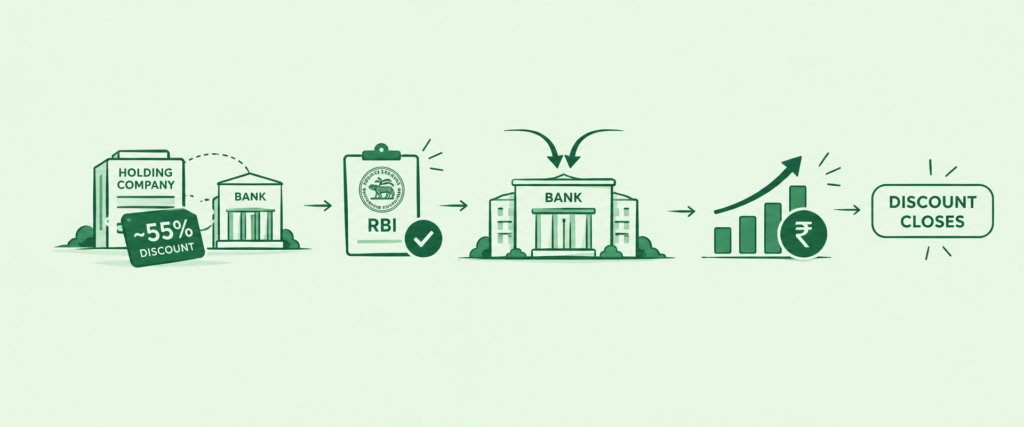
Both small finance banks were required by RBI rules to operate under a non-operative financial holding company structure. Both holding companies were separately listed. And both traded at enormous discounts, reaching more than 55%, for a specific reason: shareholders had no confidence the RBI would ever permit the holding company to merge back into the bank.
The discount wasn’t really about tax or governance. It was about a structure with no visible exit.
Then in July 2021 the RBI permitted small finance banks and their holding companies to apply for amalgamation. Equitas Holdings and Ujjivan Financial Services both hit the 20% upper circuit that day.
The mergers followed. Equitas Holdings merged into Equitas Small Finance Bank with a record date of 3 February 2023, shareholders receiving 231 bank shares for every 100 they held. Ujjivan Financial Services was amalgamated into Ujjivan Small Finance Bank in 2024. Both holding companies were delisted, and both discounts collapsed to zero.
Two lessons sit inside this.
The optimistic one: when a catalyst arrives, the discount can close completely and quickly, and shareholders capture the whole gap.
The sobering one: it took a regulatory decision, outside anyone’s control, after years of waiting. The discount didn’t narrow because the market changed its mind. It closed because the structure was dismantled.
Which is the right way to think about any holdco discount. Ask what would actually have to happen for it to close, and whether anyone has the power and the incentive to make that happen.
Why they can still be worth owning
Plenty of Indian holding companies trade at discounts wide enough to look irrational, well beyond what taxation, governance risk or structural complexity alone would justify. For patient long term investors, that gap can translate into a genuinely attractive entry point with comparatively contained risk.
Returns tend to come from three sources working together:
- Growth in the underlying businesses
- Dividend income flowing up from them
- Any narrowing of the discount itself
The first two happen regardless. The third requires a catalyst, which is why sharper investors focus less on the raw size of the discount and more on the quality of what sits underneath it.
The holding companies worth paying attention to tend to share four traits:
|
Trait |
Why it matters |
|
Disciplined capital allocation |
Determines whether cash gets deployed well or trapped |
|
Strong governance |
Reduces the risk of value being diverted within the group |
|
Healthy dividend payouts |
Relieves tax cascading under Section 80M and delivers cash to you directly |
|
Management aligned with shareholders |
Rather than purely focused on preserving control |
High dividend yields matter more here than in an ordinary stock, because the discount effectively magnifies the yield. If a holding company’s stake is worth ₹100 and you paid ₹60, every rupee of dividend that flows through represents a higher return on your actual cost.
The bottom line
Holding companies can offer real long term value, since investors often get access to genuinely strong businesses at a meaningful discount to their worth.
That said, not every holding company deserves a place in a portfolio. The quality of what it actually owns, how disciplined management is with capital, the strength of its governance and its track record on dividends all matter far more than the size of the discount itself.
A wide discount on a well-run holding company that pays out generously is an opportunity. The same discount on one that hoards cash and funds weak group businesses isn’t a bargain. It’s the market telling you something.
Disclaimer:
This article is for informational and educational purposes only. It is not investment advice or tax advice, and nothing here is a recommendation to buy or sell any security. Companies are named to illustrate corporate structures. Tax treatment depends on individual circumstances and prevailing law. Please consult a SEBI-registered investment adviser and a qualified tax professional before making financial decisions.