
Why a Great Company Can Still Be a Bad Investment: The Nykaa Lesson
A strong business, a real moat, genuine growth, and a stock that went nowhere for five years.
Nykaa was a good company. Investors who bought it on listing day in November 2021 have made roughly 3% in five years, while the business itself grew several times over. The gap between those two facts is the entire lesson.
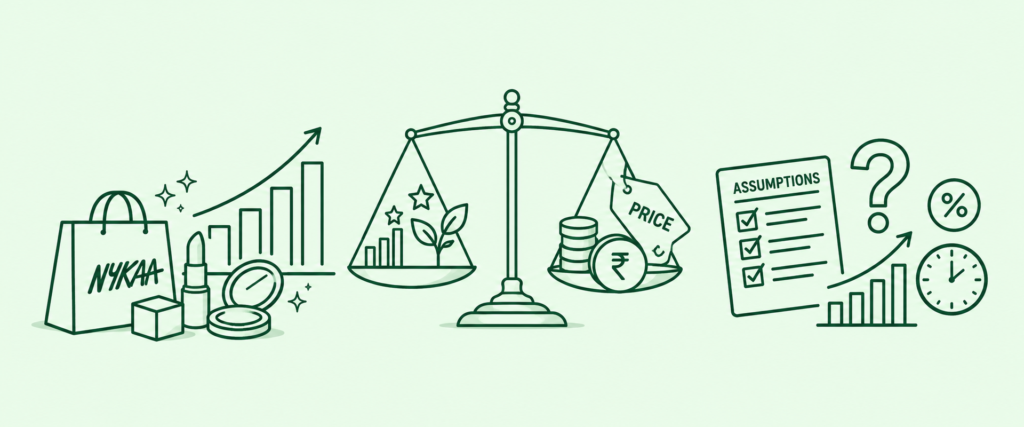
The 5 crore car
Imagine someone offers you a brand new luxury car. Beautiful design, excellent engine, respected badge, and a waiting list long enough to prove how many people want one. Everyone who already owns one seems to love it.
On the surface, it looks like an easy yes.
Price? 50 lakh rupees. You’d probably still be interested, since quality tends to come with a premium, and the decision mostly comes down to whether you can afford it and think it’s worth paying for.
Now imagine the exact same car at 5 crore. Suddenly the thinking shifts entirely. You’re not debating whether the car is good. You’re asking whether the price makes any sense at all.
The car hasn’t changed. It might still be one of the finest machines on the road. But paying far beyond what something is worth turns a wonderful purchase into a poor one.
Investing works exactly the same way. Plenty of investors know how to spot a genuinely good company. Far fewer grasp that a good company and a good investment aren’t automatically the same thing.
The company everyone wanted a piece of
When Nykaa listed in 2021, it instantly became one of the most talked about names in India.
The excitement made sense. Nykaa had carved out a genuinely strong position in beauty and personal care, built a platform millions of customers trusted, and its founder had earned real credibility for growing the business with discipline rather than reckless spending.
The growth numbers added fuel. Revenue was climbing fast, adoption was rising, and the business seemed to be riding several powerful tailwinds at once: more Indians coming online, ecommerce becoming part of daily life, and younger shoppers growing entirely comfortable buying beauty products through an app.
The IPO was subscribed around 82 times. It listed at ₹2,018 against an issue price of ₹1,125, a 79% premium, and Nykaa’s market capitalisation crossed ₹1 trillion on its first day.
To a lot of investors, it was a done deal. And to be fair, much of that optimism wasn’t misplaced. Nykaa really was a high quality business with real growth prospects.
The issue was what investors were willing to pay for that growth story.
What the IPO was actually selling
The IPO raised ₹5,352 crore. One detail tends to get glossed over.
|
Amount |
Where it went |
|
|
Fresh issue |
₹630 crore |
Into the company |
|
Offer for sale |
₹4,722 crore |
To existing shareholders |
Only about 12% of the money raised actually reached the business. The rest went to early investors selling part of their stake.
That doesn’t imply anything was wrong. Early investors sell for all sorts of reasons, often simply needing liquidity after years of waiting.
But it raises a fair question. If the future opportunity was genuinely this enormous, why were some of the earliest backers happy to sell at that price?
It’s a reminder of what every IPO actually is. One side excited to buy into the future, another side content to sell a piece of it at today’s price. The investor’s job is to understand what expectations were already baked into the price being asked.
Riding a genuine wave
Sometimes a company succeeds partly because it catches a powerful wave at exactly the right moment.
Think of a surfer. Skill matters, balance matters, experience matters. A genuinely massive wave helps enormously too.
Nykaa caught several at once. Smartphones put the internet into millions of pockets almost overnight. Mobile data got remarkably cheap. Digital payments got easier, delivery networks improved, and shoppers grew comfortable buying online in a way they hadn’t a decade earlier.
A meaningful part of Nykaa’s success came down to recognising that shift early and building the right business to meet the moment.
How tiny assumptions snowball into huge differences
Picture two people planning a road trip from Bengaluru to Delhi, over 2,000 kilometres. One assumes they’ll average 60 km/h, the other 70. The gap looks trivial. Across the whole trip, the first needs roughly 33 hours and the second under 29.
Valuing a fast growing company works the same way. Investors are constantly guessing at revenue growth, future profitability, customer additions and competitive intensity. Each guess might look only slightly different from the next investor’s.
The trouble is these assumptions don’t sit in isolation. They compound, year after year. A company growing 25% annually for a decade ends up looking wildly different from one growing at 20%, even though the gap looks small today.
This is exactly why high growth companies are so hard to value. Their worth hinges almost entirely on the future, and even minor shifts in expectations lead two reasonable investors to wildly different conclusions.
Why being wrong costs less in venture capital than in the stock market
A fair question follows. If the future is this uncertain, why are venture capitalists comfortable paying seemingly steep valuations?
The answer sits in how venture capital actually works. A VC never expects every bet to pay off. Invest in ten startups, watch six fail and three perform decently, and the one breakout success can cover every loss and still leave the portfolio comfortably profitable.
Venture investing isn’t really about predicting each company’s future accurately. It’s a game of probabilities played across many bets at once.
Public markets don’t offer that luxury. By the time a company lists and carries a valuation in the billions, most of the early stage uncertainty has already been stripped away. Investors can no longer lean purely on the possibility of a spectacular future.
At some point the business has to deliver something concrete. Revenue growth still matters, but profit, cash generation and execution start to matter just as much.
Stories can carry a stock price for a while. Over long stretches, reality tends to win.
Why interest rates matter more than most investors realise
Money today is worth more than the same amount received years from now. Offered a lakh today or the same lakh a decade later, almost everyone picks today, since money in hand can be put to work immediately.
This matters enormously when valuing growth companies, because many of them aren’t generating large profits today at all. Most of the expected earnings sit years out.
When rates are low, the gap between money today and money far in the future shrinks. Investors grow more willing to pay up for companies whose profits are still years away.
When rates climb, the calculus flips. Those same future profits become less appealing, because investors can earn solid returns in the present without waiting. A company whose valuation leans heavily on earnings a decade out can suddenly look far less attractive.
The maths gets technical. The underlying idea stays simple: the longer you have to wait for the money, the more interest rates matter to what that money is worth today.
The assumptions inside Nykaa’s valuation
In the years following the pandemic, interest rates around the world sat unusually low. Money was cheap, borrowing was easy, and investors went hunting for anything promising stronger returns, often paying premium prices for growth further down the line.
The focus shifted away from what these companies were earning today and toward what they might earn many years from now. For as long as rates stayed low and optimism stayed intact, those valuations felt entirely reasonable.
The catch was that the whole view rested on an assumption most investors didn’t consciously register. What happens if the environment shifts? What if rates rise? What if growth turns out slower than hoped?
In that scenario, investors simply stop paying the same premium for profits still sitting years away.
The business can keep growing, customers can stay loyal, management can keep executing well, and the stock can still fall, because investors are no longer valuing those future profits the way they once did.
That’s one of the easiest traps to fall into. Staying focused on the business you can see while overlooking the assumptions sitting beneath its valuation.
What actually happened
Here’s where the theory meets the scoreboard.
Nykaa issued a 5:1 bonus in November 2022, so every pre-bonus price needs dividing by six to compare like with like.
|
Actual price |
Adjusted for bonus |
|
|
IPO issue price (Nov 2021) |
₹1,125 |
₹187.50 |
|
Listing day open |
₹2,018 |
₹336 |
|
All-time high, 26 Nov 2021 |
₹2,574 |
₹429 |
|
Price in October 2026 |
₹345 |
₹345 |
Buy on listing day in November 2021 and you’d have made around 3% in five years. Not annually. In total.
Buy at the all-time high three weeks later and you’d still be down roughly 20% today, almost five years on.
Only investors who got allotment at the ₹1,125 issue price did genuinely well, up about 84%, which works out to roughly 13% a year. Respectable, and a long way short of what the day-one excitement implied.
Now put that beside the business. Nykaa’s revenue for the whole of FY21 was around ₹2,441 crore. It did roughly ₹2,782 crore in the single quarter of Q2 FY26, with a quarterly profit near ₹80 crore. The company grew substantially. The stock went sideways.
And one detail that’s almost too neat. At its all-time high in late November 2021, Nykaa had just reported Q2 FY22 results showing net profit down 95.6% year on year to ₹1.2 crore, with EBITDA down 48%. The stock peaked in the same month its earnings collapsed. Nobody was looking at the earnings.
The business was never the problem. The price was.
Still worth noting: Nykaa trades at a trailing P/E around 365 today, on a market cap near ₹96,000 crore. The lesson in this article isn’t purely historical.
Markets keep learning this lesson the hard way
None of this is new.
In the late 1960s and early 1970s, plenty of investors believed a handful of elite companies were worth buying at literally any price. During the dot com boom, people convinced themselves internet companies would grow so fast that valuation simply stopped mattering. More recently, years of near zero interest rates made investors entirely comfortable paying up for profits sitting far off in the future.
The pattern repeats with remarkable consistency. It starts with an idea that’s partly true, tips into excessive optimism once people assume the future will look exactly like the present, and eventually something falls out of balance.
No trend lasts forever, and the future is almost always less predictable than it looks from the middle of a good run.
What this story is really about
Nykaa built something genuinely impressive, and there’s no serious case against that. In a market full of startups burning through investor cash recklessly, its capital discipline stood out. The brand is real. The customer loyalty is real. The category still holds real long term potential.
But the stock market was never just about identifying great companies. It’s about paying a sensible price for them, and price depends on more than business quality. It depends on the assumptions baked into that price, on where interest rates sit, and on how much patience an investor has, or needs, before the return shows up.
No matter how good something is, it’s still entirely possible to overpay. A brilliant restaurant bought at the wrong price is a bad investment. An unremarkable one bought at a genuine discount might turn out to be a great one.
The next time someone tells you a company has an enormous runway, incredible growth and an unbeatable brand, pause before nodding along. Ask not just whether the company is great, but what price you’re being asked to pay, what assumptions that price demands, and whether those assumptions would still hold if the world shifted even slightly.
The real lesson from Nykaa is to look for the hidden cost. The growth, the brand and the exciting future were all plain to see.
When expectations run too high, investors eventually discover that the most expensive thing they ever bought wasn’t the business. It was the story wrapped around it.
Disclaimer:
This article is for informational and educational purposes only. It is not investment advice, and nothing here is a recommendation to buy or sell any security. Nykaa is discussed as a documented case study in valuation, not as a judgment on the company’s business or prospects. Share prices and financial data are as of the publication date and change continuously. Please consult a SEBI-registered investment adviser before making financial decisions.