
Gold Loan NBFCs: Why This Tiny-Sounding Industry Is Suddenly Everywhere

How rising gold prices, a new RBI framework and branch economics turned a quiet lending business into one of India’s fastest-growing credit markets.
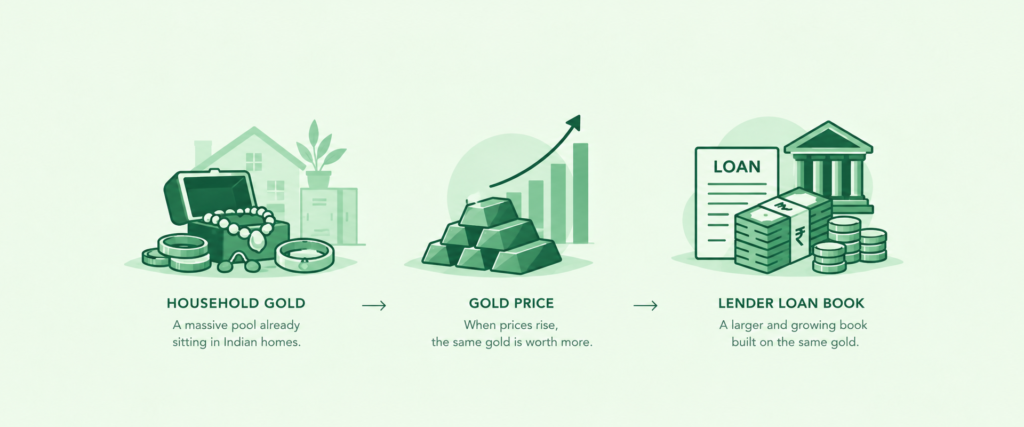
Indian households sit on an enormous pile of gold. When gold prices rise, the same jewellery supports a bigger loan, so lenders’ books grow without them finding a single new customer. ICRA expects the organised market to hit ₹15 trillion in FY2026. The catch is that the same mechanism runs in reverse.
Gold loan NBFCs are having a moment in India, and the reason is simpler than you’d think.
When gold prices go up, the same gold chain or bangle sitting in a locker suddenly lets people borrow more money against it. That’s what’s making gold lenders grow so fast.
Millions of Indian families already have gold at home, tucked away in lockers, cupboards or bank vaults. Gold loan companies take that sleeping asset and turn it into quick cash, without anyone having to sell it.
What this business actually does
A gold loan NBFC lends money against pledged gold jewellery. The customer hands over the gold, walks out with cash, and gets the gold back once the loan is repaid.
That makes gold loans quite different from most other lending. A personal loan runs mostly on your salary and credit history. A gold loan runs mostly on what the gold you brought in is actually worth.
Which means this business moves in step with the gold price. When gold gets more valuable, the lender gets a bigger safety cushion, and the borrower can usually walk away with a bigger loan.
Why growth looks so strong in 2026
ICRA expects India’s organised gold loan market to reach ₹15 trillion in FY2026, a year earlier than it previously projected, with NBFC gold loan books growing 30 to 35% over the year. The overall market compounded at roughly 26% across FY2024 and FY2025.
The biggest reason is the gold price.
According to the World Gold Council, MCX spot gold averaged a record ₹1,51,108 per 10 grams in Q1 2026, up 81% year on year and 20% on the previous quarter. Indian gold demand rose 10% by volume to 151 tonnes, but nearly doubled in value terms to a Q1 record of around ₹2,275 billion.
Imagine owning a house and watching its market value suddenly jump. You’d feel a lot more comfortable borrowing against it, simply because the asset backing the loan is worth more. Gold loans work on more or less the same logic.
One important caveat. That Q1 figure is a peak reading, not a running total. Gold touched a record of around ₹1,80,986 per 10 grams in late January 2026 before correcting, and has traded closer to ₹1.45 to 1.52 lakh since. Prices remain far above where they were two years ago, which is what matters for loan books, but the vertical part of the move is behind us.
The three things that matter
Three variables drive this industry:
- How much gold Indian households own
- What that gold is worth
- How big a loan book lenders have built on top of it
India sits on a massive pile of household gold. Even with the organised market approaching ₹15 trillion, the industry is tapping only a small slice of what families already hold.
That’s what makes the opportunity interesting. The raw material for growth is already sitting inside people’s homes. Companies just need to convince more of them to borrow through a formal lender instead of the local moneylender.
And when gold prices rise, loan books grow on two fronts at once. Existing customers can borrow more against the same jewellery, and new customers find gold loans more appealing because there’s suddenly a bigger amount to unlock.
How the industry grew up
The industry began as a largely local, relationship-driven business, especially in South India, built on trust with a neighbourhood lender rather than paperwork.
Slowly the bigger organised players arrived. They built brands, opened branches, standardised the process, and made customers comfortable treating gold as a formal financial product rather than a last resort.
Over time, gold loans started looking like a mainstream retail credit product rather than a distress option.
What the new RBI framework actually says
The industry isn’t entering a regulated phase. It’s already in one.
On 6 June 2025, the RBI issued the Lending Against Gold and Silver Collateral Directions, 2025, giving lenders until 1 April 2026 to comply. Those rules now govern the sector.
|
Previous framework |
Current, since April 2026 |
|
|
LTV cap |
Flat 75% |
85% up to ₹2.5 lakh, 80% for ₹2.5 to 5 lakh, 75% above |
|
LTV monitoring |
At origination |
Throughout the loan tenure |
|
Bullet repayment |
Unrestricted |
Capped at 12 months |
|
Gold return |
No fixed timeline |
Within 7 working days of repayment |
|
Eligible collateral |
Broader |
Jewellery, ornaments, bank-minted coins. No bars, bullion or ETFs |
|
Loans to buy gold |
Permitted |
Prohibited |
|
Valuation basis |
Lender discretion |
IBJA rates or a SEBI-regulated commodity exchange |
|
Renewals and top-ups |
Looser |
Only where the facility is standard and LTV-compliant |
Here’s the part most coverage gets wrong. This regulation was a tailwind, not a headwind.
The draft framework released in April 2025 had spooked the sector. When the final rules landed in June, they were considerably easier. Muthoot Finance rose roughly 13% and Manappuram Finance around 17% within a week, both hitting new highs. ICICI Securities described the higher LTV limits as structurally positive for small-ticket lenders. Analysts noted that the regulatory overhang hanging over gold loan NBFCs had lifted.
The higher LTV on small loans is the key commercial change. It lets lenders advance more against the same collateral in exactly the ticket size where most of their volume sits.
The cost side is real too. Tighter valuation standards, LTV monitoring through the loan life, and stricter auction procedures all add operational expense. ICRA’s view is that the sheer increase in scale, driven by gold prices, can partly offset that.
Why it costs more to run than you’d guess
Gold loan companies look simple from the outside. Running one is anything but cheap.
You need branches, trained staff, appraisal systems, secure storage, audits and tight controls, because you’re physically holding other people’s gold. That pushes operating costs higher than most people expect. Muthoot Finance’s operating cost ratio stood at 3.4% in FY2025 and 3.5% in FY2024.
But if a single branch starts doing a lot more business without a matching jump in rent or staff cost, profits can climb fast.
Think of a cinema. Whether 50 people show up or 150, most of the basic costs, rent, staff, electricity, stay roughly the same. Gold loan branches work in a similar way once loan volumes pick up.
Why AUM per branch is the number that matters
One of the best ways to judge a gold loan NBFC is to ask a simple question: how much business is each branch actually doing?
AUM per branch is the metric. If every branch is handling more loans, the company is squeezing more revenue out of the same physical network without building anything new.
That’s part of why profitability in this industry can look genuinely strong during a good cycle. Higher gold prices, better branch productivity and lower loan losses all tend to move in the same direction at once.
The flip side is worth remembering. They can also move in the same direction on the way down.
The two big names
Muthoot Finance and Manappuram Finance are the names everyone in this space knows.
Muthoot is still seen as the bellwether. Rating commentary suggests its operating metrics and asset quality have both benefited from stronger collateral cover as gold prices climbed.
That collateral cover is the real edge here. If a borrower falls behind, the lender still has the gold as backup, and when prices are high that safety margin only gets fatter.
Manappuram is also a major player, but investors tend to look at it differently, because its lending book stretches beyond pure gold loans into vehicle finance, microfinance and other segments.
Both stocks had a strong 2025, rising roughly 47% and 48% respectively.
How this compares with other NBFCs
Gold loan NBFCs aren’t risk-free, but they’re built differently from lenders leaning on unsecured personal loans or microfinance.
|
Gold loan NBFCs |
Unsecured lenders |
|
|
Collateral |
Physical gold held by the lender |
Usually none |
|
Recovery on default |
Auction the pledged gold |
Messy, slow, often partial |
|
Main exposure |
Collateral value, branch execution, regulation |
Borrower income shocks, repayment stress |
|
What hurts them |
A sharp fall in gold prices |
A slowdown in employment or incomes |
That doesn’t automatically make gold lenders the better bet. It means their fortunes are tied to different things.
The map is shifting
Gold loans have traditionally been strongest in South India, where the habit of pledging gold runs deeper and older than almost anywhere else in the country.
The industry is slowly spreading out, and that matters, because long-term growth gets a lot harder if lenders stay boxed into the same few states and the same familiar customer pockets.
A wider national footprint also cuts concentration risk. If one region slows, a lender with a broader spread has more room to make up ground elsewhere.
The risks sitting underneath
Gold prices themselves. This is the big one, and it’s no longer purely hypothetical. Gold peaked around ₹1.81 lakh per 10 grams in January 2026 and has traded meaningfully below that since. When prices fall, the collateral cushion thins, LTV ratios on existing loans drift up, and the new rules require lenders to monitor that through the loan’s life rather than only at origination. A deep enough fall pushes auctions up and loan growth down at the same time.
Competition from banks. ICRA’s data shows banks growing their gold loan books slightly faster than NBFCs, with public sector banks compounding at around 27% across FY2024 and FY2025 against 22% for private banks. PSBs remain dominant, largely through agricultural lending backed by gold jewellery. Specialist NBFCs increasingly have to compete on rates, service and speed rather than ride the tailwind.
Compliance cost. The 2025 Directions add real operational expense: standardised valuation, continuous LTV monitoring, tighter auction procedures, faster collateral return. Scale absorbs some of it. Smaller lenders will feel it more.
Scaling too fast. The classic growth trap. Open too many branches too quickly and branch productivity slips, which takes the shine off the AUM-per-branch story that makes this model work.
What the 2026 cycle is really telling us
The picture is more nuanced than it looked in the first quarter.
Gold loan NBFCs have had an exceptional run, built on a genuine combination of high gold prices, strong demand for secured credit and improving scale. A regulatory framework that looked threatening in draft arrived considerably friendlier, and the higher LTV on small-ticket loans is a real commercial gain.
But the easiest part of the cycle is behind. Gold is off its January highs, banks are growing at least as fast as NBFCs, and compliance costs are now a permanent line item rather than a looming threat.
The simplest way to think about it: India already owns the gold, families still need liquidity, and formal lenders keep getting better at turning one into the other. That structural case doesn’t depend on gold going up forever. It just gets a lot more comfortable when it does.
Disclaimer:
This article is for informational and educational purposes only. It is not investment advice, and nothing here is a recommendation to buy or sell any security. Companies are named as illustrations of an industry structure. Gold prices, regulatory provisions and company data referenced are as of the publication date and change continuously. Please consult a SEBI-registered investment adviser before making financial decisions.
Sources:
ICRA research on the organised gold loan market; World Gold Council, Gold Demand Trends India Focus Q1 2026; RBI Lending Against Gold and Silver Collateral Directions, 2025; Care Ratings webinar on Gold Loan NBFCs; contemporaneous market reporting.