
ESG and the Limits of a Good Story
Adapted from Aswath Damodaran’s essay “Sounding Good or Doing Good: A Skeptical Look at ESG,” with what happened next.
ESG bundles three very different things into one number, and the agencies producing those numbers agree with each other far less than you’d assume. The useful parts, governance quality and climate risk, are real. The promise that you can have higher returns, lower risk and a better world simultaneously was always doing more work than the evidence supported.
For most of investing history, the job was fairly simple. Find a solid business, pay a fair price, let time do the rest.
That barely changed for decades, right up until ESG investing arrived and reshaped how the industry talked about itself. Within a few years it became one of the most powerful narratives in global finance. Fund houses rushed to launch ESG-branded products, companies rewrote their annual reports around sustainability language, and an entire consulting industry sprang up to build scorecards for anyone willing to pay.
It’s not hard to see why it caught on. Investors were essentially told they could have it all: solid returns and a clean conscience at the same time. The pitch bundled profit, lower risk, environmental protection, social good and stronger governance into one neat package. For a lot of people, it felt like the investment equivalent of a free lunch.
But whenever a financial idea claims to benefit everyone at once, it’s worth slowing down.
None of this means ESG has no merit, or that companies should stop caring about their environmental and social footprint. The question is narrower and more useful: what can ESG actually deliver, and where do the claims outrun the evidence?
Every era invents its own corporate gospel
ESG didn’t emerge from nowhere. It’s the latest entry in a long line of business ideas that promised to fix companies and simplify investing.
Synergy. Six Sigma. Corporate Governance. Sustainability. Stakeholder Capitalism. Each carried real insight, and almost all of them eventually got oversold as universal fixes for problems far too complicated for any single framework.
ESG has followed the same arc. It began as a way to flag non-financial risks and slowly ballooned into something far more sweeping. Which means it deserves the same scrutiny as any other claim, judged on evidence rather than accepted on the strength of its label.
Three letters, three very different things
|
Pillar |
What it covers |
How measurable? |
|
Environmental |
Carbon output, energy consumption, pollution, climate exposure |
Partly measurable, inconsistently reported |
|
Social |
Treatment of employees, customers, suppliers, communities |
Hardest to compare across companies |
|
Governance |
Board composition, executive pay, transparency, shareholder rights |
Most reliable, rests on documented structures |
Even though these get bundled into a single score, they measure fundamentally different things. A company can shine in one area while falling short in another.
Governance tends to be easiest to assess because it rests on documented structures and policies. Social and environmental factors are far messier and harder to compare consistently.
That’s the core weakness of ESG scoring. Compress three categories of wildly different reliability into one number and a lot of nuance simply disappears. An ESG score works best as a rough guide, not a verdict.
The promise behind the promise
Supporters tend to believe in a chain reaction. Responsible practices make companies better, better companies deliver stronger returns, and stronger returns translate into broader social good.
It’s a compelling story. It’s also three separate claims stacked on top of each other:
- ESG practices make companies run better, cutting risk and improving efficiency.
- Those improved companies reward investors with better returns and lower volatility.
- Channelling capital toward responsible businesses nudges society in a better direction.
None of these automatically follows from the others. A company can genuinely improve its operations without that ever showing up in its stock price. Strong investment returns don’t guarantee any social benefit at all.
This is also why arguments about ESG talk past each other. One side is making the case for better business practices while the other is questioning investment returns, and both think they’re having the same conversation.
Can companies, investors and society all come out ahead?
Much of ESG’s appeal rests on everyone winning at once. Companies become more responsible, investors earn better risk-adjusted returns, society enjoys cleaner air and fairer outcomes.
Real trade-offs get in the way. A company might pour money into environmental programmes that genuinely help society while denting near-term profitability. Decisions built purely to maximise shareholder value don’t always line up with what’s best for the wider community.
For an investor, the useful question isn’t whether ESG is good or bad in the abstract. It’s who benefits, who bears the cost, and whether the trade is worth it.
The measurement problem everyone avoids
Try a thought experiment. Ask ten people to estimate Apple’s annual revenue and you’ll get answers clustered fairly close together, because revenue is measurable. Ask those same ten how much Apple contributes to society and you’ll get ten wildly different answers.
That gap is the central problem with ESG.
And it isn’t hypothetical. Researchers at MIT Sloan examined ratings from six prominent ESG agencies and found their scores correlate at an average of just 0.54, ranging from 0.38 to 0.71 depending on the pair.
For comparison, credit ratings from Moody’s and S&P correlate at 99%.
Sit with that for a second. Two credit rating agencies looking at the same company reach near-identical conclusions. Two ESG agencies looking at the same company agree roughly half the time. The researchers called it, aptly, “aggregate confusion.”
If the experts building these frameworks can’t agree among themselves, how much weight should any investor put on a single score?
ESG scores are routinely presented with far more precision than the underlying process supports. A score of 78 next to a score of 82 looks exact, but an enormous amount of that number comes down to subjective judgment calls about what to measure, what to include, and how to weight it.
That doesn’t mean one agency is right and the rest are wrong. It confirms how subjective the measurement really is.
Do responsible companies perform better, or do successful companies just look responsible?
Plenty of studies point to strong ESG scores correlating with strong financial performance. That correlation, on its own, proves nothing about causation.
One explanation is that responsible practices genuinely reduce risk, sharpen efficiency and build reputation, feeding through into better outcomes.
A competing explanation is simpler. Successful companies already have deep pockets, and spending some of that surplus on ESG initiatives is an easy way to boost a score. A company can post strong financials alongside a strong ESG profile without either causing the other.
Company size and industry muddy it further, since both independently influence financial performance and ESG scores at the same time.
Worth adding: when rating agencies agree with each other only 54% of the time, any study correlating “ESG scores” with returns is partly measuring which rater it happened to use.
Looking at ESG through a valuation lens
This is where Damodaran’s framework becomes genuinely useful. His argument is that a business is worth nothing more or less than the cash flows it will generate. Everything else, ESG included, only matters to the extent it changes those cash flows.
|
Valuation input |
How ESG can help |
How ESG can hurt |
|
Revenue growth |
Customers prefer sustainable products; opens new markets and contracts |
Compliance burdens cap growth in some industries |
|
Operating margin |
Cutting waste and improving efficiency lifts profitability |
ESG spending and reporting obligations add cost |
|
Reinvestment |
Sustainability upgrades can lower future risk |
Pulls capital away from expansion and innovation |
|
Cost of capital |
Strong governance and lower risk reduce financing costs |
Effect varies a lot by which factor is in play |
|
Terminal value |
Getting ahead of regulation and consumer shifts protects long-term cash flows |
Failure to adapt erodes them |
ESG doesn’t move a company’s value in one fixed direction. Its effect depends on how it shapes growth, margins, risk and future cash flows together.
It belongs inside the valuation process, not as a shortcut label for quality.
The trade-off most ESG experts skip
The biggest unstated assumption in ESG investing is that a company can improve social and environmental outcomes while simultaneously delivering higher returns and lower risk.
Real-world investing rarely hands out benefits without asking for something in return.
A company might invest in cleaner technology, pay employees more, or adopt stricter standards. These choices can genuinely help society and usually come with higher costs and thinner near-term profits. Some ESG initiatives do improve efficiency in ways that benefit the company and the world together. Not every ESG rupee spent produces that outcome.
Some initiatives create genuine value. Some involve real trade-offs. Others barely move the needle either way.
The right question was never whether ESG is inherently good or bad. It’s whether the benefit produced is worth what it costs.
Good according to whose definition?
Perhaps the biggest challenge is that there’s no agreed definition of what makes a company good. ESG ratings compress complicated ethical questions into one number, but investors themselves disagree sharply about the same company.
|
Industry |
Why some investors avoid it |
Why others support it |
|
Oil and gas |
High carbon emissions, climate exposure |
Central to global energy needs and to funding the transition itself |
|
Defence |
Products built for military use |
Vital for national security and geopolitical stability |
|
Tobacco |
Well-documented health risks |
A legal industry producing steady, reliable cash flows |
|
Big Tech |
Privacy and misinformation concerns |
Drives innovation, productivity and global connectivity |
There’s also the practical problem of competing stakeholders. Employees want higher pay, shareholders want stronger profits, customers want lower prices, communities want tighter environmental protections. ESG ratings try to weigh all of these at once, and there’s no universally accepted formula for whose priorities count for more.
Many frameworks also carry the cultural and regulatory fingerprints of the regions where they were built, so certain criteria reflect one country’s priorities more than another’s.
An ESG score is a blend of data, assumptions and value judgments, not a clean scientific reading.
A good company isn’t always a good investment
Once a company becomes widely admired, more investors want in, demand pushes the price higher, and expectations drift into optimistic territory. At that point even continued strong performance may not be enough, because so much of the good news is already in the price.
The same dynamic applies to ESG investing. When demand tilts heavily toward ESG-friendly names, those stocks get bid up, and higher valuations generally mean lower expected returns.
People often assume a better company automatically means a better investment. Markets rarely work that cleanly.
Does buying ESG stocks actually change anything?
Many investors assume that buying ESG-focused stocks directly funds positive change.
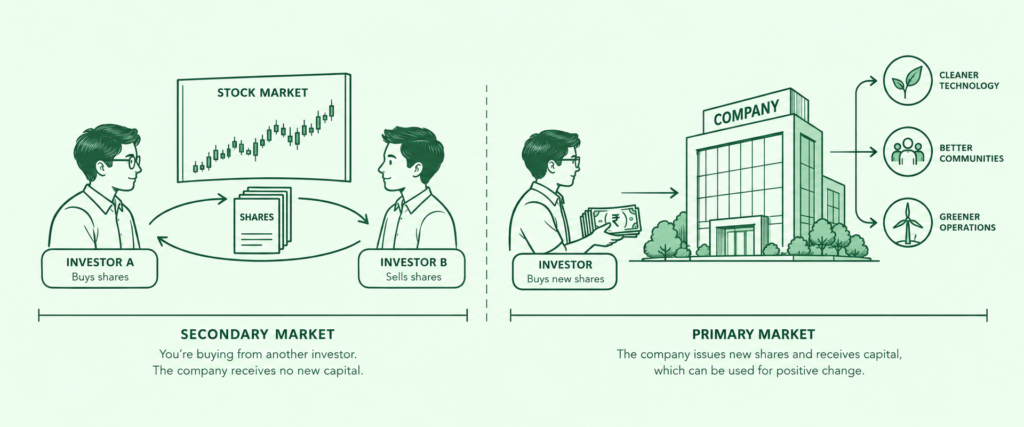
In practice, most share purchases happen in the secondary market. You’re buying from other investors, not from the company. The business typically receives no new capital at all when its shares change hands.
Owning ESG stocks doesn’t automatically produce better social or environmental outcomes. Primary issuance, green bonds and direct engagement are different matters, but ordinary secondary-market buying is not the lever most people assume it is.
Who actually profits from ESG?
Whenever an investment trend takes off, it’s worth asking who benefits most from its popularity.
|
Participant |
How they benefit |
|
Rating agencies |
Sell ESG ratings, data feeds and research |
|
Consultants |
Help companies with reporting and compliance |
|
Asset managers |
Launch ESG funds and collect management fees |
|
Corporations |
Build reputation and attract capital |
|
Index providers |
Create and license ESG benchmarks |
|
Individual investors |
Seek returns while supporting responsible businesses |
|
Society |
Hopes for genuine environmental and social gains |
Notice the asymmetry. The top five rows earn fees whether or not ESG delivers on its return or social promises. The bottom two carry the outcome.
That doesn’t imply bad intent. It does show how strongly incentives shape any growing industry from the inside.
What happened next
Damodaran wrote his sceptical essay in 2020, near the peak of ESG enthusiasm. What followed is worth recording, because it tested the argument directly.
The label collapsed. In January 2025, BlackRock exited the Net Zero Asset Managers initiative. Days later NZAM suspended operations entirely, citing legal pressure and political scrutiny. Larry Fink had already stopped using the term ESG, saying it had been weaponised by political figures on both sides.
The money followed. Q1 2025 was the worst quarter on record for global sustainable funds, with $8.6 billion of net outflows, and Europe saw its first quarterly outflows since tracking began in 2018. The full year brought Europe’s first annual outflows ever, roughly $61 billion, against $54 billion of inflows the year before. US funds recorded eleven consecutive quarters of outflows, with a record twenty ESG funds closing in a single quarter.
Most tellingly, fund rebranding hit a record high, and “ESG” became the single most frequently removed term from European fund names. The industry that built the label spent 2025 taking it off the packaging.
Politics accelerated it. Republican-led US states passed laws restricting ESG in public pension management, and the SEC abandoned its climate disclosure rule.
The underlying activity did not collapse. Global sustainable fund assets still stood at roughly $3.16 trillion. Sustainable funds remain about 20% of the European fund universe against roughly 1% in the US. Cumulative labelled sustainable bond issuance has reached several trillion dollars, a structural market that political noise doesn’t easily unwind.
So both halves of the sceptical case held up. The oversold promise, that a single score could deliver returns, safety and virtue at once, did not survive contact with evidence or politics. The genuinely useful parts, governance quality, climate risk exposure, long-term sustainability, are still being priced, still being disclosed, and still being regulated.
What faded was the story, not the substance. Which is roughly what happens to every corporate gospel in the end.
Separating insight from hype
ESG has become one of the defining ideas in modern investing, but popularity alone shouldn’t shield it from scrutiny.
Certain elements, particularly governance quality, climate-related risk and long-term sustainability, genuinely add insight that traditional financial analysis can miss.
At the same time, many of the bigger claims made in ESG’s name remain unproven. A high ESG score doesn’t guarantee higher returns, lower risk, or a better society by itself. The real relationship is shaped by valuation, company size, industry dynamics and investor preferences all pulling in different directions at once.
The lesson here was never really about whether ESG is good or bad. It’s that sound investing still demands the same discipline it always has. Question the assumptions, examine the evidence, and learn to tell the difference between what sounds good and what genuinely creates value.
Disclaimer:
This article is for informational and educational purposes only. It is not investment advice, and nothing here is a recommendation to buy or sell any security or fund. Industries and companies are named as illustrations. Fund flow and market data are as of the dates stated and change continuously. Please consult a SEBI-registered investment adviser before making financial decisions.
Sources:
Aswath Damodaran, “Sounding Good or Doing Good: A Skeptical Look at ESG” (2020). Berg, Kölbel & Rigobon, “Aggregate Confusion: The Divergence of ESG Ratings,” Review of Finance 26(6), 2022. Fund flow data from Morningstar sustainable fund research.