
Costco’s Dilemma: Be Kind to Its Workers, or Wall Street?
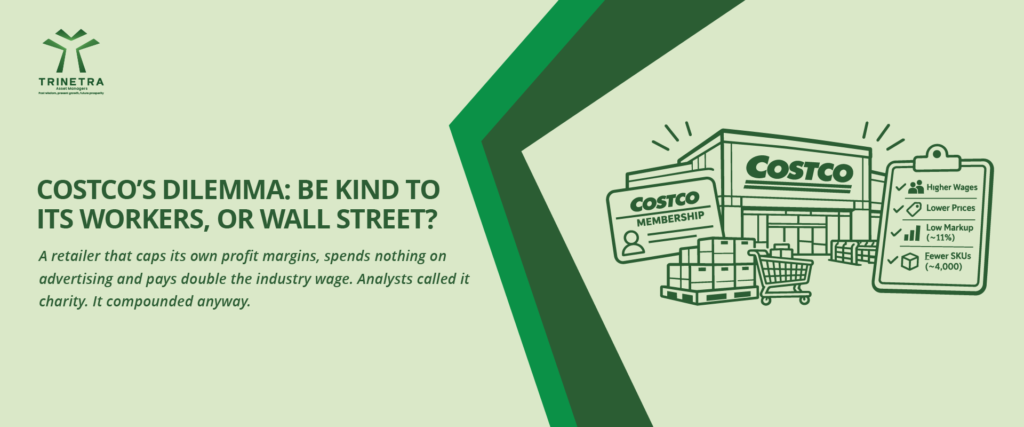
A retailer that caps its own profit margins, spends nothing on advertising and pays double the industry wage. Analysts called it charity. It compounded anyway.
Costco makes most of its operating profit from membership fees and runs the actual shop at close to break-even. That inversion is why it can pay more, charge less and still compound. The model isn’t generosity. It’s arithmetic that only works if you hold every piece of it at once.
The headline that started the argument
In March 2004, The Wall Street Journal ran a headline that captured a growing debate across corporate America: “Costco’s Dilemma: Be Kind to Its Workers, or Wall Street?”
At the time, rival Walmart was under intense scrutiny for keeping hourly wages low and benefits minimal. Labour unions, economists and politicians kept pointing to Costco as the counter-argument: proof that a massive retail chain could pay significantly higher wages and still thrive.
The headline reflected a genuinely bitter sentiment on Wall Street. Analysts openly expressed frustration with management, accusing the company of leaving money on the table. By paying starting wages near double the industry average and funding healthcare for both full-time and part-time workers, the argument went, Costco was willingly trimming its own margins.
Under traditional shareholder value theory, a public company’s primary responsibility is to maximise immediate returns. Critics said Costco was effectively running a charity for its staff at investors’ expense.
Long-term investors were unbothered. They recognised what short-term traders missed. Costco wasn’t being reckless or soft-hearted. It was executing a carefully calculated model designed for compounding over decades rather than quarters.
The birth of the subversive membership model
Costco’s operating model didn’t happen by accident. Its foundation was laid decades earlier by Sol Price, a lawyer turned retail innovator.
In the mid-1950s, retail was governed by strict manufacturer price controls. Under fair trade laws, manufacturers could legally dictate minimum selling prices. Retailers were prohibited from discounting below those floors, even if their operations were efficient enough to do so profitably.
Price identified a loophole while founding FedMart. Price-floor regulations applied to retail sales open to the general public. They did not cover private buying clubs.
By requiring customers to pay an annual membership fee for entry, FedMart lawfully operated as a private club, and could sell well below manufacturer floor prices.
When Price launched Price Club in 1976, he found something bigger. Membership fees weren’t merely a legal workaround. They were a recurring profit engine.
Because subscription fees generated substantial, predictable, high-margin revenue upfront, the business could deliberately forego traditional retail margins on merchandise and pass maximum savings back to members.
Jim Sinegal began his retail career at 18, working directly under Sol Price at FedMart, and followed him to Price Club. When Sinegal co-founded Costco in Seattle in 1983, he embedded Price’s philosophy into its DNA.
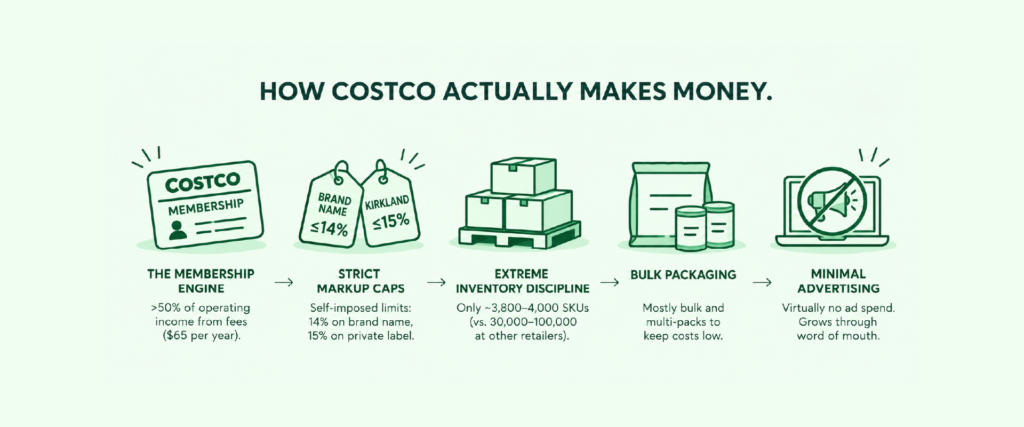
How Costco actually makes money
Costco’s financial engine runs on a fundamental inversion of retail mechanics. Most retailers buy cheap and mark up as high as the market will bear. Costco does the opposite.
The membership engine
More than half of Costco’s total operating income comes directly from annual membership fees, which start at $65 following the increase effective September 2024.
In FY2025, membership fee revenue reached $5.32 billion, up 10% from $4.83 billion the previous year. US renewal rates stood at 92.3%.
The warehouses, gas stations, food courts and pharmacies are designed to operate near break-even after expenses. Their job is to make the membership fee feel like an undeniable bargain.
Strict self-imposed markup caps
Supermarkets and department stores typically apply markups between 20% and 40%. Costco imposes a hard ceiling:
|
Product type |
Maximum markup |
|
Brand name products |
14% |
|
Kirkland Signature (private label) |
15% |
If Costco uses its scale to negotiate a lower purchase cost, it doesn’t pocket the difference. It lowers the shelf price.
The result shows up in the filings. Costco’s gross margin in FY2025 was 11.12%, across the entire business. For context, most grocery chains run gross margins in the high twenties, and general merchandise retailers are still higher.
That single figure is the strategy. A company that structurally refuses to earn more than eleven cents of gross margin on a dollar of sales, and makes its profit elsewhere.
Extreme inventory discipline
A typical supermarket carries 30,000 to 50,000 individual items. A Walmart Supercenter may stock over 100,000. Costco limits itself to roughly 3,800 to 4,000 SKUs.
By offering one or two high-volume options per category, two large containers of mayonnaise rather than twelve competing brands, Costco achieves enormous volume per item.
That gives it unmatched purchasing leverage over suppliers, while simplifying logistics, minimising stocking labour and lowering inventory holding costs.
Bulk packaging and minimal overhead
Products sell almost exclusively in bulk or multi-packs. Pallets move straight from delivery trucks onto warehouse floors with minimal handling.
And Costco spends virtually nothing on traditional advertising. No television campaigns, no large digital marketing budgets. It relies on word of mouth driven by customer satisfaction.
Every one of these decisions does the same thing: strips cost out of the system so the shelf price can stay low enough to justify the membership fee.
The human factor: investing in people
While analysts historically viewed high retail wages as an expense dragging down quarterly earnings, Costco’s leadership treated compensation as a high-return capital investment.
The company pays frontline staff well above retail averages and provides healthcare and retirement benefits to over 80% of its workforce.
The operational benefits are tangible:
Industry-low turnover. Standard retail turnover often runs between 60% and 100% annually. Costco’s drops below 10% after one year of service.
Savings on training and recruitment. Low turnover saves tens of millions annually in hiring, onboarding and retraining, while reducing shrink, the losses from theft, damage and administrative error, to a fraction of the industry average.
An internal promotion pipeline. Costco prioritises promoting from within. Current CEO Ron Vachris started more than 40 years ago as a forklift operator.
Sinegal addressed Wall Street’s demands with characteristic directness, noting that Wall Street is in the business of making money between now and next Thursday, while he wanted to build a company that would still be there fifty or sixty years out.
His position was that shareholder returns aren’t generated by squeezing employees or shortchanging customers. They’re the downstream result of a loyal workforce delivering exceptional value.
The strategy worked. Over the past two decades Costco stock has compounded at roughly 16 to 18% annually including dividends, consistently ahead of the broader market and well ahead of what its 2004 critics expected.
The model under pressure
Here’s the part that doesn’t appear in most retellings, and it matters.
Costco’s labour model isn’t a settled arrangement running on autopilot. It’s a live negotiation, and in early 2025 it nearly broke.
In January 2025, the International Brotherhood of Teamsters, which represents roughly 18,000 Costco workers across about 50 of the company’s 624 US stores, voted to authorise a strike. It would have been the largest strike ever at an American retail chain, and the first in Costco’s history.
The union’s argument was straightforward. Costco had just reported record net income of $7.4 billion in FY2024, up 17% and nearly double its 2019 figure, on revenue of about $249.6 billion. The Teamsters said the company had failed to bargain constructively and that wages hadn’t kept pace with that growth. Beyond pay, their demands covered seniority pay, paid family leave, bereavement policy, sick time and protections against workplace surveillance.
The day before the contract expired, Costco announced raises for its non-union employees: top of scale rising $1 to $30.20 an hour, with another dollar in each of the following two years, and starting pay up 50 cents to $20. Union members were excluded, pending their own contract.
A Teamsters spokesperson said the raises happened because of their pressure.
A tentative agreement arrived in the early hours after the deadline, and the strike was averted.
Why include this in a piece arguing the model works?
Because the alternative is a story about a company that discovered a permanent solution to the tension between workers and shareholders. It didn’t. Nobody has.
What Costco has is a model that makes high wages economically rational rather than philanthropic, which is a much more durable thing than goodwill. But rational doesn’t mean frictionless. At 624 US stores and record profits, the question of how the gains get split is still contested, still negotiated, and still capable of producing a near-strike.
If anything, that strengthens the original argument. A strategy that has to be actively defended against its own success is a strategy. A company that never faces the question probably isn’t making enough money for anyone to argue about.
An unshakeable competitive moat
The membership model is widely understood across business schools, yet competitors rarely attempt to replicate it in full.
|
Structural barrier |
Why competitors cannot easily replicate it |
|
Capital and scale |
Operating at a 14% markup cap requires immense volume to stay profitable. Smaller retailers cannot achieve the purchasing scale to negotiate rock-bottom supplier pricing |
|
Short-term market pressure |
An established listed chain cannot shift to a low-markup model without an immediate, multi-year drop in operating margins, which would trigger intense investor pressure |
|
Decades of consumer trust |
Asking customers to pay upfront for access requires confidence that savings will exceed the fee. Costco built that over forty years. New entrants cannot manufacture it |
|
System alignment |
Success relies on every component working together: bulk packaging, restricted SKUs, membership fees, high wages, minimal advertising. Adopting one element without the rest fails |
That last row is the real moat. Any single piece of this is copyable. The combination requires accepting lower reported margins for years before the flywheel turns, and most listed companies cannot survive the wait.
Does this travel to India?
The obvious domestic comparison is DMart, operated by Avenue Supermarts.
The similarities are real. DMart runs an everyday-low-price model built on deliberately thin margins, a tightly controlled assortment, ownership rather than leasing of most stores to keep occupancy costs down, and famously low advertising spend. Like Costco, it treats low price as the product and operational discipline as the moat. Like Costco, it has been criticised by analysts for choosing volume and price over margin expansion.
The differences matter just as much.
DMart carries no membership fee, so it has no equivalent high-margin recurring revenue stream subsidising the shop floor. Its profit has to come from the merchandise itself, which means its markup discipline is a competitive choice rather than a structural one. And Indian retail labour economics differ enough that the wage argument doesn’t transfer directly.
The transferable lesson isn’t the membership fee. It’s the underlying principle both companies share: a retailer can build a durable advantage by deliberately refusing to maximise margin, provided every other part of the operation is built to support that choice.
What Costco adds to the Indian reader’s understanding is where the profit can come from instead. The membership fee isn’t a loyalty programme. It’s the reason the rest of the model is possible.
Conclusion
Costco’s history demonstrates that prioritising employees and customers over quarterly profit targets isn’t naive management or corporate charity.
It’s a strategy, and a demanding one. It requires holding every component in place simultaneously, accepting lower reported margins than peers, and defending the arrangement against pressure from analysts, competitors and sometimes your own workforce.
The 2004 critics weren’t stupid. By the logic they were applying, Costco genuinely was leaving money on the table.
They were just measuring the wrong table.
Disclaimer:
This article is for informational and educational purposes only. It is not investment advice, and nothing here is a recommendation to buy or sell any security. Financial data is drawn from company filings for the periods stated and changes over time. Please consult a SEBI-registered investment adviser before making financial decisions.
Sources:
Costco Wholesale Corporation Form 10-K, FY2025; The Wall Street Journal, March 2004; contemporaneous reporting on the 2025 Teamsters negotiations.