
What 2020 Taught Us About Markets, Money and the Human Mind
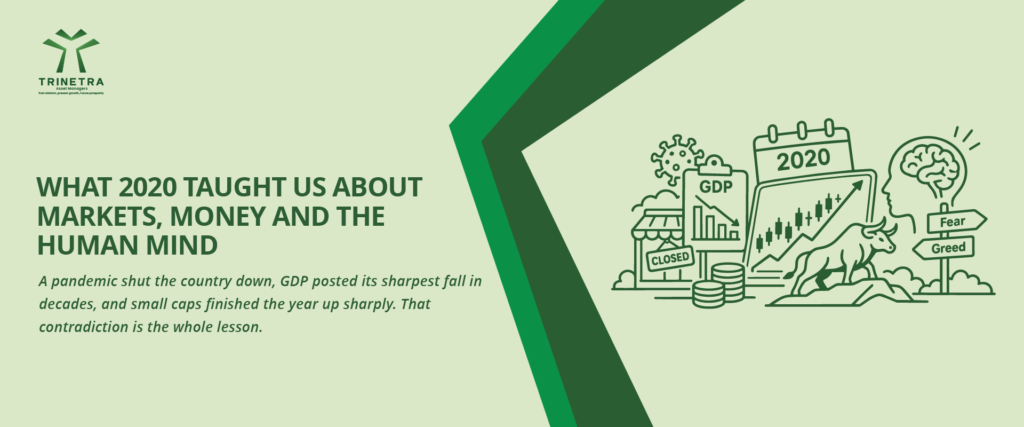
A pandemic shut the country down, GDP posted its sharpest fall in decades, and small caps finished the year up sharply. That contradiction is the whole lesson.
The economy and the stock market are not the same machine. Markets are adaptive systems where any pattern dissolves the moment enough people spot it. What doesn’t change is how humans behave under fear and greed, which is why studying the last crisis teaches you less than studying yourself.
Every investor should sit with one fact from 2020: Indian small caps finished the year substantially higher, with major small cap indices gaining somewhere between a fifth and a third over the calendar year, and far more than that measured from the March low.
Now put that next to what actually happened.
A pandemic shut down the country. GDP posted its sharpest fall in decades. Millions lost their jobs overnight.
If you had known all of this in January, you would probably have sold everything and run for cash. And you would have been badly wrong to do it.
That’s the whole puzzle of markets in one example. The economy and the stock market are not the same machine, and 2020 is the clearest proof anyone could ask for.
There’s a second number worth remembering from that year, and it matters more than the headline recovery.
During the crash, the Nifty fell by something close to 37% peak to trough. A well-constructed portfolio might have fallen considerably less, perhaps in the mid-twenties.
That gap does two things. Losing less means you need a smaller bounce just to get back to even. And it means you’re sitting on more capital by the time the rebound actually arrives.
Anyone can make money in a rising market. What separates portfolios is how much they give up when markets fall apart.
Your brain is the wrong tool for this job
Think about how you were taught to think in school.
Newton’s laws. Every action has an equal and opposite reaction. Push something and it moves in a way you can calculate in advance.
Most of classical economics, and most investing frameworks people are taught, run on that same idea. Find the right formula, feed in the numbers, get a clean answer out.
Markets don’t play by that rulebook. If anything they behave more like a colony of ants than a physics equation.
There’s a name for this in the sciences: a complex adaptive system. It describes any network where the participants are constantly watching each other, learning from each other, and adjusting their behaviour in response.
Ant colonies work this way. So do ecosystems, political systems, and stock markets.
The defining feature is that the whole is never just the sum of the parts, because the parts never stop reacting to one another.
Which is also why any strategy that seems to always work eventually stops working. The moment enough people catch on and start moving early, the edge disappears. Not because the logic was wrong, but because the logic got crowded.
You could watch this happen in real time from March 2020.
Analysts kept pointing to historical data showing markets typically bounce hard once they’ve recovered two-thirds of a crash. That view became so widely accepted that a great deal of money had already been positioned for the bounce well before it arrived.
So when the rally came, it didn’t stop politely at the levels everyone expected. It blew straight through them, because the market was one step ahead of the very pattern everyone thought they’d spotted.
Why patterns keep dissolving
Sir John Templeton had a warning for exactly this kind of thinking. He called “this time it’s different” the four most dangerous words in investing.
But notice what that warning actually implies. Markets almost never repeat themselves cleanly, because by the time everyone has noticed a pattern, the market has priced it in and moved past it.
So if patterns keep dissolving, what’s worth studying?
Not the specific shape of the last crisis. The one thing that genuinely doesn’t change: human behaviour under fear and greed. The trigger is always new. The panic and the euphoria that follow look remarkably similar every single time.
There’s a related trap worth naming. Economists had been warning about excessive global debt and money printing since 2011.
Risk that everyone is already staring at rarely turns out to be the thing that triggers a crash, precisely because the market has already adjusted for it. History suggests the next real shock tends to come from somewhere nobody is currently looking.
Which is an uncomfortable thought, because it means the quality of your worry list is a poor guide to your actual exposure.
Two honest cases for India, both at once
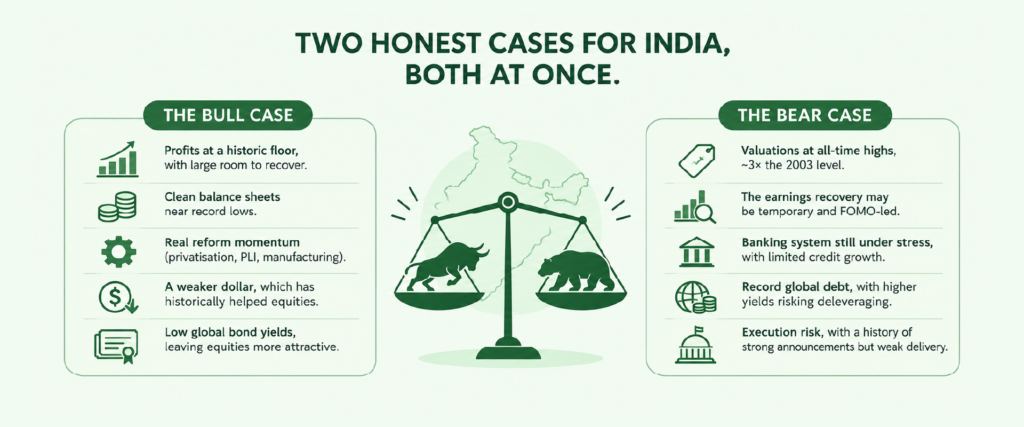
Around the time of the 2020 recovery, two well-reasoned and directly opposing views on Indian markets were circulating. Both were serious, and both were held by thoughtful people.
The bull case
Corporate profits were at a historic floor. They sat at roughly 1.8% of GDP in FY20, far below the peak seen in FY08, which meant enormous room for earnings to recover from a depressed base.
Balance sheets were the cleanest in modern history. Net debt-to-equity across corporate India sat near record lows.
Reform momentum was real. Privatisation, production-linked incentive schemes, and a genuine attempt at turning India into a manufacturing base for global supply chains.
The dollar had broken a ten-year uptrend. Equities have historically done well when the dollar weakens.
And bond yields were on the floor globally, leaving equities as one of the few places offering investors a real return.
The bear case
Valuations were at all-time highs. Nifty multiples sat at more than three times where they stood in 2003, when the last great bull run began.
The earnings recovery might be an illusion. What looked like growth could easily be temporary cost cutting dressed up as growth, with fear of missing out doing more work than fundamentals.
The banking system was still under real stress. Without credit growth picking up, both GDP and corporate earnings had a ceiling on them.
Global debt was at record levels, and rising bond yields could tip into a painful deleveraging spiral.
And the government had formed. A long history of strong announcements followed by weak execution.
The comparison hiding underneath
There’s a useful distinction buried in that argument, and it concerns how the two bull markets were financed.
The 2008 run was fuelled by a heavily leveraged corporate India. Companies borrowed aggressively to grow fast, and when the music stopped the pain was severe and the recovery slow, because the following decade went into repairing balance sheets rather than expanding them.
By 2020 that deleveraging was already behind corporate India. The balance sheet was clean, the interest burden manageable, and cash flow from operations as a share of profits had climbed to its highest point since 2003.
That last figure matters more than it sounds. It’s a sign that the earnings sitting on the books were real cash rather than accounting sleight of hand.
Look at 2020’s P/E next to 2008’s in isolation and stocks look expensive. Account for cash generation running at roughly double the level, and the comparison stops being fair.
The reform window nobody expected
One of the more underrated stories of 2020 is what the crisis quietly allowed the government to do.
Covid provided political cover for reforms that had struggled against resistance in calmer years. Corporate tax cuts, PLI schemes, labour reform, changes to farm laws, and a real push on PSU privatisation, much of it announced or accelerated inside a single window.
What’s more surprising is that bond markets and rating agencies let it pass. India ran a double-digit fiscal deficit and wasn’t punished for it the way it likely would have been before the pandemic, which gave the finance minister room to be considerably bolder than usual.
So which case was right?
Here’s where the benefit of hindsight earns its keep, and the answer is clearer than anyone expected at the time.
The bull case won, and its central argument won decisively.
Corporate profit as a share of GDP, the optimists’ first and strongest point, went like this:
|
Year |
Profit to GDP, Nifty 500 |
|
FY20 |
~1.8%, a two-decade low |
|
FY23 |
4.0% |
|
FY24 |
4.8%, a 15-year high |
|
FY25 |
4.7%, a 17-year high |
Corporate profits grew 30.5% year on year in FY24, then another 10.5% in FY25. For the full listed universe the ratio reached 5.1%, a 14-year high. Mid-cap profit-to-GDP rose more than six times from the 2020 lows.
The recovery from a low base was not just real. It ran for four consecutive years.
And the bears’ sharpest objection got answered directly. They argued the recovery would turn out to be temporary cost cutting rather than genuine growth. Motilal Oswal’s FY25 analysis notes that for the first time in many years, corporate earnings are tracking GDP growth rather than running ahead of it through margin expansion. That’s the signature of real volume-driven growth, not a one-off squeeze on costs.
Now the part that keeps this honest.
The bull case was right, but not entirely for the reasons it gave.
The dollar argument did not play out as a straight line. The reform execution was uneven, exactly as the bears predicted it would be, and several of the flagship items delivered considerably less than announced. The banking stress the bears worried about resolved, but through a credit cycle nobody could have forecast in 2020.
And the valuation concern never actually went away. It was outrun by earnings rather than disproved.
The ratio was also flat between FY24 and FY25. The easy phase of the recovery is behind us. The bears were wrong about the direction and may yet be right about the ceiling.
Which is the point this article has been making throughout. Two sets of intelligent people looked at the same facts and reached opposite conclusions. One turned out closer to the right. Neither predicted the mechanism, and the person who simply held good businesses did better than either side’s forecast would have suggested.
What this actually means for how you invest
Nobody can reliably call market cycles in advance. Too many moving parts, and the way they react to each other makes clean prediction close to impossible.
The 2003 to 2007 bull run needed a very specific set of global conditions to line up simultaneously. Today’s setup, with a more cautious banking system, more disciplined lending and a different global backdrop, simply isn’t the same animal.
What is within reach is a narrower and far more dependable set of things to focus on.
Management teams with a real track record. Businesses built on genuine competitive advantages. Balance sheets sturdy enough to survive a downturn without breaking. Valuations that still leave room for error.
Markets themselves will keep behaving in ways that are adaptive, reflexive and frequently confusing. Good businesses, run well, in growing industries, compound in ways that are far more predictable over a long enough stretch.
Timing the economy is close to a losing game. Backing well-run businesses for the long haul is something you can actually do with confidence, and sleep while doing it.
The economy and the markets are not the same thing. The sooner you stop trying to read one by watching the other, the better an investor you’re likely to become.
And if you’re building a worry list for the next crisis, remember what 2020 actually demonstrated. The thing that breaks the market is almost never the thing already on everyone’s list.
Disclaimer:
This article is for informational and educational purposes only. It is not investment advice, and nothing here is a recommendation to buy or sell any security. Market and economic data are as of the periods stated and change over time. Past performance does not indicate future results. Please consult a SEBI-registered investment adviser before making financial decisions.
Sources:
Motilal Oswal India Strategy, corporate profit-to-GDP analysis, FY24 and FY25; publicly available index and economic data.