
What Warren Buffett Told a Room Full of Students in 1994
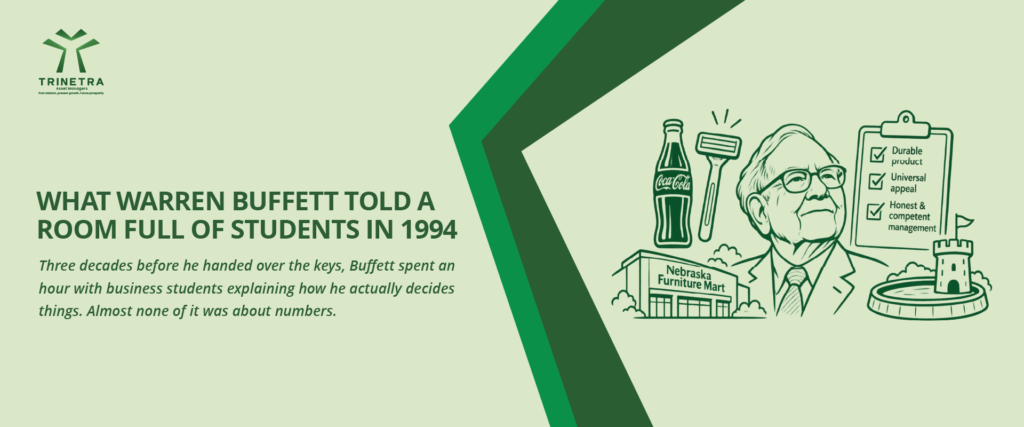
Three decades before he handed over the keys, Buffett spent an hour with business students explaining how he actually decides things. Almost none of it was about numbers.
Buffett hired the most important person of his career without reading a resume, bought a furniture business on a handshake and a $1,400 legal bill, and told a room of MBA students that the thing separating people who compound and people who don’t is habits, not talent.
In August 1991, Warren Buffett took a phone call before sunrise.
Salomon Brothers, one of the largest bond trading firms on Wall Street, had just been told by the New York Fed that its entire top leadership had to go. Immediately.
Berkshire Hathaway held a large stake. So Buffett, who ran his own office with about ten people in it, flew to New York to stop a $150 billion balance sheet from coming apart.
Of that $150 billion, only $4 billion was actual equity. The remaining $146 billion was owed to someone else, and a dangerous slice of it could be called back within weeks.
He had to find someone capable of running an 8,000-person firm by Monday morning. One shot.
Three years later, he told the story to business students at the University of North Carolina, and used it to explain how he makes almost every decision that matters.
The most important hire of his life
Buffett interviewed around twelve people that evening. He knew four or five by sight.
He never looked at a single resume. He never asked about grades or which business school anyone attended.
Everyone in the room already had the intelligence. Nobody climbs that high at a Wall Street trading firm without being sharp enough to understand the products and the markets. What Buffett was watching for was character: whether someone came across as full of themselves, whether they’d hold up under real pressure, whether they’d give credit away before taking it.
He picked Deryck Maughan. Walked over, tapped him on the chest, told him “you’re it.”
Twenty minutes later Maughan was standing in front of 200 reporters with almost no warning that he was about to run the company.
Over the following month, Buffett noticed something. Maughan never once raised the subject of his own pay. He simply worked 18-hour days and, as Buffett put it, had a knack for knowing exactly what to bring to his attention and what not to bother him with.
The lottery ticket thought experiment
That story led Buffett into an exercise he liked running with students.
Imagine you find a lottery ticket under your seat. The prize is the right to pick any one classmate and receive 10% of their earnings for life. You have one hour to decide.
Would you pick the person with the best grades? Probably not. The highest IQ? Not really. The best looking? Definitely not.
Given that hour, almost everyone picks on character. People who are reliable. Generous with credit. Careful not to cut corners. Who quietly deliver slightly more than they promised.
And none of that requires talent you don’t already have. It isn’t like being able to jump seven feet or win an Olympic race. It’s a habit.
The earlier you start building good ones, the easier they stick, because as Buffett likes to quote: the chains of habit are too light to feel until they’re too heavy to break.
Rose Blumkin’s one-page contract
Rose Blumkin arrived in Seattle from Russia unable to speak English, with a tag around her neck so the Red Cross could keep track of her.
She settled in Omaha and started a furniture store with $500.
By the time Buffett told this story, she was approaching 101, still working seven days a week, and her single Omaha store was turning over around $230 million a year. More than double what any other single-location furniture retailer in the country was doing.
She also couldn’t read.
Give her a room’s dimensions in feet and she’d work out the square yardage in her head, multiply by price per yard, add sales tax, and quote you a number on the spot. Usually knocking a bit off because she liked you.
When Berkshire bought the Nebraska Furniture Mart from her, the entire legal and accounting bill came to $1,400.
Buffett never checked the property records on the 60 acres the store sat on. He trusted that whatever Rose Blumkin told him was true, and built the deal on that.
Which is the point. A simple business run by someone you trust completely can be a far easier bet than a complicated business you only half understand.
Coke, Gillette, and the idea of a moat
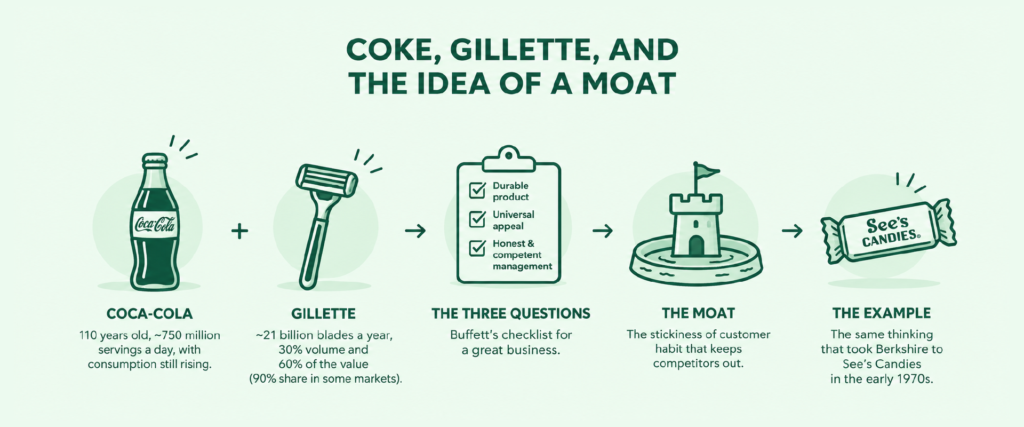
Buffett’s favourite example was Coca-Cola. A company 110 years old at the time, selling around 750 million eight-ounce servings a day, with consumption still climbing in nearly every country it operated in.
He said his whole process comes down to three questions.
Is the product durable? Is the appeal universal? Is management honest and competent?
For Coke, all three were yes. He liked quoting Peter Lynch’s line about wanting a business so good that any fool could run it, because sooner or later one will.
Gillette made the related point about moats. Around 21 billion razor blades get used worldwide every year. Gillette made 30% of that volume and captured 60% of the value, with 90% market share in some countries.
For roughly $20 a year, a man gets a decent daily shave and has little reason to switch once he’s happy. That stickiness, combined with distribution muscle, is what Buffett means by franchise value. A moat that keeps competitors out through a grip on customer habit rather than through price.
His test for it was almost childishly simple. If a store is out of Hershey bars and offers you an unmarked chocolate bar instead, would you walk across the street for Hershey? Would you pay a nickel more?
If yes, that’s a franchise.
It’s exactly the thinking that took Berkshire to See’s Candies in the early 1970s.
Why he never sells, and never splits the stock
A student asked the obvious follow-up. If you find a business that is good, when do you sell it?
His answer was that the right time to sell a truly wonderful business is almost never.
He admitted it took him years to learn this and that he still hadn’t fully mastered it. But the logic was straightforward. Once you’re convinced the long-term economics are excellent, selling because the price looks a little rich is usually a mistake, mostly because you’re unlikely to find another business that good to put the money into.
The same thinking explains one of Berkshire’s odder habits. It has never split its stock, even as the price climbed from around $12 in 1965 to over $25,000 by 1995.
Anyone can buy shares in a public company. But a split, he argued, tends to attract people chasing short-term price moves rather than long-term owners. By keeping the price high and never splitting, Buffett was filtering for shareholders who think like owners rather than traders.
He compared it to booking a concert hall. You can host a rock show or a ballet. Both crowds are fine on their own. You just don’t want to advertise one and end up with the other.
The mistakes he actually regrets
Around 1988 he seriously considered buying Fannie Mae and, for reasons he couldn’t fully explain even to himself, never pulled the trigger. By his own estimate that hesitation cost about a billion and a half dollars.
Then Disney, which is the better story.
In 1966 the entire Walt Disney Company, debt free, was valued at $80 million. Buffett, then 35 and running the Buffett Partnership rather than Berkshire, put in $4 million for a 5% stake. He sold roughly a year later for about $6.2 million.
A 50% gain in twelve months. At the time it looked like a good trade.
That same 5% stake would have been worth close to a billion dollars by 1994, and vastly more since.
At the time he bought it, Disney owned 300 acres in Anaheim drawing nine million visitors a year, and had roughly 200 films already sitting in its library. The library alone was arguably worth more than the price of the whole company.
And then US Air, which he summed up in two words: temporary insanity.
This one is worth sitting with, because it’s a rare case of Buffett going directly against his own stated rules. He had written, years earlier, that the airline business was one of the toughest around, pointing out that since the Wright brothers first flew, the entire US airline industry had collectively returned less than zero to its owners despite swallowing billions in capital.
And then in 1989, sitting on a pile of cash, he bought it anyway.
His fix afterwards was a joke about an imaginary hotline he’d call whenever the urge returned. He’d say his name was Warren, he was an airaholic, and someone would talk him down.
What he actually thinks about the stock market
Buffett treated forecasting the market, and interest rates, as something he simply didn’t know how to do and had no interest in learning.
His real test was always whether he’d make the same decision if the company were private, with no way to ever resell it.
Would he have bought 5% of Disney in 1966 if it had no public listing at all?
Yes. Because the answer depended entirely on what he thought Disney’s business would do over time, not on what the stock market might feel like doing tomorrow.
That single question strips out almost everything investors worry about. No charts, no sentiment, no exit plan. Just: is this a business I want to own a piece of.
On banks, going global, and leaving money to his kids
On bank mergers, he was sceptical that bigger automatically means better. He mentioned a small bank Berkshire once owned in Rockford, Illinois, which earned 2% on assets after tax and ran conservatively across the board. Folding it into a larger institution would probably make it earn less rather than more, since the real economies of scale in banking taper off well before the size most acquirers chase.
On investing outside the US, he said he’d happily buy a great business anywhere in the world, but admitted to having a mild home-field bias. He understood American accounting and corporate governance a little better, and given that the US equity market alone was worth around five trillion dollars at the time, he saw little logic in assuming a few thousand miles of distance would suddenly make him a sharper investor.
And on leaving money to his children, he gave one of his most quoted lines: leave them enough to do anything, but not so much that they end up doing nothing.
He drew a pointed comparison to a debate he often heard at the country club, where people worried that welfare created dependency while never applying the same worry to a large trust fund. To Buffett, both amount to the same thing. A lifetime supply of food stamps, handed out by a trust officer instead of a welfare officer.
He was also careful to credit a large share of his own success to the country and the system he happened to be born into, noting that the same talent dropped into Bangladesh or Peru would likely have produced a very different life.
The takeaway
Hire and partner with people based on character, not credentials.
Invest only inside the edges of what you genuinely understand.
Look for businesses with real moats, the kind customers would walk across the street for.
Once you’ve found one, hold on tight, because they’re too rare to trade away over a bit of short-term price noise.
And treat the stock market as background chatter you’re under no obligation to predict.
A note on when this was said. Buffett gave this lecture in 1994. He stepped down as Berkshire’s chief executive at the end of 2025, handing over to Greg Abel after 55 years, and relinquished the chairmanship the following year.
Which makes the lottery ticket exercise land differently now than it did then. He was asking students to pick someone they’d bet on for life based on habits rather than credentials. Thirty years later, the succession he spent decades preparing for came down to exactly the same judgment.
This article summarises publicly available remarks made by Warren Buffett at the University of North Carolina in 1994. It is for informational and educational purposes only, is not investment advice, and is not a recommendation regarding any security. Figures and company details relate to the period discussed. Please consult a SEBI-registered investment adviser before making financial decisions.
Source: Warren Buffett, lecture at the University of North Carolina Kenan-Flagler Business School, 1994, recorded by PBS and released as Warren Buffett Talks Business.