
Thinking in Bets: A Poker Champion’s Guide to Better Decisions
A good decision and a good outcome are different things. Almost nobody can tell them apart at the moment.
Investing is poker, not chess. You act on partial information, assign rough odds, and live with the fact that a well-reasoned decision can still lose money. Annie Duke’s framework is about judging the quality of your thinking separately from the quality of the result, which turns out to be far harder than it sounds.
The worst play call in football history
Super Bowl XLIX. Twenty-six seconds on the clock.
The Seattle Seahawks are trailing the New England Patriots by four points, sitting on the Patriots’ one-yard line. Second down. One timeout remaining. In the backfield is Marshawn Lynch, one of the most effective short-yardage runners in the game.
Coach Pete Carroll calls for a pass.
Malcolm Butler intercepts it in the end zone. Seattle loses the Super Bowl.
The reaction was immediate and brutal. Commentators called it the worst play call in football history. The decision followed Carroll for years.
Annie Duke opens her book with this story, and argues the critics were wrong.
Not about the outcome, which was catastrophic. About the decision. With the clock and timeout situation as they were, a pass preserved options that a run wouldn’t have. Interceptions in that specific situation were historically rare. The call was defensible, arguably correct, and it produced one of the worst outcomes in Super Bowl history.
Almost nobody could see the difference, because the outcome was so vivid that it swallowed everything else.
That gap, between the quality of a decision and the quality of what happened next, is what this entire framework is about.
Why poker, not chess
Annie Duke spent two decades as a professional poker player. She won a World Series of Poker gold bracelet in 2004, took the WSOP Tournament of Champions the same year, won the NBC National Heads-Up Poker Championship in 2010, and accumulated over $4 million in tournament earnings.
She also holds a PhD in Cognitive Psychology from the University of Pennsylvania, completed in 2023 after she returned to finish doctoral work she had abandoned decades earlier when illness forced a leave of absence. She had originally gone to Penn on a National Science Foundation Fellowship.
Poker champion and academic, which is an unusual combination and explains why the book works.
Her central claim is simple and uncomfortable: most important decisions, including where we allocate capital, are not like chess. They’re like poker.
Chess is a game of complete information. Both players see the entire board. If you lose, you are outplayed. There’s no luck to hide behind and none to blame.
Poker is not. You act on a partial picture, estimate odds, and live with the fact that a well-reasoned decision can still lose. The best hand doesn’t always win. A terrible hand sometimes does.
Investing is unmistakably the second game. And that reframing changes almost everything about how a “good decision” should be judged.
Every decision is a bet on a future you can’t fully see
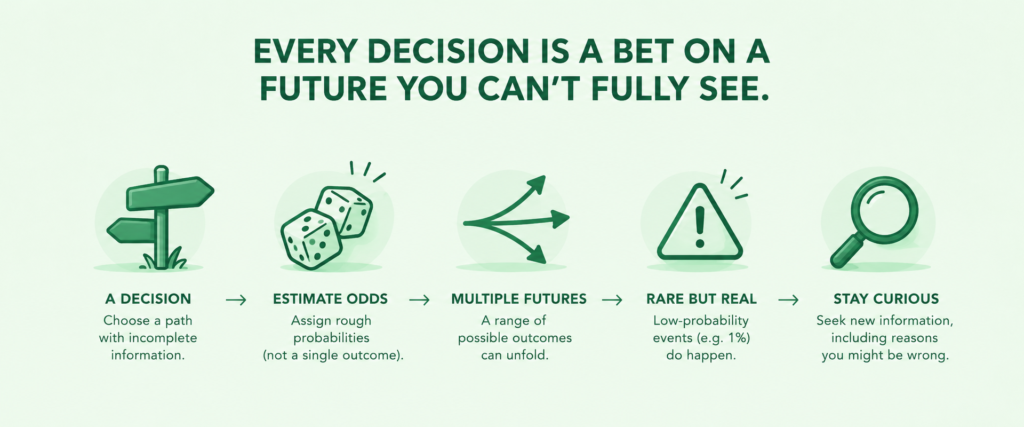
Duke’s starting point is that every decision is an attempt to estimate the probability of several possible futures.
You’re not predicting one outcome. You’re assigning rough odds across a range of them.
This rests on an honest admission: nobody has perfect information about anything. However carefully a problem has been researched, some part of the future remains genuinely unknown.
And a low-probability bad outcome can still happen. Something with a 1% chance occurs one time in a hundred, which over a long investing career means it will occur. Internalising that, rather than treating it as theoretical, is what pushes thinking into properly probabilistic territory.
The effect of taking uncertainty seriously is counterintuitive. It doesn’t make an investor more anxious. It makes them more curious.
Once you accept that you don’t have the full picture, you become hungrier for information and more open-minded. Not about why you might be right, which comes easily enough, but about why you might be wrong.
Duke describes a useful habit for this: asking what the other person knows that you don’t.
She also argues that saying “I’m not sure” is a strength rather than a weakness. In most professional settings, expressing uncertainty reads as incompetence. In a probabilistic world it’s simply accurate, and the people who can’t say it are the ones most likely to be blindsided.
Resulting, and the gravity well of outcomes
Poker players have a word for the Pete Carroll problem: resulting.
Resulting is the habit of judging the quality of a decision by the quality of its outcome. The decision worked, so it must have been smart. It failed, so it must have been stupid.
In poker this is obviously wrong. You can play a hand perfectly and lose, or play it terribly and win. Over a few hands, luck dominates. Over thousands, skill emerges. Everybody who plays seriously learns to separate the two, because the alternative is learning the wrong lesson every session.
In investing, almost nobody does.
Duke describes the final result as acting like a gravity well. Once an outcome is known, climbing back out to objectively assess whether the process was sound becomes extremely difficult.
A profitable trade feels like proof of a good process. A loss feels like proof of a bad one. Neither is necessarily true, and the pull of the outcome makes it hard to see past.
Her advice is to deliberately ignore the outcome when reviewing a decision. It feels unnatural, and it’s the only reliable way to separate the quality of your thinking from the result the market happened to deliver.
Worth being specific about what this means for an investor. A stock that rose 40% in a market that rose 35% is not a validated thesis. A stock that fell 20% after a sector-wide shock you explicitly identified as a risk is not a failure of analysis. In both cases the result tells you something about the world and almost nothing about your process.
“Wanna bet?”
Duke’s most quoted practical tool is also her simplest.
When someone states something as a fact, ask whether they’d bet on it.
The effect is immediate. Claims stated with total confidence suddenly acquire caveats. “The stock is definitely going to 500” becomes “well, probably, if the order book holds.” People instantly start calibrating, because money forces a distinction between what they believe and what they actually know.
You can run this on yourself. Before acting on a conviction, ask what odds you’d genuinely accept on it. If you’re certain a company will double in three years, would you take an even-money bet on that? If the honest answer is no, your conviction and your estimate have come apart, and the conviction is the part that’s wrong.
This is why the betting frame matters. Not because investing is gambling, but because a bet forces you to state a probability, and a stated probability can be checked later.
Find your own learning pod
Duke argues that group decision-making has a specific advantage: other people are far better at spotting our biases than we are, and we’re equally well placed to spot theirs.
Left alone, an investor’s blind spots stay blind. In a well-run group, they get surfaced.
The condition is that the group has to be built for accuracy rather than agreement. A group that exists to reassure each other is worse than no group at all, because it converts individual bias into collective conviction.
One structural technique she describes. Tell one colleague that a decision worked out well, and tell another that the same decision didn’t, then ask each to analyse it independently.
The two accounts will often look strikingly different. One searches for what was done right. The other for what went wrong. Merging the two produces a far more balanced read than either alone.
Duke draws a parallel to interview panels. When two people interview the same candidate, their assessments should stay separate until both are formed, rather than being discussed beforehand. Independent judgment compared afterwards avoids one person’s read quietly becoming the other’s consensus.
The same applies to an investment committee, or to asking two friends about a stock.
Deciding before the outcome exists
The most practical technique in the book involves doing the work while the future is still open.
Before committing capital, map out the range of possible outcomes, assign a rough probability to each, and note the payoff attached.
Duke describes two complementary versions:
|
Technique |
What you do |
|
Backcasting |
Imagine a future where the decision worked. Work backwards and identify what had to happen for it to succeed |
|
Premortem |
Imagine a future where it failed. Work backwards and identify what went wrong |
Most people only do the first, usually informally, which is why bull cases are more detailed than bear cases in nearly every investment memo ever written.
The premortem is the harder and more valuable one, because imagining a specific failure is a different cognitive act from acknowledging that failure is possible.
And it changes what happens when things go wrong. If the bad outcome arrives, it isn’t a shock. It was already a mapped possibility with a probability attached, which means you can adapt rather than panic. The investor who wrote down “this thesis breaks if the regulator changes the pricing rule” responds very differently to that headline than the one who never considered it.
Be selective: don’t bet on everything
A common misreading of “thinking in bets” is that it means a scattershot approach. Throw capital at many ideas and see what sticks.
Duke pushes back directly.
The point isn’t to throw spaghetti at the wall. It’s to ensure that every strand you do throw carries a genuine expected payoff.
Probabilistic thinking is a filter, not a licence. Recognising that you can’t be certain about anything is an argument for sizing positions carefully and passing on most opportunities, not for treating every idea as equally worth a punt.
Reasoning to be right versus reasoning to be accurate
Every investor will recognise the pattern. When we win, we credit skill. When we lose, we blame luck.
Flip the outcome to someone else and the attribution flips with it. Their win becomes luck. Their loss becomes a lack of skill.
This self-serving arrangement protects the ego at the direct expense of learning. You cannot improve a process you’ve already decided was correct.
Underneath it sits Duke’s central distinction.
Reasoning to be right means defending a position, filtering information to confirm what you already believe, and treating disagreement as a threat.
Reasoning to be accurate means being genuinely willing to update, including when it’s uncomfortable and especially when you’ve said the opposite publicly.
The two feel almost identical from the inside, which is what makes the first so dangerous.
Framing decisions as bets pushes thinking toward the second mode, because a bet has a settlement date. You find out. And once you’ve committed to a probability rather than a conviction, being wrong becomes information rather than an insult.
Putting it together
Duke’s framework comes down to five habits:
- Think probabilistically. You’re assigning odds across futures, not predicting one.
- Resist the result. Judge the decision, not the outcome. They’re different things.
- Use groups to expose blind spots, but only groups built for accuracy rather than agreement.
- Stay selective. Uncertainty is an argument for fewer bets, not more.
- Reason to be accurate, not to be right.
None of it is complicated to understand. All of it is difficult to practise, because every instinct you have runs the other way.
Pete Carroll made a defensible call and lost a Super Bowl. Somewhere in your portfolio is a position that went up for reasons you didn’t anticipate, and one that went down despite you being right about everything that mattered.
Knowing which is which is most of the work.
Disclaimer:
This article summarises ideas from Annie Duke’s book “Thinking in Bets: Making Smarter Decisions When You Don’t Have All the Facts” (2018) for informational and educational purposes. It is not investment advice, and nothing here is a recommendation regarding any security. Please consult a SEBI-registered investment adviser before making financial decisions.
Source:
Annie Duke, Thinking in Bets: Making Smarter Decisions When You Don’t Have All the Facts, Portfolio/Penguin (2018).