
The Story Market

A gold rush, a railway boom and an electric car bubble. The narrative was right every time. The investment wasn’t.
Markets don’t run on numbers alone. They run on shared stories, and a story can be entirely true while the investment built on it destroys you. The difference is almost always price and timing, which is exactly what a good narrative makes you stop asking about.
The men who sold the shovels
In January 1848, in the valley of Coloma, California, a carpenter named James W. Marshall was checking the tailrace, the shallow channel carrying water away from a local lumber mill.
In the water he noticed a few glittering flakes.
Within months that discovery had ignited one of the great episodes of mass human behaviour. Thousands abandoned homes, jobs and businesses. Farmers left their farms. Workers quit stable employment. Ships arrived carrying prospectors from across the world.
Newspapers printed stories of ordinary men becoming wealthy overnight, and the narrative travelled far faster than the facts ever did.
Most of those who rushed to California never got rich. They found brutal conditions, empty rivers and financial ruin.
But a few people looked at the same scene and saw something different. The wealth wasn’t in the ground. It was in the pockets of the people doing the digging.
Sam Brannan is the clearest example. A San Francisco merchant, he quietly bought up every shovel, pick and pan he could find, then walked through the streets holding a vial of gold dust and shouting about the discovery on the American River. He had cornered the supply before the crowd knew there was anything to buy. He became California’s first millionaire without ever panning for gold.
Levi Strauss arrived five years later, in 1853, and built a dry goods business supplying miners and the merchants who served them. The riveted denim trousers he’s remembered for came much later, patented with Jacob Davis in 1873, a full quarter century after Marshall’s discovery. The fortune came from supplying the rush, not from inventing jeans during it.
Others ignored the riverbeds entirely and built transport networks to move the crowd, or banking services to hold the money of the few who struck it rich.
The Gold Rush wasn’t just an economic event. It was a viral narrative. The people who made real money were the ones who stepped back from the story and built something to serve the behaviour it produced.
Markets still work this way.
Why human beings are wired for stories
In Sapiens, Yuval Noah Harari argues that humans rose from the middle of the food chain to dominance through one capability: flexible cooperation in very large numbers.
An individual human loses a fight with a chimpanzee. But no other animal can organise thousands of its kind toward a shared goal. Ants cooperate in millions, but rigidly, hardwired and unable to adapt. Chimpanzees adapt flexibly, but only in small groups where everyone knows everyone.
Which raises the question underneath modern civilisation. How do you get millions of strangers who have never met to build cities, obey laws and trade across oceans? How do you get them to trust governments, corporations, legal systems and financial markets?
Through shared belief. Harari’s argument is that humans are the only creatures who can create, communicate and collectively believe in things that don’t physically exist. Imagined realities. Shared myths.
These aren’t lies. They’re collective constructs that hold society together.
As long as enough people believe the same story, that story acquires real power. It coordinates energy, dictates behaviour at scale, and forms the invisible glue behind everything from religions to equity markets.
Consider the money in your account. A currency note has no intrinsic value. You can’t eat it, shelter under it or burn it for meaningful warmth. Its power rests entirely on a collective narrative. While society agrees to believe in it, the system works. When that belief breaks, it’s paper.
The same rule governs the stock market. Nobody clicking “buy” is purchasing a slice of present-day earnings alone. They’re buying a story about what the company becomes.
Sometimes the story turns into a blueprint. Sometimes it turns out to be a delusion. Often it’s both, in sequence.
Narrative economics: when stories spread like diseases
To connect human psychology with economic data, the Nobel laureate Robert Shiller developed a framework he called narrative economics.
He defines it as the study of how popular stories, especially those carrying human interest, emotion and a moral, spread through a population like a virus, changing shape as they travel and eventually driving real economic outcomes.
His best illustration is the recession.
Mainstream economics treats a recession as a mechanical problem: interest rates shifted, inventories adjusted, a supply shock hit. Shiller asks a different question.
Is the recession caused by the data, or is the data caused by the story?
A recession is simply millions of people independently deciding to spend less, freeze budgets and postpone investment at roughly the same time. Those decisions aren’t usually made after reading economic reports. They’re made after a frightening story starts circulating at dinner tables and on the news.
As the story spreads, people act defensively. They skip holidays, stop hiring, cut back on spending. And by acting on the story, the crowd manufactures the recession it was afraid of.
Shiller borrows the epidemiologist’s model directly. Three variables govern how far a narrative travels:
|
Variable |
What it means |
|
Susceptible population |
Investors or consumers open to believing a new idea |
|
Contagion rate |
How fast it spreads from person to person |
|
Recovery rate |
How quickly people lose interest, get bored, or see it disproved |
Many narratives compete at any moment. A story stays dominant for exactly as long as its contagion rate exceeds its recovery rate.
Which means a narrative doesn’t need to be true to persist. It needs to be interesting.
Railway Mania, 1840s
One of the earliest and most instructive examples of a narrative seizing an economy happened in Britain during the 1840s.
Railways were a genuinely revolutionary technology. They cut travel times dramatically, lowered the cost of moving goods, boosted industrial productivity and connected isolated towns.
Investors believed railways would permanently reshape society. They were completely right.
But as the story spread, business judgment evaporated.
New railway companies appeared almost daily. Newspapers printed accounts of ordinary people turning small investments into fortunes. Driven by fear of missing out, shopkeepers, doctors and aristocrats withdrew savings from secure accounts and poured them into speculative railway stock. Politicians promoted the expansion enthusiastically.
At the peak, investors stopped asking basic questions:
- Will this particular line generate actual cash profits?
- Is there enough passenger demand along this route to justify the track?
- Does laying rails through this terrain make any economic sense?
The story had become more persuasive than the arithmetic. Hundreds of unviable projects were funded, including competing companies laying parallel tracks between the same two towns.
When reality arrived in 1847, the collapse was severe. Demand for railway shares vanished, prices fell apart, and thousands of families were ruined.
And the narrative was never wrong. Railways did transform Britain over the following fifty years.
The error was in the speed, the short-term profitability and the ease of execution. Investors paid prices that required perfect success immediately, forgetting that a genuinely world-changing technology can still be a terrible investment at the wrong price.
The decentralised saviour: Bitcoin
Bitcoin is the modern masterpiece of narrative construction.
Mathematically, a single bitcoin has no intrinsic value in the traditional sense. It generates no earnings, pays no dividend, has no industrial utility and carries no sovereign backing.
Yet its price moved from fractions of a cent to tens of thousands of dollars, because it arrived wrapped in a layered story:
The anti-establishment hero. Born in the aftermath of the 2008 financial crisis, presented as an escape from central banks and government money printing.
Digital gold. A supply mathematically capped at 21 million coins, framed as an un-debasable store of value for a digital age.
The mysterious founder. The anonymous “Satoshi Nakamoto” added folklore, which captivated technologists and libertarians alike.
As the contagion rate exploded across forums, video platforms and eventually mainstream media, it generated enormous fear of missing out. People weren’t buying a software protocol. They were buying a ticket to a revolution.
And the story became self-fulfilling. More discussion drove the price up, which drove more coverage, which drew in more susceptible buyers.
Whether that narrative ultimately holds is still an open question, which is precisely what makes it a live example rather than a historical one.
The electric illusion: Rivian and Lucid
By late 2021, investors had suspended traditional valuation entirely, operating on a narrative that every new electric vehicle company was destined to become an industrial giant.
Rivian went public in November 2021 having produced fewer than 200 vehicles, with essentially no revenue. Within days its market value passed $150 billion, making a company that hadn’t yet scaled a factory worth more than Volkswagen, Ford or General Motors.
Lucid followed, reaching a valuation above $90 billion on the strength of prototypes and pre-orders.
The loop was self-reinforcing. Rising prices attracted media coverage. Coverage attracted retail investors. Retail buying pushed prices higher. Social media amplified stories of traders getting rich on EV options. Analysts raised targets to avoid looking out of touch.
Then execution arrived.
Building cars at scale turned out to be capital-intensive and difficult. Supply chains buckled. Rates rose. Battery material costs spiked. Demand growth slowed as early adopters filled their garages. Capital got expensive and profitability stayed years away.
What happened next is more instructive than the crash itself.
Lucid
|
Milestone |
Figure |
|
All-time high, Feb 2021 |
$580.50 split-adjusted |
|
Peak market cap |
Around $90 billion |
|
1-for-10 reverse split |
August 2025 |
|
Recent price |
Roughly $3 to $5 |
|
Recent market cap |
Roughly $1.2 to $2 billion |
|
Decline from peak |
Over 99% |
In FY2025 Lucid reported revenue around $1.4 billion against a net loss of roughly $2.7 billion. Its market capitalisation now sits at a fraction of what Saudi Arabia’s Public Investment Fund has put into it. The 2025 reverse split lifted the share price to around $20, and it fell back below $5 within months, setting repeated all-time lows.
Rivian
Rivian is the other half of the story, and it’s the half that matters.
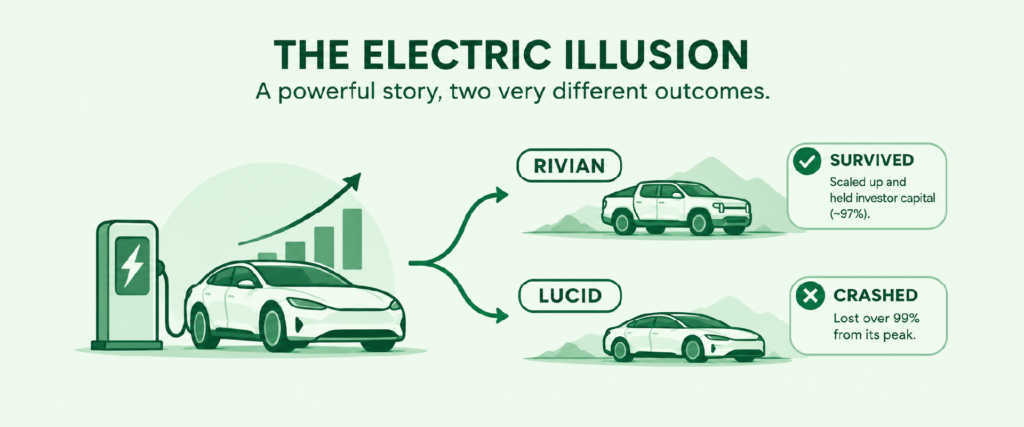
It trades around $12 to $18 with a market cap near $18 billion. Still far below the $150 billion peak, but it survived, achieved positive gross margin, and over one recent twelve-month period held roughly 97% of an investor’s capital while Lucid lost 84% of the same amount.
Same sector. Same thesis. Same macro conditions. Opposite outcomes.
That’s the lesson, and it’s sharper than “even a correct story can be a bad investment.”
The EV narrative was broadly right. Electric vehicles are taking share. But the narrative told you nothing whatsoever about which company would still be standing, because narratives operate at the level of sectors and themes, while survival happens at the level of balance sheets, gross margins and cash burn.
Believing the story correctly and losing 99% of your money are entirely compatible outcomes.
When a great story meets a terrible price
The greatest mistake available to an investor is confusing a great narrative with a great investment.
A business can have excellent products, visionary leadership and genuine industry potential, and still be a terrible investment if you buy at an irrational price. Market history is full of wonderful businesses that produced dreadful returns for years because investors paid for perfection.
Microsoft, 1999
By 1999, Microsoft was a juggernaut. It dominated personal computing through Windows and Office, ran enormous margins, held a pristine balance sheet and was led by a team nobody doubted.
The narrative was airtight: Microsoft owned the digital future.
Investors bid the stock to a split-adjusted peak near $59 in late December 1999, on a price-to-earnings ratio above 70.
Then Microsoft went and did exactly what the story promised. Over the following fifteen years it grew revenue substantially, grew profit consistently, and embedded itself deeper into global enterprise.
The stock went nowhere.
Someone who bought at the December 1999 peak waited until around 2016 to recover on share price alone, roughly seventeen years. Including reinvested dividends the breakeven arrives a couple of years earlier, but either way it’s the better part of two decades.
The business was wonderful. The investment was a disaster. Both things were true simultaneously, and the only variable separating them was the price paid.
What survives
Every market cycle carries its own dominant narrative.
In bull markets the story sounds intelligent, inevitable and revolutionary. In bear markets it shifts to structural decline and permanent pessimism.
Neither extreme lasts.
What’s striking about the examples here is how often the story was correct. Railways did transform Britain. Electric vehicles are taking share. Microsoft did own the digital future. The gold was genuinely in the ground.
Being right about the narrative was never the hard part.
The hard part was everything the narrative conveniently stopped you asking. What price am I paying? How long will this take? Which of these companies actually survives the transition? And what happens to my capital if the story is right but slower than everyone assumes?
Sam Brannan understood something the prospectors didn’t. He wasn’t sceptical about the gold. He simply noticed that a story spreading that fast creates a crowd, and a crowd needs shovels.
In the short run, stories move prices. Over the long run, economic reality has the final word.
Disclaimer:
This article is for informational and educational purposes only. It is not investment advice, and nothing here is a recommendation to buy or sell any security or asset. Companies are named as illustrations. Share prices and market data are as of the dates stated and change continuously. Please consult a SEBI-registered investment adviser before making financial decisions.
Sources:
Yuval Noah Harari, Sapiens; Robert J. Shiller, Narrative Economics (2019); company filings and contemporaneous reporting on Rivian, Lucid and Microsoft.