
The Markopolos Mindset: Reading the Numbers, Not the Story
Every major fraud came wrapped in a compelling narrative. The financial statements were telling a different one the whole time.
Long-term returns are determined less by finding extraordinary winners than by avoiding businesses that permanently destroy capital. The method is unglamorous: check whether reported profits turn into cash, whether receivables track revenue, and whether management’s actions match its words. Most investors skip it because the story is more interesting.
Every investor wants an edge. Yet long-term success is usually determined less by finding extraordinary winners than by consistently avoiding businesses that permanently destroy capital.
Indian equities have delivered attractive long-term returns, and a large proportion of retail investors still underperform the indices. That gap rarely comes from a lack of information. It comes from paying attention to narratives while ignoring the financial characteristics that actually determine business quality.
The analyst nobody listened to
In the late 1990s, a Boston-based analyst named Harry Markopolos was asked by his employer to reverse-engineer the investment strategy of a fund manager posting unusually smooth returns.
Markopolos, a Chartered Financial Analyst and Certified Fraud Examiner, spent an afternoon on the numbers and concluded the returns were mathematically impossible. The options positions required to generate them would have exceeded the total volume trading in the relevant market.
In 2005 he submitted a detailed report to the US Securities and Exchange Commission titled “The World’s Largest Hedge Fund is a Fraud.”
Nothing happened.
Bernie Madoff confessed in December 2008, during the financial crisis, after roughly $65 billion of client money had evaporated.
The Madoff case is remembered for the regulator’s failure. For investors, the more useful lesson is simpler and sits in how Markopolos approached the problem.
He didn’t investigate Madoff’s reputation, his client list, his social standing or his decades of credibility. He checked whether the numbers could physically be true.
Financial statements deserve more trust than management narratives. Stories change. Numbers eventually tell the truth.
A note on the man himself, for completeness. Markopolos’s most prominent work since Madoff was a 2019 report alleging $38 billion of accounting fraud at General Electric and predicting insolvency. GE did not go bankrupt, and the stock has risen substantially since. He was also paid by an undisclosed hedge fund holding a short position, taking a percentage of its trading profits, which he acknowledged publicly at the time. The Madoff analysis was remarkable. The checks below stand on their own merits rather than on his record.
The mindset, and what it isn’t
The mindset is his. The specific checks that follow are not, and they aren’t new. They’re standard forensic accounting applied to investment decisions, built on academic research going back decades.
What Markopolos contributed was the posture. Start somewhere unusual: not with growth projections or valuation multiples, but with a question.
Is this company’s reported performance supported by underlying cash generation, balance sheet strength and accounting quality?
The logic is that extraordinary claims require extraordinary evidence. A company consistently reporting exceptional growth, margins or returns should be able to demonstrate that performance through equally strong cash flows and transparent reporting.
If the numbers don’t support the narrative, investigate before you think about valuation.
This doesn’t assume every company is fraudulent. It requires verifying business quality before accepting management’s claims at face value.
[Image here]
Pillar one: revenue quality
Revenue growth is meaningful only when it reflects genuine business activity.
Companies can temporarily inflate reported sales through aggressive revenue recognition, extended credit terms, or transactions with related parties. These practices increase reported earnings without generating corresponding cash.
What to monitor:
- Whether trade receivables are growing faster than revenue
- Whether Days Sales Outstanding is rising consistently
- Whether reported growth materially exceeds industry trends without an operational explanation
Strong businesses convert revenue into cash. When sales keep rising while collections lag, the quality of those earnings needs examining.
Pillar two: earnings quality
Reported profits don’t always reflect economic reality. Accounting standards give management discretion over several non-cash items, which makes earnings susceptible to shaping. Cash flows are considerably harder to distort over extended periods.
The academic foundation here is Richard Sloan’s work on the accrual anomaly. His 1996 paper in The Accounting Review, “Do Stock Prices Fully Reflect Information in Accruals and Cash Flows About Future Earnings?”, found that the accrual component of earnings is less persistent than the cash component, and that investors systematically fail to price that difference.
The practical implication: companies whose operating cash flows consistently exceed reported earnings tend to outperform those with persistently high accruals. The finding has been among the most replicated in financial research, holding across markets and periods.
Sustainable earnings are supported by cash generation, not accounting adjustments. Persistent divergence between reported profit and operating cash flow is a warning signal.
Pillar three: cash flow analysis
Operating cash flow represents cash generated from core operations and gives a clearer picture of health than reported earnings alone.
Free cash flow, calculated after capital expenditure, shows what’s available for reinvestment, debt reduction or distributions. Businesses that consistently generate positive and growing free cash flow have more financial flexibility and more resilience.
The cash conversion ratio is the quickest single check available:
Cash Conversion Ratio = Operating Cash Flow ÷ Net Profit
|
Reading |
What it suggests |
|
Consistently above 1.0 |
High earnings quality, profits backed by cash |
|
Around 0.8 to 1.0 |
Generally healthy |
|
Repeatedly below 0.5 |
Warning. Reported profits aren’t arriving as cash |
One weak year has innocent explanations. Five consecutive years below 0.5 rarely does.
Pillar four: balance sheet strength and management
Leverage isn’t inherently problematic. Debt becomes a serious risk when it isn’t supported by sustainable cash flows.
A business that continually relies on borrowings to fund operations or expansion despite weak operating cash generation deserves scrutiny. Watch trends in net debt, debt relative to EBITDA, contingent liabilities and related-party transactions. Deterioration in any of these usually precedes visible stress.
Asset quality matters just as much. Excessive goodwill, unexplained advances, or large investments in related entities can conceal weaknesses that only emerge under pressure.
And then there’s management credibility, which is harder to quantify and just as important.
What matters is what promoters and management do, not what the investor presentation says.
- Are they buying or selling their own shares?
- Is promoter holding being pledged, which often signals personal financial stress?
- Do capital allocation decisions benefit all shareholders, or mainly insiders?
- Does delivery track past guidance?
A management team that guides conservatively and consistently delivers is worth a real premium over one that constantly revises forecasts downward while blaming external factors.
Why great stories often hide weak numbers
People are wired for narrative. A compelling story about revolutionary technology, a charismatic founder or an untapped market activates something a balance sheet ratio never will.
Nearly every major corporate fraud came wrapped in one.
Enron called itself the world’s most innovative company. Madoff was the quiet genius running a strategy nobody fully understood but everyone wanted access to. In India, Satyam Computers was a celebrated success story at a time when IT could do no wrong.
Each collapsed once reality caught up.
Market enthusiasm can sustain a share price well beyond what fundamentals support, but only for a while. When the story finally collides with the numbers, the correction tends to be swift and permanent.
Red flags worth never ignoring
|
Red flag |
What it suggests |
|
Rising trade receivables with flat cash conversion |
Revenue may be fictional or uncollectable |
|
Profit consistently outpacing operating cash flow |
Poor earnings quality, high accruals |
|
Frequent equity dilution without matching growth |
The business can’t fund itself internally |
|
Excessive debt growth while margins stay flat |
Financial engineering masking weak operations |
|
Unusual related-party transactions |
Possible fund diversion |
|
Sudden profit spikes without a clear driver |
One-time or manufactured earnings |
|
Rising promoter share pledging year over year |
Promoter under financial distress |
|
Frequent auditor changes or a mid-term resignation |
Management wants fewer questions asked |
When several appear together, the risk isn’t additive. One flag can usually be explained. Five or six inside the same company almost never can.
Case studies: where the framework would have helped
Satyam Computer Services, 2009
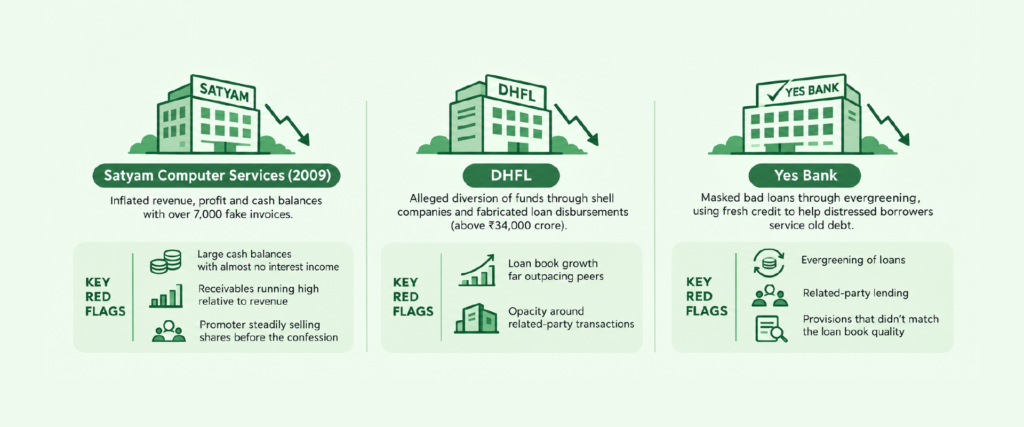
India’s largest corporate fraud at the time. Founder Ramalinga Raju confessed to inflating revenue, profit and cash balances over several years, with over 7,000 fake invoices created along the way. The stock crashed more than 70% in a single day, with investor losses estimated at around $2.82 billion.
The signals were sitting in the filings:
- Suspiciously large cash balances generating almost no interest income
- Receivables running high relative to revenue
- The promoter steadily selling shares across the three years before the confession
The cash yield check alone, comparing interest income against the stated balance, would have raised the question. Merrill Lynch, running acquisition due diligence, found the fraud within ten days. The company’s own auditors had missed it across nine years.
DHFL
Promoters allegedly diverted substantial sums through shell companies and fabricated loan disbursements. The CBI’s case put the figure above ₹34,000 crore.
The visible warning signs were loan book growth far outpacing peers, and an opacity around related-party transactions that resisted explanation.
Yes Bank
Founder Rana Kapoor masked bad loans through evergreening, using fresh credit to help distressed borrowers service old debt, concealing substantial stressed exposure while reported NPA ratios looked enviable next to peers.
A closer look at provisions, related-party lending and the actual quality of loan book growth would have told a different story.
In all three, a systematic review of cash flow, related-party disclosures and receivable trends would have raised serious questions years before collapse.
What long-term wealth creators tend to have in common
Applied constructively, the same mindset also identifies businesses genuinely building value.
India’s most consistent long-term compounders share a recognisable set of traits:
They generate consistent cash. Operating cash flow matches or exceeds reported earnings across cycles, and they don’t borrow to pay dividends or fund growth.
They earn high returns on capital. Sustained ROCE well above the cost of capital is the financial expression of a genuine competitive advantage.
They carry conservative balance sheets. Low or zero net debt, growth funded from internal accruals, which provides resilience and optionality in downturns.
Their management behaves honestly. Stable promoter ownership, no pledging, capital allocation that benefits all shareholders proportionally.
The Motilal Oswal Wealth Creation Study has repeatedly found that India’s most consistent compounders are overwhelmingly consumer-facing businesses with real pricing power and strong free cash flow. Which is to say, the ones that pass numerical tests most comfortably.
One caution on using past compounders as examples. Competitive advantage is never permanent. Businesses that sustained exceptional returns on capital for decades can face new competition that changes the picture quickly, as several Indian consumer names have discovered recently. The checks identify what quality looked like historically. They cannot guarantee that quality persists, which is why they need re-running rather than treating it as a one-time verdict.
Limitations worth keeping in mind
No approach is perfect.
A capital-intensive business in its investment phase may show weak free cash flow for years with nothing fraudulent happening. Building a plant consumes cash before it produces any.
Early-stage, high-growth companies naturally carry high accruals and may not generate meaningful cash for extended periods. A strict version of this checklist would have screened out several legitimate compounders in their early years.
Confirmation bias cuts both ways. Once a red flag is spotted, subsequent data gets unconsciously interpreted to support that initial read. This works as a systematic checklist, not as a story to confirm.
And quantitative analysis can’t capture everything: management quality, the depth of a moat, or the risk of a business model being disrupted.
The mindset works best paired with qualitative judgment, not as a replacement for it.
A practical checklist for retail investors
On cash flow
- Is operating cash flow consistently close to or above reported net profit over five years?
- Is free cash flow positive and growing?
- Is the cash conversion ratio typically above 0.8?
On earnings quality
- Are accruals low relative to total assets?
- Do receivables grow in line with, or slower than, revenue?
- Are there large “other income” items inflating reported profit?
On the balance sheet
- Is net debt declining or near zero?
- Are contingent liabilities clearly disclosed and manageable?
- Are there large, unexplained advances or loans to subsidiaries?
On governance
- Is promoter pledging absent or minimal?
- Has the auditor changed frequently, or resigned mid-term?
- Are related-party transactions small and clearly disclosed?
- Does management’s delivery track its past guidance?
On valuation
- Is the price supported by real cash generation rather than reported earnings?
- Does the growth story require assumptions that look unrealistic under scrutiny?
A company clearing most of these deserves further investigation. A company failing several deserves far more caution before any capital is committed.
Conclusion
Building meaningful wealth rarely requires spectacular decisions. It requires avoiding catastrophic ones.
The mathematics is unforgiving about permanent loss. A 50% drawdown needs a subsequent 100% gain just to break even. Avoiding that drawdown is worth more than catching the occasional ten-bagger.
Markopolos spent an afternoon working out that Madoff’s returns were impossible, then five years trying to get anyone to care. The analysis wasn’t the hard part. Looking at numbers that contradicted a story everyone wanted to believe was.
That’s the whole mindset. The market will always have compelling stories on offer. The work is checking whether the numbers are telling the same one.
Disclaimer:
This article is for informational and educational purposes only. It is not investment advice, and nothing here is a recommendation to buy or sell any security, nor an allegation about any company’s present conduct. Companies named as case studies are documented historical matters. Please consult a SEBI-registered investment adviser before making financial decisions.
Sources:
Richard G. Sloan, “Do Stock Prices Fully Reflect Information in Accruals and Cash Flows About Future Earnings?”, The Accounting Review (1996); Harry Markopolos, “The World’s Largest Hedge Fund is a Fraud,” submission to the SEC (2005); Motilal Oswal Wealth Creation Study; contemporaneous reporting on Satyam, DHFL and Yes Bank.