
The Invisible Work
Kobe scored 81 points in one night. The night took twenty years to build.
Markets celebrate outcomes and ignore preparation, the same way sport does. The confidence that lets an investor buy during a crash isn’t courage. It’s homework finished years earlier.
The night that changed everything
22 January 2006. Staples Center, Los Angeles. Just under 19,000 people in the building.
The opponent was the Toronto Raptors. The Lakers were struggling, down by as many as 18 points in the third quarter. The weight of the franchise sat on one man.
By halftime Kobe Bryant had 26 points. For most NBA players, 26 in a whole game is a headline.
He scored 55 more in the second half.
When the buzzer went, he had 81 points. It remains the second-highest scoring performance in NBA history, behind only Wilt Chamberlain’s 100 in 1962.
The sports world remembers the 81. What most people miss is what made that night possible.
Teammates and coaches later described a preparation routine that bordered on obsession. He didn’t show up and start hitting shots.
He was in the gym at 4am, before sunrise. He stayed late, long after everyone had gone home. He studied opponents the way a scientist studies a specimen, dissecting defensive patterns. He watched the same footage repeatedly, hunting for a fraction of a second of lag in a defender’s reaction. He practised identical footwork thousands of times in an empty gym until the movement stopped requiring thought.
The public saw one magical night. Kobe saw thousands of invisible hours.
Markets work the same way.
Financial media celebrates multibaggers, the stocks that rise 500% or 1,000% and make early investors wealthy. The public cheers the outcome. Nobody sees the quiet years of research, the tedious analysis of financial statements, or the discipline required to hold through a panic.
Preparation creates real confidence
Kobe’s teammates and Olympic rivals have told the same story for years: text messages arriving at 4am. He wasn’t finishing a late night. He was already drenched, halfway through his first session.
His reasoning was simple arithmetic. If he practised four hours a day while competitors practised two, the gap would eventually become uncloseable.
Investing runs on the same compounding logic. Which makes it odd that many retail investors spend more time researching a phone purchase than the companies holding their savings.
Professional investors spend weeks or months on a business before buying a share. They don’t check a chart to see whether the line is going up.
They read hundreds of pages of annual reports. They study industry structure to work out who holds the real power. They map competitors to find who has the lowest costs or the best product. They examine management incentives, checking whether executives are paid for value creation or for share price movement. They look at how excess capital gets allocated, and whether it goes into bad acquisitions or gets reinvested at high rates of return.
The confidence great investors show during a crash isn’t optimism. It’s preparation.
Buffett and Coca-Cola
Here’s the story most tellings get slightly wrong, and the correct version is better.
Buffett drank his first Coca-Cola around 1935 or 1936. In 1936 he was buying six-packs for 25 cents from his family’s grocery store and reselling individual bottles at five cents each.
He bought the stock in 1988.
Fifty-two years of watching.
Not immediately after Black Monday either, which is how the story usually gets told. The crash came in October 1987. Buffett began accumulating in the autumn of 1988, almost a year later, and finished in spring 1989.
He has been openly funny about the delay. In the 1989 shareholder letter he noted that the investment demonstrated the remarkable speed with which Berkshire’s president responds to opportunities, however obscure or well-disguised they may be. Elsewhere he described it as taking until the summer of 1988 for his brain to catch up with his eyes.
|
Detail |
Figure |
|
Initial investment |
~$1.02 billion |
|
Average price paid |
~$43.81 per share, or $3.25 split-adjusted |
|
Valuation |
Roughly 15x 1988 earnings |
|
Position size |
About 25% of Berkshire’s net worth |
|
Total stake by 1994 |
~$1.3 billion, 400 million shares |
|
Annual dividends today |
~$848 million |
That last row deserves a pause. The dividend alone now runs at roughly 65% of what Berkshire paid for the entire position. Every year.
What made it possible wasn’t the 1988 decision. By then Buffett had watched the product reach every corner of the world for five decades. He understood the brand, the distribution network, and the consumer habits. He knew that while technology and manufacturing businesses faced obsolescence, the human desire for a cold familiar drink was about as structurally permanent as anything in commerce.
So when the market finally offered Coca-Cola at 15 times earnings, there was no research to scramble through. The homework was fifty years old.
And then he held it for thirty-six years without selling a share.
Like Kobe at the free-throw line with the game on the line, the calm came from everything that happened before.
Review every decision dispassionately
Kobe watched game film obsessively. Not just after losses. More intensely after wins.
His reasoning was that success hides mistakes. You can play an inefficient game, blow defensive rotations, make poor decisions, and if teammates hit their shots and you win, the scoreline buries all of it.
Investors have the identical blind spot.
Buy a stock, watch it rise 50%, and most people feel a surge of competence. They conclude they understand markets.
But markets are chaotic. A stock can rise because the economy is booming, because rates are low, or because of luck. A rising market hides sloppy research the way a win hides bad defence.
The 2021 frenzy, and its sequel
During the post-pandemic boom, social media forums and zero-commission apps pulled millions of new investors into heavily shorted companies like GameStop and AMC, alongside speculative tokens. Prices moved by thousands of percent within weeks.
Traders woke up to portfolios up five or ten times. Many concluded their instincts were excellent and that they had found a permanent edge over Wall Street.
Then rates rose in 2022, the liquidity dried up, and those positions fell 80% to 90%, erasing the paper gains.
And here’s the part that makes the lesson stick. It happened again. In May 2024, when Keith Gill, the trader behind the original GameStop episode, resurfaced online, the stock surged again on the same dynamic with many of the same participants.
Three years later, after a full cycle of losses, the pattern repeated. Which tells you the problem was never a single moment of mania. It was a method of deciding.
The antidote is Kobe’s film room. Every time you buy a stock, write the thesis down before you buy it.
- Why are you buying this company now?
- What are your concrete assumptions about revenue growth and margins over five years?
- What specific risks could break this business?
Then, when the future arrives, compare it against what you wrote. Did the stock move for the reasons you predicted, or did you get lucky while the business underperformed?
That comparison is the only way a retail investor separates skill from luck, and it only works if the thesis was written before the outcome was known.
Actively hunt for reasons you might be wrong
One of Kobe’s genuine strengths was self-criticism. He didn’t seek praise. He searched for his own weaknesses. Notice a few missed pull-up jumpers going left, and the next week was spent on exactly that shot until the gap closed.
Most investors do the reverse. The moment they buy, they fall in love.
They read only the articles that praise the company. They follow forums that function as echo chambers. They dismiss negative news as scaremongering or manipulation.
Behavioural finance calls this confirmation bias. Good investors fight it by deliberately seeking intelligent arguments against their own holdings.
Munger and inversion
Charlie Munger, Buffett’s long-time partner at Berkshire, who died in 2023, built his career around a borrowed mental model: invert, always invert.
His version of it was that if you want to help a company succeed, don’t ask how to make it successful. Ask what could reliably destroy it, then avoid those things.
Before Berkshire committed capital, the two would construct the strongest possible bear case against a business. Not a token objection. An argument fierce enough to talk themselves out of the investment.
If the company survived that interrogation, if the balance sheet held and the competitive position stayed intact under the worst assumptions they could build, only then did they buy.
Your goal as an investor isn’t to be proved right in front of friends. It’s to avoid being wrong in ways you didn’t see coming. Seeking out the smartest people who disagree with you is the cheapest protection available.
Don’t play someone else’s game
Kobe knew exactly what he was. A mid-post scoring guard with elite footwork and a turnaround jumper that was close to unguardable.
He never tried to play like Shaquille O’Neal, a 300-pound centre dominating through physical force. He never tried to become a pass-first point guard like Steve Nash. He built a style around his own strengths and executed it for twenty years.
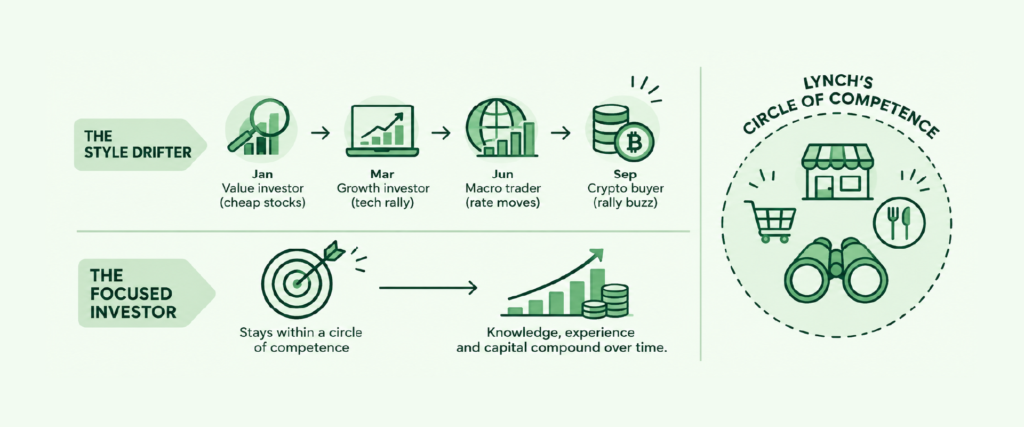
Retail investors routinely fail through the opposite habit: style drift. No foundational identity, so the strategy changes with whatever is working this quarter.
A value investor in January, hunting cheap utility stocks. A growth investor by March, because tech is running. A macro trader by June, predicting rate moves. A crypto buyer by September, after reading about a rally.
Hopping between approaches means never staying anywhere long enough for knowledge, experience or capital to compound. You end up playing a game where you hold no advantage at all.
Lynch and the circle of competence
Peter Lynch ran Fidelity’s Magellan Fund from 1977 to 1990, averaging 29.2% annually across those thirteen years, roughly doubling the market.
His edge wasn’t a formula. It was a refusal to drift.
He stayed inside what he called his circle of competence: businesses he could understand as an ordinary consumer. He visited shopping malls, talked to store managers, ate at restaurants, and watched what people were actually buying. He bought retail and restaurant chains because he could see the operational reality on the ground.
He was open about what he couldn’t do. He had no idea how to forecast GDP, predict Federal Reserve decisions or trade currencies. He didn’t try.
You don’t need an edge in every sector. You need one reliable edge that matches what you actually know, executed consistently for years, without wandering into someone else’s game.
The real Mamba Mentality for investors
Most people associate the Mamba Mentality with intensity. The jaw-clenching, the dunks, the shouting.
That’s the surface.
The substance was a commitment to deliberate improvement. Getting marginally better every day, every game, every season, on the understanding that skill and knowledge compound the same way money does.
Markets run on the same mathematics.
Real wealth creation almost never comes from dramatic moments. It comes from the slow, quiet, frequently boring accumulation of sound decisions over decades.
Kobe’s 81 points took one evening. It also took twenty years.
Buffett’s Coca-Cola position took one afternoon in 1988. It also took fifty-two years of watching, and thirty-six years of not selling.
The work that produces the result is almost never the work anyone sees.
Disclaimer:
This article is for informational and educational purposes only. It is not investment advice, and nothing here is a recommendation to buy or sell any security. Historical performance figures relate to the periods stated. Please consult a SEBI-registered investment adviser before making financial decisions.