
The Truth About Startup Valuations
A company was worth $22 billion. Then it was worth $25 million. Nothing about the business changed that fast.
A startup valuation isn’t a measurement. It’s the price two parties agreed on, based on what they both hoped would happen next. When the hope changes, the number changes, and it can change by 99% without the underlying business doing anything unusual.
Every few weeks, the startup world celebrates another funding announcement. A company has raised at a valuation of ₹1,000 crore, ₹5,000 crore, sometimes far more.
People naturally assume the startup must genuinely be worth that. If investors are willing to put money in at that price, surely someone calculated it carefully.
Startup valuations don’t work that way.
Unlike mature businesses, early-stage startups usually have limited revenue, little or no profit, and a genuinely uncertain future. In that setting, valuation is rarely a precise measure of what a business is worth today. More often it reflects what investors and founders believe it could grow into tomorrow.
India has just finished running the most expensive demonstration of this anyone has seen.
Why valuing a startup is a different exercise
Imagine buying a rental property. You can estimate its value from rental income, location, construction quality and comparable nearby prices. Tangible metrics that get you to a reasonable number.
Now picture evaluating a startup that launched six months ago. It may have a promising product and a talented founder, but no profits and a handful of customers. There’s no equivalent route to an exact value.
Most startup investors aren’t valuing what exists today. They’re valuing a future that may or may not arrive, working through questions like whether this company can dominate a large market, grow tenfold, or attract the next round of funding.
Since nobody knows those answers, startup valuation becomes part analysis and part expectation.
Why the traditional toolkit falls short here
Valuing a mature company relies on tools like discounted cash flow, price to earnings, or EV/EBITDA multiples. Those work because established businesses have reasonably predictable revenue, profit and cash flow.
Startups look nothing like that. Most early-stage companies are losing money or generating very little revenue, future growth is deeply uncertain, and the business model is often still taking shape.
Take DCF specifically. It requires forecasting future cash flows and discounting them back. For a mature business, doable. For a startup, even the basic inputs are guesswork.
What will revenue look like in five years? When does it turn profitable? Will customers stick around? Will the model hold up at scale?
Small shifts in those assumptions swing the result wildly. A startup that looks worth ₹500 crore under one set of assumptions can look worth ₹2,000 crore under a slightly different set.
This is why early-stage investors rarely rely on traditional models alone. They focus on the founding team, the size of the market, product-market fit, growth potential, and how likely the company is to attract future funding.
Startup valuation has less to do with calculating present value and more to do with estimating future possibility.
Where the number actually comes from
A founder needs ₹1 crore to expand. An investor agrees to provide it for a 10% stake. People start describing the startup as worth ₹10 crore.
The investor didn’t uncover a hidden formula revealing intrinsic value. The founder and investor reached an agreement based on shared expectations, and the valuation emerged from that negotiation.
The investor wasn’t careless. They likely weighed the founder, the market opportunity, the product and the competition closely. But even with all that analysis behind it, the final number is a judgment about the future rather than a fact about the present.
Here’s what that looks like at scale.
In March 2022, Byju’s raised around $800 million at a valuation of $22 billion, making it India’s most valuable startup. The investor base over its life included Prosus, Tiger Global, General Atlantic, Sequoia, BlackRock, Silver Lake and the Qatar Investment Authority. Some bankers had reportedly floated numbers as high as $50 billion.
These are not amateurs. They are among the most sophisticated allocators of capital in the world, with full access to the company’s books.
By early 2024, Byju’s was raising via a rights issue at a valuation of roughly $25 million.
Not a 20% correction. Not a 50% one. A figure arrived at by the world’s best-resourced investors turned out to be wrong by approximately the entire amount.
That’s not an argument that those investors were foolish. It’s an argument about what the number was ever measured.
Venture capital buys possibilities, not certainties
Venture investors aren’t paying for what a company is today. They’re paying for what it might become.
Picture two businesses. One generates ₹5 crore in revenue and turns a steady profit. The other generates ₹50 lakh and is still losing money.
A traditional investor would prefer the first, since its performance is proven. A venture capitalist might choose the second, if they believe it can grow into a market leader worth thousands of crore.
Startup investing runs less on current reality and more on future possibility. That’s the model working as designed. It also explains why the numbers move so violently when the possibility fades.
The relay race
One of the clearer ways to picture startup funding is as a relay race.
The founder starts with an idea. A seed investor hands over the first round and helps the company reach its next milestone. A Series A investor takes over, followed by Series B, growth investors, and eventually public market investors through an IPO.
Each participant helps the company move to the next stage, while thinking about the next runner in line.
A seed investor isn’t only asking whether the company looks attractive today. They’re asking whether a Series A investor will find it attractive in two years. A Series A investor does the same with growth investors in mind.
This chain of expectations, each investor partly betting on what the next one will believe, plays a major role in how valuations form.
And it has an obvious failure mode. The next runner doesn’t show up.
Byju’s raised over $5 billion in equity and debt across its life, and spent more than $2.5 billion acquiring companies in 2021 and 2022 alone. That spending made sense only if the next round arrived on schedule.
When the global funding environment tightened, it didn’t. A $1 billion fundraise fell apart amid governance concerns, the resignation of its auditor and the departure of board members.
The relay race has no provision for a runner who never appears. The baton simply drops, and everything built on the assumption that it wouldn’t comes apart at once.
The part nobody explains: liquidation preferences
Here’s the mechanical reason headline valuations overstate reality, and most explainers skip it entirely.
When a venture investor puts money in, they usually don’t buy the same shares the founder holds. They buy preferred shares, which typically carry a liquidation preference: the right to get their money back first, often 1x their investment, before common shareholders receive anything.
Work through the arithmetic.
An investor puts ₹100 crore into a company at a ₹1,000 crore valuation, taking 10%. Headlines report a ₹1,000 crore company.
The company later sells for ₹300 crore.
With a 1x liquidation preference, that investor takes their ₹100 crore off the top. The remaining ₹200 crore is split among everyone else. The investor is whole. The founders and employees holding common shares and ESOPs are not.
|
Exit value |
Preferred investor gets |
Everyone else splits |
|
₹1,000 crore |
₹100 crore (or 10%, whichever is better) |
₹900 crore |
|
₹300 crore |
₹100 crore |
₹200 crore |
|
₹100 crore |
₹100 crore |
Nothing |
The headline valuation assumes every share is worth the same. They aren’t.
This is why a company can be “valued at ₹1,000 crore” and have employees whose ESOPs are worth nothing, and why down rounds with harsh terms can leave founders holding a smaller real stake than the cap table suggests.
When you read a valuation in a headline, you’re reading the price of the most senior shares in the company, applied to every share as though they were identical.
Why a high valuation can be dangerous
Valuation often gets treated as a measure of success. Higher number, more successful company.
Valuation and value aren’t the same thing.
A valuation captures the price investors and founders agreed to transact at, at one specific moment. It guarantees nothing about what follows. It reflects high expectations, not a promise.
It can also create obligations the business can’t meet.
The clearest illustration from the Byju’s story is the trigger. India’s National Company Law Tribunal admitted insolvency proceedings in July 2024 over a petition from the Board of Control for Cricket in India, seeking roughly $19 million in unpaid sponsorship dues.
Nineteen million dollars, against a company once valued at twenty-two billion. A ratio of roughly 1,150 to 1.
A high valuation had not created the cash to pay a sponsorship bill. It had created the expectations that made the sponsorship seem affordable in the first place.
In October 2024, after the Supreme Court set aside a settlement and returned the company to insolvency, founder Byju Raveendran put it plainly in public: the company was worth zero.
Paper wealth versus real wealth
Startup valuations create an illusion of wealth.
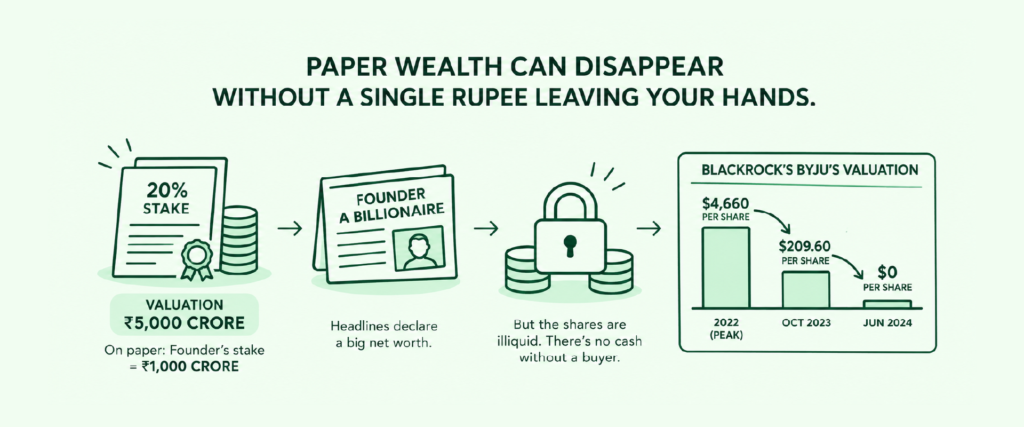
Suppose a founder owns 20% of a startup valued at ₹5,000 crore. On paper that stake is worth ₹1,000 crore, and headlines might call the founder a billionaire.
Those shares are usually illiquid. Without a buyer willing to purchase them, paper wealth can’t become cash.
Raveendran is the working example. His net worth was reported at $2.2 billion in 2023. By 2024 it was zero.
He didn’t lose it in a bad trade or spend it. The number was never money. It was a percentage multiplied by a valuation that existed only as long as investors were willing to transact at it.
BlackRock’s own marks show the mechanism precisely. It valued Byju’s shares at around $4,660 each at the 2022 peak. By October 2023 it marked them at $209.60. By June 2024, zero.
The shares were the same shares. The company was in worse shape, certainly. But the valuation fell further and faster than the business did, because the valuation was never describing the business in the first place.
The exhaust fumes
A useful way to hold all of this together is to compare a startup valuation to the exhaust coming out of a car.
When a car is running, fumes come out of the tailpipe. Those fumes tell you the engine is on. They’re not the engine.
Startup valuations work the same way. They’re a by-product of the fundraising process, telling you that investors and founders reached an agreement. They’re not a description of the business.
The real business is built on customers, product, revenue, execution and competitive advantage. Those decide whether a startup succeeds.
Conclusion
The next time a headline announces a startup valued at ₹1,000 crore, or ₹10,000 crore, look past the number.
A high valuation doesn’t mean a great business sits behind it. In the early stages, a startup’s valuation usually reflects what investors think the company could become, not what it has achieved.
Byju’s went from $22 billion to zero in roughly thirty months. The teaching videos didn’t get worse by 100%. The engineers didn’t become worthless. What collapsed was a shared expectation about the future, and the number that expectation had produced.
The valuation captures expectation. Real value depends on how the business actually performs.
Investors can guess at the future all they like. Only the business gets to decide whether those guesses were right.
This article is for informational and educational purposes only. It is not investment advice, and nothing here is a recommendation regarding any company or security. References to Byju’s and Think & Learn are based on publicly available reporting, regulatory filings and court records. The company is subject to ongoing insolvency proceedings and litigation, and positions described may have changed. Please consult a qualified professional before making investment or business decisions.