
Quality Investing vs Valuation: Lessons from Sunil Singhania and Saurabh Mukherjea

Two of India’s most respected investors debated whether quality excuses price. Then the market answered.
Mukherjea argues valuation must be assessed alongside quality. Singhania argues quality itself is never permanent. The panel treated these as different emphases. Events since have suggested they were two descriptions of the same risk, and both men were right.
Few debates in investing have endured as long as the one between business quality and valuation.
Should investors willingly pay a premium for exceptional businesses, or should valuation remain the anchor of every decision?
The question has divided investors for decades because both positions contain truth. A high-quality business can generate extraordinary long-term returns, but even the best company can become a poor investment if bought at an unrealistic price. Equally, a cheap-looking stock may never deliver satisfactory returns if the business lacks quality.
At the Outlook Business Investment Summit, Saurabh Mukherjea and Sunil Singhania shared their perspectives. Rather than presenting opposing philosophies, the discussion revealed two complementary ways of evaluating businesses.
Their conclusions differed on some points. On one principle they agreed completely: successful investing requires far more than relying on valuation ratios or financial screens.
Who’s arguing
Saurabh Mukherjea is the founder and Chief Investment Officer of Marcellus Investment Managers, which he set up in 2018. He previously co-founded Clear Capital in London and served as CEO of Ambit Capital in India. Marcellus built its reputation on the Consistent Compounders Portfolio, a concentrated strategy holding a small number of high-quality Indian businesses for long periods.
Sunil Singhania founded Abakkus Asset Manager in 2018. Before that he spent close to two decades at Reliance Mutual Fund, latterly as Chief Investment Officer for equities, managing some of India’s largest equity schemes. He was also the first Indian to serve on the global board of the CFA Institute.
Two different vantage points. One running a concentrated quality strategy, the other with a long institutional background across market cycles.
Valuation: how much is too much?
Mukherjea’s position is that no matter how exceptional a business may be, investors cannot ignore the price they pay.
His focus extends beyond conventional valuation metrics to the total capital employed in the business. When investors buy a high-quality company at a substantial premium, they are implicitly assuming it will keep growing at a high and consistent rate for many years.
If that growth slows, even temporarily, the valuation multiple can compress. The result is disappointing shareholder returns despite the business remaining fundamentally strong.
He illustrated the point using Hindustan Unilever and Asian Paints, both widely regarded as outstanding businesses. Their operational quality isn’t in question. The question is whether the future growth already embedded in the share price justifies the valuation being paid.
Importantly, Mukherjea does not argue against quality investing. His argument is that quality and valuation must be assessed together. Quality alone is not a complete investment thesis.
The limits of forecasting
Singhania approaches it from a different angle.
Rather than beginning with valuation, he begins with the inherent uncertainty of forecasting. Predicting what a business will look like ten or twenty years out is exceptionally difficult, and investors who lean heavily on long-term projections should recognise what those forecasts can and cannot tell them.
Instead of trying to predict distant outcomes precisely, he advocates identifying businesses with the resilience to withstand changing competitive conditions, economic cycles and unexpected disruption.
He also cautions against over-reliance on any single valuation metric. Financial ratios carry real information, but businesses operate in dynamic environments shaped by management decisions, competition, regulation and technological change. Those factors don’t fit neatly into a spreadsheet.
Mukherjea emphasises valuation discipline. Singhania emphasises business resilience. The two aren’t contradictory. They identify different sources of the same risk.
The importance of management
Their strongest area of agreement is management quality.
Financial statements reveal what a business has achieved. Management determines what it’s capable of achieving next.
Singhania argues that even businesses with attractive economics can underperform if management fails to allocate capital well or respond to changing industry conditions. Competitive disruption, regulatory change and strategic mistakes rarely show up in financial statements until after the damage is done.
The reverse also holds. Exceptional management teams can turn average businesses into outstanding long-term investments through disciplined execution and sensible capital allocation.
For both investors, evaluating management is a core part of business analysis rather than an optional qualitative extra.
Technology and competitive advantage
Mukherjea views technology primarily as an opportunity for well-run businesses. Companies with capable leadership can use it to improve productivity, strengthen competitive advantages and generate higher returns on capital without proportionately increasing investment.
Singhania acknowledges that and offers a counterpoint. History is full of businesses that dominated their industries and then failed to adapt when technology altered the competitive landscape.
His central argument is that business quality is never permanent. Competitive advantages have to be continually reinforced as industries evolve.
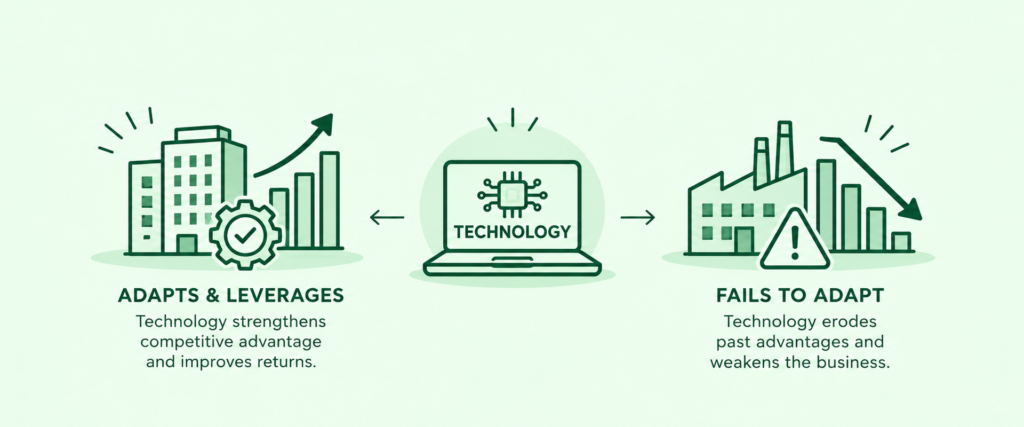
Together these perspectives make a single point. Technology either strengthens an existing advantage or erodes it, depending entirely on how management responds.
India’s evolving competitive landscape
Both investors see a structural shift in which larger, professionally managed businesses are steadily taking share from smaller, less organised competitors.
That creates long-term opportunity, and it raises the importance of identifying which companies can actually sustain their advantages.
Both emphasise that organisational quality is becoming a key differentiator. Businesses that decentralise decision-making, develop future leaders and build institutional cultures tend to be better positioned than companies dependent on a single promoter or founder.
Competitive advantage therefore extends beyond products and brands to organisational capability itself, which traditional financial analysis routinely overlooks.
Has the P/E ratio lost its relevance?
Mukherjea considers the P/E ratio useful for its simplicity, while believing it often fails to capture the economics of high-quality compounding businesses.
A P/E multiple reflects only current earnings relative to the prevailing price. Businesses that can reinvest capital at high returns and compound earnings over many years frequently look expensive on that measure, even as intrinsic value keeps increasing.
Companies that appear overvalued on conventional P/E analysis may therefore deliver superior returns if earnings keep compounding over long periods.
He also stresses the limit. Investors should not use “quality” as a justification for paying any price. High valuations are warranted only when supported by sustainable growth, disciplined capital allocation and durable competitive advantages.
That caveat turned out to matter more than it may have seemed at the time.
Investing style matters less than discipline
Singhania argues there’s no universally superior investment style. Whether an investor follows a quality-oriented, value-based or quantitative approach matters less than understanding the chosen framework thoroughly and applying it consistently.
Successful investing requires conviction, but conviction grounded in rigorous analysis rather than emotion or stubbornness.
Periods of underperformance are inevitable for every philosophy. Long-term success depends on staying disciplined through those periods rather than abandoning one strategy for whichever approach has recently done well.
Consistency of process, in his view, matters more than the specific framework.
Common ground
Despite the differences in emphasis, both investors share several convictions.
Both believe management quality is indispensable. Both prioritise businesses capable of holding their competitive position across cycles. Both evaluate investments over years rather than quarters. And both are looking for businesses likely to be substantially larger, stronger and more profitable five to ten years out.
Their disagreement is one of the starting points. Mukherjea begins with valuation discipline. Singhania begins with business resilience. The objective is identical.
What happened next
Panel discussions rarely get graded. This one did, and using one of the exact companies named in it.
Asian Paints met a competitor with capital
In February 2024, Grasim Industries launched Birla Opus with a stated commitment of around ₹10,000 crore.
What followed is one of the fastest competitive shifts in recent Indian corporate history:
|
Measure |
Outcome |
|
Asian Paints decorative market share |
Fell from roughly 59% to 52% |
|
Birla Opus share of organised decorative capacity |
About 21% within months |
|
Birla Opus reach |
6,000 to 8,000 towns, six plants operational |
|
Asian Paints Q4 FY25 net profit |
Down roughly 45% year on year |
|
Asian Paints Q1 FY26 |
Revenue down 5.4%, operating profit down 25.1% |
|
Stock, three years to early 2025 |
Down about 20% while the benchmark rose nearly 40% |
|
Trailing P/E at that point |
Around 70, against a sector average near 19 |
Nothing in that table says Asian Paints stopped being a good business. It still has scale, dealer relationships and brand recall that took decades to build.
What it says is that a multiple of around 70 was pricing in a competitive position nobody could successfully attack, and someone attacked it.
These are both arguments at once. Mukherjea’s point about multiple compression when growth slows. Singhania’s point that quality is never permanent and advantages must be continually reinforced. The same event proves both.
Mukherjea said so himself
The more instructive development came from Marcellus.
In a March 2025 investor newsletter, the firm acknowledged that valuation mistakes were central to its recent underperformance. It noted that failing to act on its own learnings about valuation had left returns merely tracking earnings growth while benchmarks moved ahead. The flagship Consistent Compounders Portfolio delivered roughly 17.4% CAGR over FY19 to FY24, broadly in line with the underlying earnings growth of its holdings rather than ahead of it.
The firm had faced sustained criticism of a perceived buy-at-any-price approach, and PMS assets had fallen.
Mukherjea’s public response was to invite more of it, saying he and his colleagues would be the wiser for the criticism.
That matters more than the underperformance. It’s worth noting what it actually demonstrates: the man making the valuation-discipline argument on that panel went on to say publicly that his own firm hadn’t applied enough of it. That is not a contradiction. It’s the argument being tested in real conditions by the person who made it, and reported honestly.
Most investors facing a bad stretch explain it away. Writing it down in an investor letter, naming the cause as your own valuation discipline, is rarer and more useful than being right in the first place.
What the resolution actually is
The panel framed this as two complementary approaches. The evidence since suggests something slightly different.
Quality and valuation are not two separate tests you apply in sequence. They’re the same test asked from opposite ends.
Asking “is this business durable enough to justify this multiple?” and asking “does this multiple assume a durability this business can’t guarantee?” are the same question. Singhania’s resilience framing and Mukherjea’s valuation framing converge on it.
The failure mode isn’t paying up for quality. It’s paying for permanence, which no business can offer.
Conclusion
The debate between quality and valuation won’t be settled in the abstract, because both perspectives capture something essential.
Quality determines a company’s ability to create long-term value. Valuation determines the return investors actually earn from owning it. Ignoring either produces an incomplete framework.
Mukherjea reminds investors that even outstanding businesses must justify the premium they command. Singhania reminds us that uncertainty is unavoidable, that management execution determines outcomes, and that competitive advantages are never permanent.
The paint industry made both points simultaneously in about eighteen months.
Long-term success depends less on choosing between quality and valuation than on building a well-defined framework, applying it consistently, and having the honesty to say so when you haven’t.
Disclaimer:
This article summarises publicly reported remarks made at an industry event, alongside subsequent publicly available company and fund disclosures. It is for informational and educational purposes only, is not investment advice, and is not a recommendation regarding any security, fund or investment manager. Views attributed to individuals are drawn from public commentary and may not reflect their current positioning. Company data is as of the dates stated. Please consult a SEBI-registered investment adviser before making financial decisions.