Navigating the Unpredictable: What Shackleton’s Endurance Expedition Teaches Us About Risk
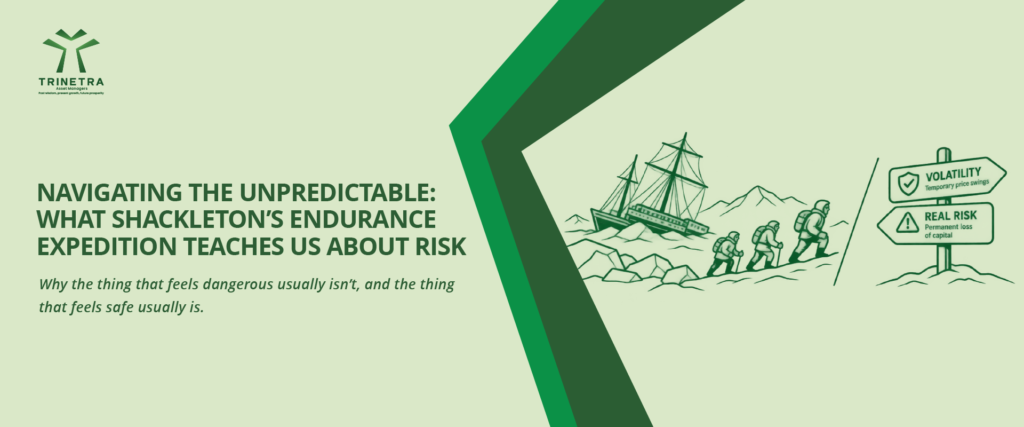
Why the thing that feels dangerous usually isn’t, and the thing that feels safe usually is.
“A smooth sea never made a skilled sailor.” — Franklin D. Roosevelt
Most investors define risk as price movement. Real risk is permanent loss of capital, and it tends to be invisible precisely when conditions look calmest. Amazon fell 90% and was safe. Enron rose smoothly and was not.
The ship that never reached Antarctica
In 1914, a ship named Endurance set sail for Antarctica under Ernest Shackleton. The mission was ambitious: cross the entire continent on foot, through one of the harshest environments on Earth.
It did not go according to plan.
Before the team could begin the crossing, the ship became trapped in thick Antarctic pack ice. For months the crew waited as the ice slowly crushed the wooden vessel. Eventually Endurance sank, leaving the men stranded on shifting floes.
What followed became one of the great survival stories. They lived for months on floating ice, enduring freezing temperatures, near-starvation and open-sea voyages in small lifeboats.
Not a single crew member died.
Shackleton became famous not because he avoided the storms, but because he navigated through them.
Investing works much the same way.
Why most people misunderstand risk
Ask most people what investment risk means and the answer usually involves volatility, market crashes, daily fluctuations. Financial television reinforces this every day.
But price movement alone does not define risk.
A ship crossing an ocean will encounter waves. The existence of waves does not make the voyage dangerous. What matters is:
- The strength of the ship
- The capability of the captain
- The preparedness of the crew
- The availability of supplies
- Whether the vessel can survive a storm
In investing, temporary price fluctuations are a normal feature of the environment. Real risk sits much deeper.
Volatility is not always risk
A stock moving sharply may feel uncomfortable. Discomfort is not danger.
Imagine two businesses.
The first has low debt, strong cash flows, competent management, a durable competitive advantage and growing earnings. During a market panic its stock falls 35%.
The second has a weak balance sheet, questionable management, excessive leverage and deteriorating economics. Its stock price stays stable because investors haven’t yet noticed.
Which is riskier?
Amazon, 2000
When the dot-com bubble burst, investors didn’t just sell the bad companies. They sold everything.
Amazon fell from a high around $106 per share to a low under $6, a decline of more than 90%. Judged purely on the chart, an analyst would have labelled it extraordinarily risky, close to fatal.
Underneath, something else was happening. Jeff Bezos noted in his shareholder letter that Amazon’s operational metrics were strengthening through exactly this period. The customer base was expanding, revenues were growing, operational efficiencies were improving.
The fundamentals improved while the price was being destroyed. Investors who read that volatility as permanent danger sold at the bottom and missed one of the great compounding machines in corporate history.
Enron, 2000
For years Enron was hailed as America’s most innovative company. Its stock climbed with remarkably smooth progression. To anyone measuring risk statistically, low volatility signalled safety. It looked stable, in contrast to the wild swings of younger tech names.
Beneath that placid surface sat enormous debt hidden through off-balance-sheet accounting and businesses that didn’t work.
When the truth emerged, the stable stock went to zero within months, permanently destroying tens of billions of dollars of investor wealth.
The distinction experienced investors draw is simple. Volatility is temporary uncertainty in price. Risk is the possibility of permanent damage to capital.
Amazon was volatile and safe. Enron was stable and lethal. The chart told you the opposite of the truth in both cases.
The ocean does not care about emotions
The sea is indifferent to fear, greed, optimism and panic. It simply exists. Markets behave the same way.
The heights of euphoria
During bull markets, investors grow convinced that risk no longer matters, that prices only move upward, and that caution is unnecessary.
There’s a famous Wall Street anecdote about Joe Kennedy, father of the future president, who supposedly received stock tips from a shoeshine boy in 1929 and concluded that when people with no capital or training are speculating on margin, the top is in. He is said to have sold his holdings shortly before the crash.
The story is almost certainly embellished, and historians have never verified it. It survives because the underlying observation keeps proving accurate.
The same pattern repeated nearly a century later. Pandemic lockdowns, stimulus payments and viral social media hype pulled millions of inexperienced retail investors into markets. Money poured into a bankrupt rental car company, speculative digital tokens with no underlying utility, and unprofitable startups. The prevailing view on internet forums was that caution was a drag on returns and that cash flow and earnings were outdated concepts.
The market felt safe because prices rose every day. That environment of widespread overconfidence was precisely when structural risk was highest.
The depths of despair
In bear markets the opposite happens.
In 2008, the collapse of Lehman Brothers sent shockwaves through global banking. In March 2020, the world locked down and the S&P 500 fell roughly a third in a matter of weeks.
Fear dominated. The financial media predicted the end of capitalism. High-quality, cash-generating businesses were sold off for a fraction of their worth simply because people wanted cash.
Investors abandoned carefully planned long-term strategies at the bottom, converting temporary paper volatility into permanent loss.
The external environment always changes. The real challenge is maintaining internal stability. A skilled sailor does not overreact to every passing wave.
Risk is often invisible
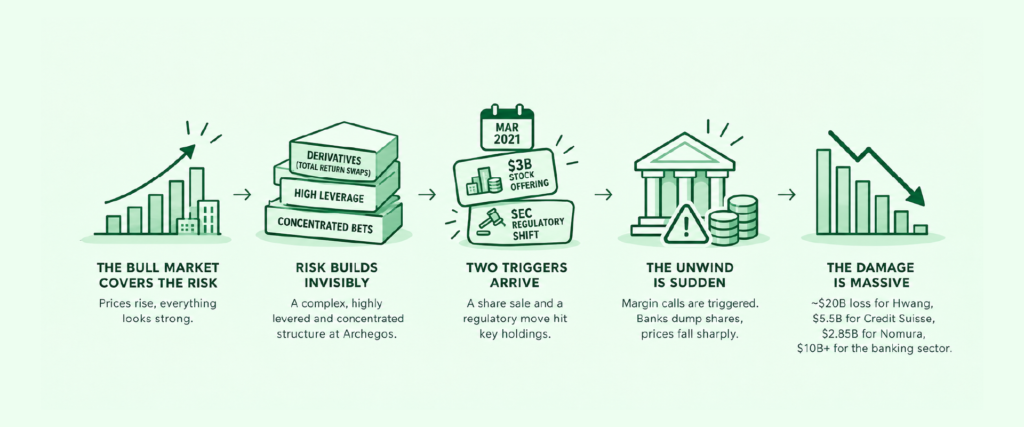
One of the most dangerous features of financial markets is that real risk hides during good times.
A ship overloaded with cargo may look perfectly stable in calm water. Its structural weakness only appears when the weather turns.
Excessive leverage, poor governance, extreme concentration, liquidity mismatches and weak business models are all temporarily masked by a rising tide.
Archegos Capital Management, 2021
Archegos was a private family office run by former hedge fund manager Bill Hwang. During the bull market it used enormous hidden leverage through derivatives called total return swaps, provided by a web of global banks including Credit Suisse, Nomura, Morgan Stanley and Goldman Sachs.
The structure was the point. Because the banks held the actual shares on their own balance sheets while Hwang took only the price exposure, he avoided the disclosure rules that normally require an investor holding more than 5% of a company to declare it publicly.
Prosecutors later put his total stock exposure at roughly $160 billion, built on a firm with around $36 billion in assets. The portfolio was concentrated in a handful of names: ViacomCBS and Discovery, alongside US-listed Chinese technology stocks including Baidu, Tencent Music and Vipshop.
From outside, everything looked spectacular. ViacomCBS tripled in months. The risk was invisible to other participants because the market was calm and rising.
Two small events in late March 2021 brought it down.
A capital raise. On 22 March, ViacomCBS management saw the soaring price as an opportunity and announced a $3 billion stock offering. Wall Street read the issuance as dilution, and the stock fell around 9%.
A regulatory shift. At almost the same moment, the SEC moved forward with rules threatening to delist foreign firms that failed to comply with American auditing standards, triggering a sell-off across US-listed Chinese tech.
Because Archegos was so heavily levered, double-digit drops in its core holdings wiped out its margin buffer. That triggered a cascade of margin calls.
When Archegos told the banks its cash was exhausted, Goldman Sachs and Morgan Stanley declared default, seized the collateral and launched multi-billion-dollar block trades, dumping tens of millions of shares before anyone else could react. ViacomCBS and Discovery fell more than 27% in a single day.
Slower institutions were left holding the position.
The damage:
|
Party |
Loss |
|
Bill Hwang’s personal fortune |
~$20 billion, gone in days |
|
Credit Suisse |
$5.5 billion |
|
Nomura |
$2.85 billion |
|
Global banking sector total |
Over $10 billion |
The reputational damage crippled Credit Suisse, triggering an exodus of risk executives and a loss of client confidence that contributed to the forced UBS takeover of the 167-year-old bank two years later.
And it didn’t end there. In July 2024, a Manhattan jury convicted Hwang on ten criminal counts including securities fraud, wire fraud and racketeering conspiracy. Former CFO Patrick Halligan was convicted on all three counts he faced.
In November 2024, Judge Alvin Hellerstein sentenced Hwang to 18 years in prison, slightly below the 21 years prosecutors sought. Halligan received eight. Both remain free on bail pending appeal.
The risk was invisible for years. It took a $3 billion share sale and an auditing rule to make it visible, and then it took less than a week to destroy everything.
The biggest risk is not short-term volatility
For long-term investors, the greatest threats are rarely daily market drops. The real dangers are:
- Permanent loss of capital
- Poor asset allocation
- Emotional decision-making
- Overpaying for businesses
- Excessive leverage
- Inability to stay invested long enough for compounding to work
Investors who try hardest to avoid short-term volatility often create much larger long-term risks for themselves.
The Great Inflation of the 1970s
Consider an investor in the early 1970s. Shaken by the severe crash of 1973 to 1974 and tired of watching their portfolio swing, they decided to play it safe. They moved everything out of equities into cash and short-term government bonds.
Over the next decade they slept well, proud to have avoided the visible, nerve-wracking movements of the stock market.
While they watched the ticker, a different predator entered the room. US inflation surged into double digits, peaking above 14% in 1980.
Because yields on cash and short-term bonds failed to keep pace with the rising cost of goods, purchasing power eroded silently. By the decade’s end, a dollar bought substantially less than it had at the start.
Had they stayed in equities, their capital would have fluctuated uncomfortably. But the cash flows and physical assets of robust businesses eventually adjust upward to pass on rising costs.
In trying to avoid visible short-term volatility, they accepted a far larger structural risk: guaranteed long-term erosion.
Not all risks announce themselves with a crash. The most lethal ones destroy wealth in silence.
Cash is like a lifeboat
Every experienced sailor respects the importance of reserves. In investing, liquidity plays the same role. Adequate cash reduces panic, provides flexibility, and allows an investor to survive difficult conditions.
More importantly, cash creates opportunity. When storms arrive, distressed sellers emerge. Investors holding liquidity can act rationally while others are forced to react.
Warren Buffett, 2008
While Wall Street was paralysed, buried in toxic real estate debt and starved for liquidity, Buffett used Berkshire’s cash to go shopping.
Because he had spent years holding boring, low-yielding reserves, he was the captain with surplus lifeboats when the storm hit. Distressed corporate giants came to him.
He injected $5 billion into Goldman Sachs and $3 billion into General Electric. These weren’t rescues. He negotiated preferred shares paying 10% dividends, alongside warrants to buy common stock at very attractive prices.
When the storm cleared, those investments generated billions in profit.
Volatility becomes an opportunity only for those structurally prepared to handle it. Everyone could see the same bargains in 2008. Almost nobody had the cash to act on them.
Markets reward survival
In the short term, markets often reward aggression, speculation and excitement. Over decades, survival matters more than brilliance.
Many investors lose not through lack of intelligence, but because they take excessive risks, overleverage, chase trends, abandon discipline, or capitulate during downturns.
Long-Term Capital Management, 1998
LTCM was an elite hedge fund founded by bond trader John Meriwether, who assembled a team including Myron Scholes and Robert Merton, the Nobel laureates who co-created the Black-Scholes-Merton option pricing model.
The firm used sophisticated models to find microscopic price discrepancies between fixed-income securities. Because the differences were tiny, LTCM borrowed enormously to amplify returns.
|
Measure |
Figure |
|
Equity capital |
~$4.7 billion |
|
Borrowed debt |
Over $125 billion |
|
Off-balance-sheet derivatives, notional |
Over $1.25 trillion |
|
Balance sheet leverage |
Roughly 25 to 1 |
In calm conditions the models worked flawlessly, delivering returns that made them the envy of Wall Street. The leverage left no margin for error. When critics raised concerns, the fund’s response was that their models showed a catastrophic market event was effectively impossible.
Then it happened. In August 1998, Russia defaulted on its domestic debt and devalued the rouble. Investors worldwide abandoned their models, fled emerging-market assets and crowded into US Treasuries.
Every historical correlation LTCM depended on broke down simultaneously. Instead of the price gaps closing as predicted, they widened violently. Hyper-leveraged, even small deviations translated into catastrophic losses.
Within weeks the firm had lost billions and stood at the edge of disorderly default. Because LTCM was entangled with every major institution on Wall Street, its collapse threatened to freeze global credit markets.
The Federal Reserve Bank of New York organised a $3.6 billion rescue from a syndicate of fourteen banks, purely to wind the positions down safely.
The pattern across all four cases. Archegos, LTCM, Enron and the 1970s cash investor each failed through a risk that didn’t show up as volatility. Hidden leverage. Model dependence. Accounting fraud. Silent inflation. In every case the chart looked calm until it didn’t.
The goal of investing is never to avoid storms. That isn’t available. The goal is to build something strong enough to survive them.
Think like captains, not passengers
Passengers panic during turbulence because they have no control and don’t understand the vessel. Captains stay calm because they focus on navigation.
Great investors think like captains. They understand that markets will always fluctuate, that uncertainty is permanent, that short-term predictions are unreliable, and that risk can never be fully eliminated.
Instead of obsessing over daily movements, they focus on process, preparation, discipline, valuation and long-term business quality.
Successful investing is less about predicting every storm and more about navigating through uncertainty consistently.
Conclusion
Calm waters do not create strong sailors.
The investor who succeeds over decades is usually not the one who avoids every wave. It’s the one who builds resilience, stays rational during storms, and remains committed long enough for compounding to work.
Shackleton never crossed Antarctica. He failed at the thing he set out to do. He is remembered anyway, because he brought every one of his men home.
In investing, survival is not merely defensive. Survival is what allows extraordinary outcomes to happen at all.
Disclaimer:
This article is for informational and educational purposes only. It is not investment advice, and nothing here is a recommendation to buy or sell any security. Companies and individuals are named as documented historical examples. Please consult a SEBI-registered investment adviser before making financial decisions.