
The Reality Matrix: Where Market Perception Becomes Corporate Truth
How a stock price stops reflecting a business and starts creating one.
“The stock market is the story of cycles and of the human behaviour that is responsible for overreactions in both directions.” — Seth Klarman
Textbooks treat the market as a scoreboard recording what a business does. George Soros argued the opposite can also be true, that the price itself changes what the business is capable of. Three cases show the loop running: one building a conglomerate, one destroying a bank, and one interrupted mid-flight by a regulator.
Tulips, and what they were actually about
In 1637 the Netherlands witnessed one of the odder episodes in financial history. At the peak of the frenzy, rare tulip bulbs such as the Semper Augustus were reportedly changing hands for sums comparable to a house in Amsterdam’s canal district.
People were trading contracts on a plant root that would eventually wither.
At first glance it sounds absurd. Why would successful merchants, doctors and noblemen hand over their financial security for a flower?
Because tulip mania was never about the flowers. It was about psychology. A game of musical chairs where rising prices created belief, and belief drove prices higher.
Three mechanics took over:
- Comparison. Ordinary citizens watched neighbours, bakers and cobblers get rich in weeks by buying and flipping contracts.
- Permanence. The public read skyrocketing prices as proof the boom would last.
- Fear of missing out. People stopped analysing what a tulip was worth and bought purely expecting to sell higher.
A historical caveat worth stating. The popular version of tulip mania, ruined merchants and a shattered Dutch economy, has been substantially revised by modern historians. Anne Goldgar’s research found relatively few participants, limited lasting economic damage, and that many of the most dramatic stories originated in moralising pamphlets written afterwards rather than in contemporary records.
The behavioural lesson survives the correction. The apocalyptic framing doesn’t, which is itself a useful reminder about how financial narratives get built.
Reflexivity: the two-way street
Standard finance textbooks teach a one-way rule. Strong fundamentals push the stock price up. Weak fundamentals push it down. The market is a passive scoreboard, recording points scored in the real economy without any power to change the game.
George Soros threw that out. In The Alchemy of Finance (1987) he introduced reflexivity.
His argument was that the market is never a passive observer. It’s an active participant that shapes corporate reality.
Reflexivity is the continuous two-way feedback loop where investor perceptions change the stock price, and that changing price alters the real-world health of the business.
Traditional finance says reality dictates the price. Reflexivity says the price also dictates reality.
When a stock moves sharply, it doesn’t just change a number on a screen.
|
A high stock price lets a company |
A crashing stock price can |
|
Raise capital cheaply, issuing fewer shares |
Trigger margin calls and collateral demands |
|
Secure loans at better rates |
Cause lenders to withdraw credit |
|
Attract talent with valuable options |
Destroy employee morale and retention |
|
Acquire competitors using stock as currency |
Panic customers and counterparties |
The high price itself creates a stronger business. The low price itself creates a weaker one.
The prevailing bias
To map how the loop gets triggered, Soros identified a key variable: the prevailing bias.
At any moment, thousands of participants hold different opinions, calculations, fears and hopes. In a balanced market, these views largely cancel out.
But when a compelling story, a technological breakthrough or a wave of macroeconomic panic takes hold, that diversity breaks down. Individual opinions merge into one dominant collective sentiment, which can be aggressively optimistic or deeply pessimistic.
This bias is never entirely objective. It’s a mix of facts, misconceptions and emotional exaggeration. Because markets are reflexive, the accuracy of the bias doesn’t matter initially. The market acts on it anyway.
The positive loop. An optimistic bias bids the price to irrational levels. The company uses that inflated price to fund expansion, retire debt and achieve scale. The exaggerated optimism has manufactured a genuinely stronger company.
The negative loop. A pessimistic bias drives selling. The crashing price damages reputation, causes banks to pull credit, and dries up funding. The exaggerated fear has manufactured a real corporate failure.
The market isn’t a place where rational actors discover pre-existing values. It’s a place where collective belief creates and destroys them.
The conglomerate mirage of the 1960s
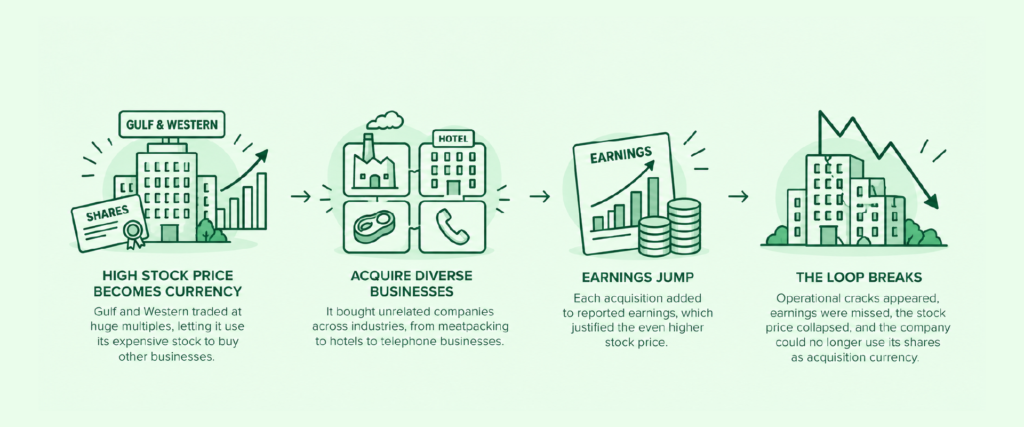
During the 1960s bull market, a powerful optimistic bias took hold around a new corporate structure: the conglomerate. The narrative held that a brilliant management team could buy up unrelated businesses, a meatpacking plant, an insurance firm, a hotel chain, a telephone company, and run them better than anyone else.
Gulf and Western was the undisputed king of that narrative, buying dozens of small, unglamorous businesses.
Here’s where reflexivity turned a story into a machine:
The stock became currency. Because it traded at huge multiples, Gulf and Western didn’t need cash to buy other companies. It printed new shares of its own expensive stock and traded them for solid, profitable businesses.
The accounting did the rest. Every time an expensive stock bought a cheaper company, total corporate earnings leapt forward on the next quarterly report.
The rising stock price was actively manufacturing the earnings growth that justified the rising stock price. The bias grew more aggressive, the price went higher, and the company could buy still larger businesses.
For years it looked like a permanent wealth machine.
But the loop depended entirely on the high price. Eventually Gulf and Western had acquired so many complex businesses that management couldn’t run them efficiently. Operational cracks appeared. The company missed earnings by a small margin, and investors panicked.
The bias flipped. The price collapsed. And because the stock was suddenly cheap, it could no longer function as currency. The acquisition machine stopped, and the company spent the following decade dismantling the empire at heavy losses.
The death spiral of Lehman Brothers
Reflexivity runs both ways, and it destroys faster than it builds.
Lehman Brothers had survived civil wars, world wars and depressions across its 158-year history. By 2008 it had loaded its balance sheet with billions in risky mortgage-backed securities. As real estate softened, a negative bias formed. Short-sellers and rivals began suggesting Lehman lacked the cash to cover its losses.
That perception triggered a drop in the share price. In a textbook world, that’s a harmless score change. In banking, it was a death sentence.
Ratings followed price. As the stock fell day after day, credit agencies downgraded the bank’s safety score.
Funding followed ratings. Other banks refused to lend overnight, fearing they wouldn’t be repaid. Hedge funds holding cash at Lehman cleared out their accounts.
Collateral demands followed funding. Trading partners demanded billions in additional cash just to keep everyday trades open.
Lehman didn’t run out of assets. It ran out of confidence. The negative bias drove the price down, which cut off access to cash, which made the rumour of bankruptcy self-fulfilling.
On 15 September 2008 it filed the largest bankruptcy in US history, with roughly $613 billion in debt.
Hertz, and the limits of the loop
The third case is the most instructive, because it’s the one where the loop broke.
When Covid struck in 2020, global travel stopped. Hertz found itself with a vast fleet nobody was renting and roughly $19 billion of debt it couldn’t service. On 22 May 2020 it filed for Chapter 11. By every traditional measure the equity was worthless, and the company said so in its own filings.
Then something strange happened. An unprecedented positive bias exploded across retail trading forums. Day traders piled into the bankrupt stock as a speculation.
The shares went from an intraday low of around $0.40 on 26 May to roughly $5.53 by 8 June. A rise of more than 1,000%, in a company that had just told the court its stock might be worthless.
Hertz’s management made a genuinely clever reflexive move. They went to the bankruptcy judge and asked permission to sell brand-new shares into the frenzy. On 12 June, the court approved the sale of up to 246 million shares, worth up to $1 billion.
This was the loop closing. Irrational belief creates a price, the company capturing that price to fund a real-world rescue.
And then a regulator stopped it.
Within days, SEC Chair Jay Clayton publicly raised investor-protection concerns about selling potentially worthless stock to retail buyers. On 18 June, Hertz terminated the offering.
Total raised before it stopped: $29 million, from 13.9 million shares, against a planned $500 million to $1 billion.
The company then had to seek debtor-in-possession financing precisely because the equity raise had failed. The NYSE delisted it in October 2020.
Hertz did eventually exit Chapter 11 in 2021 with shareholders recovering value, but that came from a bidding war between competing investor groups, not from the meme-stock rally.
Why this case matters most. Gulf and Western and Lehman both show the loop running to completion. Hertz shows it being interrupted.
Reflexivity isn’t a law of physics. It’s a mechanism that operates inside legal and regulatory constraints, and those constraints can cut it off mid-cycle. A company can only convert belief into cash if someone lets it.
The six stages of a market cycle
Across these examples, a recognisable sequence emerges:
|
Phase |
What happens |
|
1. Scepticism |
A genuine trend begins. A few investors notice. The crowd ignores it |
|
2. Recognition |
Numbers improve visibly. Prices rise, a positive bias takes root, media reports the success |
|
3. Euphoria |
Optimism runs wild. The narrative overpowers reality. Valuations disconnect from the maths |
|
4. Disappointment |
Growth slows slightly. The company fails to meet impossible expectations |
|
5. Panic |
Prices collapse. Fear replaces greed. Falling prices actively damage operations |
|
6. Stabilisation |
The spiral runs out of sellers. Pessimism overcorrects. Price meets reality, and the cycle resets |
The thoughtful investor’s advantage
Markets aren’t cold calculators. They’re living social systems.
To gain an edge you have to study both the hard numbers and the prevailing narrative. That doesn’t mean guessing short-term price movements, which is impossible. It means recognising when the gap between the popular conversation and the underlying maths has grown dangerously wide.
When the story is far more beautiful than the balance sheet, reflexivity says be cautious. The loop that lifted the price can reverse, and the business that the high price built will weaken as the price falls.
When the story is far more terrifying than the balance sheet, look past the panic. The same mechanism that’s destroying the company’s funding may be creating an opportunity once the bias exhausts itself.
And remember the Hertz lesson. The loop can be interrupted. Regulators, courts and lenders all sit between a narrative and its consequences, which means the mechanism is a tendency rather than a certainty.
In the short run, stories rule. Over the long run, economic reality has the final word.
Disclaimer:
This article is for informational and educational purposes only. It is not investment advice, and nothing here is a recommendation to buy or sell any security. Companies are named as historical illustrations. Please consult a SEBI-registered investment adviser before making financial decisions.
Sources:
George Soros, The Alchemy of Finance (1987); Anne Goldgar, Tulipmania (2007); contemporaneous reporting and SEC filings on Lehman Brothers and Hertz Global Holdings.