
The Opposite of a Good Idea: Inversion, Blind Spots and Second-Order Thinking
Why eliminating bad investments beats hunting for great ones.
Most investing losses come from predictable, repeatable thinking errors rather than bad luck. The most reliable edge available isn’t finding the next winner. It’s systematically identifying what a terrible investment looks like and refusing to own one.
Most investors spend the bulk of their time hunting for the next great stock. Reading annual reports, sitting in on earnings calls, digging through financial statements, all in pursuit of the one idea that will make their portfolio.
That pursuit is natural. It’s also, more often than people realise, where the real damage begins.
The uncomfortable truth is that most investing losses don’t come from bad luck or unusual circumstances. They come from predictable, repeatable mistakes rooted in how we think, how we process information, and how easily a compelling story gets mistaken for a sound business.
There’s a different way to approach this. Rather than asking only what makes a great investment, ask what makes a terrible one.
That deliberate search for failure, inversion, turns out to be one of the more powerful tools an investor can carry.
Why smart people still make terrible investments
Intelligence has surprisingly little to do with investing success.
Behavioural economist James Montier surveyed 300 professional fund managers with a simple question: do you consider yourself above average at your job? 74% said yes. Most of the remainder described themselves as merely average. Almost nobody admitted to being below average, a distribution arithmetic doesn’t permit.
The pattern shows up everywhere. Studies consistently find around 93% of drivers rate themselves better than average.
Daniel Kahneman, whose work on cognitive bias earned him a Nobel Prize, described overconfidence as among the most dangerous human tendencies, particularly for investors, because the field self-selects for it. Pessimists tend not to stick around. What’s left is a room full of people convinced their judgment sits above average, acting accordingly.
The data reflects this, and recent data shows the mechanism clearly.
DALBAR’s Quantitative Analysis of Investor Behavior has tracked the gap between fund returns and what investors actually captured since 1994. Over the 20 years ending December 2024, the average US equity investor returned 9.24% annually against the S&P 500’s 10.35%.
That roughly one-point annual gap compounds, across two decades, into the index portfolio ending up worth over 22% more than what the average investor captured.
The year-by-year numbers show why:
|
Year |
Average equity investor |
S&P 500 |
Gap |
|
2024 |
16.54% |
25.02% |
848 bps |
|
2025 |
17.16% |
17.88% |
72 bps |
In 2024, the second-largest gap of the decade, with equity fund outflows in every single quarter and the largest coming immediately before a major rally.
In 2025, the gap collapsed to 72 basis points, among the smallest on record. Not because investors got smarter, but because they moved money around less. DALBAR still recorded elevated selling in 2025, including a record monthly withdrawal rate of 2.30% in July.
Same people. Same biases. The difference was how much they acted on them.
Intelligence doesn’t fix this. Often the smartest people in the room are the most convinced their convictions must be right.
The danger of falling in love with a story
Nearly every significant investing mistake shares a common thread: someone fell in love with a narrative.
When management is charismatic, growth looks fast and the industry sounds revolutionary, investors start believing they’re not buying a stock, they’re joining a movement.
Narratives are built to persuade. A good story selects its best evidence, minimises anything inconvenient, and wraps the whole thing in a sense of inevitability. The numbers that follow are often constructed to fit the story rather than test it.
Once a business gets evaluated primarily through its narrative, the hard questions stop. Does it generate cash? Do the margins hold up? Who else is competing, and at what cost?
Markets have a long history of rewarding a good story in the short run and punishing it eventually. The dot-com era produced hundreds of businesses valued on imagination rather than economics, and the same script has replayed in different costumes since: debt-fuelled roll-ups, fintech disruptors with no path to profit, commodity companies trading at peak multiples right as earnings were about to collapse.
The difference between a great story and a great business ultimately comes down to performance.
Confirmation bias: the silent portfolio killer
Once an investor falls for a thesis, a second force takes hold. Confirmation bias, the tendency to seek information supporting what we already believe while discounting anything that challenges it.
An investor holding a stock reads analyst upgrades more carefully than downgrades. Finds reasons why a competitor’s strong results were a one-off while their own holding’s weak results are temporary. Reads ambiguous data as good news and treats clear warning signs as overblown.
The result is a position held far too long into deteriorating fundamentals. Sell discipline, which should mirror buy discipline exactly, collapses once every fresh piece of bad news gets filtered through the same biased lens.
The fix is deliberately seeking the strongest possible case against your own position, and treating the bear case as though it were genuinely your own rather than dismissing it as coming from someone who doesn’t get the business.
The power of inversion
Charlie Munger had a favourite mental model borrowed from the mathematician Carl Jacobi: invert, always invert.
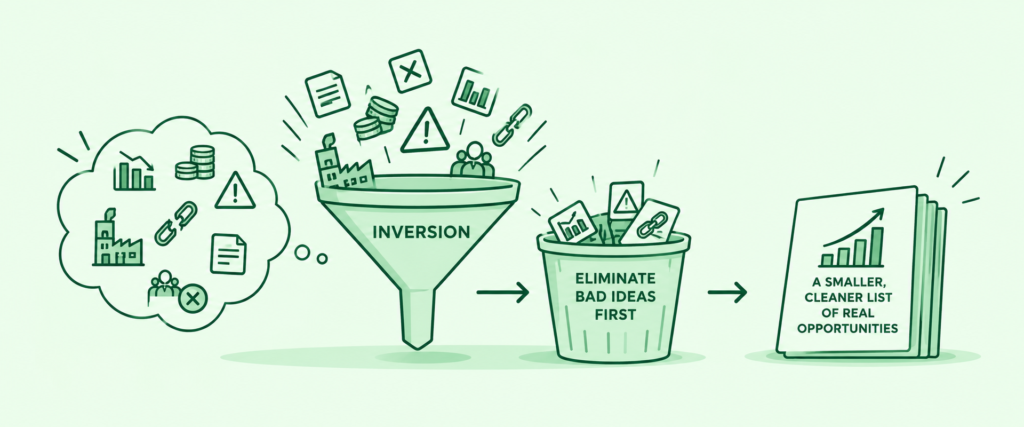
Rather than asking only what leads to success, ask first what leads to failure. Rather than asking what makes a great investment, spend real time asking what makes a terrible one, then avoid doing those things.
Munger applied this with typical bluntness. Not which businesses would thrive, but what a genuinely terrible business looks like. Which industries are structurally incapable of earning good returns? What kind of management destroys value by default? What balance sheets make outcomes unpredictable no matter how good the product is?
Eliminating those categories first leaves a far smaller, cleaner list of real opportunities.
The space of bad ideas is vastly larger than the space of good ones, and clearing out the obvious failures quickly is the most direct route to something worth owning. Munger’s own framing was that the long-term advantage comes less from brilliance than from consistently avoiding stupidity, which is among the more practically useful observations ever made about investing.
The opposite of a good business
If inversion is the method, understanding the opposite of a good business is the output. A genuinely poor business tends to carry a recognisable set of traits. Not all need to be present. Several appearing together is a clear warning.
|
Trait |
Why it matters |
|
Weak unit economics |
A business that doesn’t make money per transaction has a business model problem, not a profitability problem. Scaling a loss never turns it into a profit |
|
Low returns on capital |
Companies earning below their cost of capital destroy value even while revenue grows. Growth plus poor capital returns is often worse than no growth |
|
Structurally necessary leverage |
Debt funding operations that can’t organically service it creates fragility. Stable in good times, insolvent the moment conditions dip |
|
Poor capital allocation |
Overpaying for acquisitions, chasing low-return projects, buying back stock at prices that mainly benefit departing shareholders |
|
Governance concerns |
Related-party transactions, frequent auditor changes, complex ownership, a board unwilling to challenge management. Warning signs about the integrity of the numbers |
|
Narrative-driven growth |
Growth existing mainly in the story rather than the cash flow, where the business must permanently tap external capital to survive |
A single trait can often be managed. Several together, especially inside a richly valued business, is close to a working definition of the opposite of a good investment.
Second-order thinking: looking past the obvious
Howard Marks built much of his philosophy around the difference between first-level and second-level thinking.
First-level thinking is simple. It sees a good company and buys, sees bad news and sells, follows consensus because consensus feels safe.
Second-level thinking asks what happens after that first thought. Not just whether something is good, but whether it’s better or worse than the market already expects, understanding that price already reflects whatever the obvious observation would suggest.
Marks framed it precisely: spotting a good company that everyone else also recognises as good likely means paying a price that already reflects that shared opinion.
This creates a demanding but clarifying discipline. Generating above-average returns requires an investor to:
- Know something the market doesn’t, or
- Interpret shared information differently from the crowd, or
- Hold a longer time horizon than most participants will sit through
An investor who can’t clearly name which of these three edges they hold is almost certainly relying on hope rather than any real advantage.
Incentives drive behaviour more than intelligence does
Munger had another line that cuts to the heart of most investing disasters: show me the incentives, and I’ll show you the outcome.
Analysts. Someone whose career depends on maintaining access to management has a built-in incentive to avoid negative coverage. It’s part of why sell-side research has historically issued far more buy ratings than sell ratings. Not because good investments outnumber poor ones, but because preserving relationships shapes the output.
Fund managers. Those measured against quarterly benchmarks have an incentive to hug the index closely enough to survive, taking concentrated risk only when consensus already backs it. The career risk of being wrong alone dwarfs the career risk of being wrong alongside everyone else.
Corporate management. Teams paid mainly through stock options have an incentive to push the share price up near term, which doesn’t always align with building a sustainable business. Aggressive accounting, excess leverage and optimistic guidance are the predictable output of that mismatch.
Understanding incentives often tells you more than reading the annual report. The annual report tells you what management wants you to believe. The incentive structure tells you what they’re optimising for.
Why most investing mistakes look obvious in hindsight
The most frustrating thing about major investing disasters is how recognisable the warning signs look afterwards.
Looking back, Enron’s financial complexity, the opacity of its off-balance-sheet vehicles and the implausibility of its reported margins were clear signals. Looking back, Wirecard’s €1.9 billion in missing cash and its endlessly deferred audit explanations weren’t bureaucratic technicalities. They were the fraud itself, visible to anyone looking closely enough.
At the time, both companies were celebrated. Analysts carried buy ratings. Institutions held large positions. Management came across as credible. The rising stock price itself became a form of evidence to a mind prone to recency bias.
This is hindsight bias working in reverse. The same cognitive machinery that makes past errors look obvious makes present ones nearly invisible, and believing we would have spotted the warning signs makes us overconfident that we’re seeing clearly right now.
The best response is assuming the next major mistake is already sitting in plain sight, and asking which favourite narrative today carries the same structural flaws as past disasters.
A framework for avoiding bad investments
|
Dimension |
The questions |
|
Business quality |
Does this business earn consistently high returns on capital? Are those returns from genuine competitive advantage or temporarily favourable conditions? |
|
Balance sheet |
Can it survive a material drop in revenue or margins without outside funding? What happens to equity holders if conditions worsen by 30%? |
|
Management |
Does leadership have a track record of doing what they said? Have they created value for shareholders or mainly for themselves? |
|
Incentives |
How is management actually paid? Does that structure align with long-term shareholders or push toward the near-term stock price? |
|
Industry |
Do participants earn good returns on capital over time, or do structural forces steadily erode profitability? What does the industry’s own return history show? |
|
Capital allocation |
How has management historically deployed capital? Have acquisitions created or destroyed value? Do they return cash when internal opportunities run thin? |
|
Valuation |
What would have to be true for the current price to make sense? Is the optimistic scenario already priced in? What does this look like if growth comes on average? |
Any investment that can’t answer these clearly, with real evidence behind the answers, deserves far more scrutiny or far less capital.
Why avoiding mistakes creates better returns
The mathematics of losses run more asymmetrically than most investors credit.
|
Loss |
Gain required to recover |
|
-25% |
+33% |
|
-50% |
+100% |
|
-75% |
+300% |
One large loss can erase years of compounded gains, not only in rupees but in time. Time is the one irreplaceable ingredient in compounding, and permanent capital loss steals it outright.
Buffett’s most famous rule, never lose money and never forget rule number one, gets dismissed as a platitude. But avoiding permanent capital destruction isn’t merely defensive. It’s the single most powerful lever a long-term investor has.
The professional evidence is humbling. Over the 20 years to the end of 2025, roughly 93% of active large-cap US equity funds and about 95% of all active US equity funds trailed their benchmarks, according to S&P’s SPIVA scorecard.
And the figure understates it. Only around 35% of large-cap funds survived the full 20 years. The rest merged or closed, which means 93% is the underperformance rate among the ones that lasted.
The funds that held up best over the long run were usually distinguished less by their best years and more by how well they limited damage in the bad ones.
Building an anti-fragile investing process
Acting purely on consensus generates, at best, consensus returns. An investor who can’t explain why their view differs from the market’s, and why the market is likely mistaken, hasn’t done the work.
Intellectual humility matters just as much. The investor most certain they’re right is often the most dangerous person in the room to their own portfolio. Certainty is a feeling, not a fact, and staying aware of what could go wrong even inside your highest conviction positions is the mark of a serious practitioner.
Seeking disconfirming evidence belongs here too. Actively hunting for the strongest argument against a position before committing. Not a weak version easy to wave off, but the real case a thoughtful, informed sceptic would make. If that case can’t be answered, the analysis isn’t finished.
Continuous learning. Markets change and industries evolve. What worked in one cycle can look structurally different in the next.
Long-term decision making. Much of what the market prices reflects near-term expectations. An investor genuinely operating on a five to ten year horizon is playing a different game from one managing to the next quarter, though that becomes a real edge only when paired with the discipline to hold through short-term volatility.
Conclusion
The best returns in investing are built less on spectacular picks and more on the steady, unglamorous work of eliminating bad ones.
The opposite of a good idea is usually easier to spot than the next multibagger. A business with poor economics. A management team with misaligned incentives. A balance sheet that can’t survive real adversity. A story that outpaces the numbers behind it.
None of these are hard to recognise on their own. They’re simply easy to ignore when the story is exciting and the stock keeps climbing.
Protecting capital is the foundation everything else sits on. It isn’t the opposite of building wealth, it’s the prerequisite for it, and every rupee protected from a permanent loss is a rupee still able to compound.
The great investors spend as much time eliminating bad ideas as chasing good ones, understanding that intellectual honesty, real humility and the habit of inverting every question aren’t philosophical preferences. They’re competitive advantages.
The next major investing mistake is probably already visible to anyone willing to examine the assumptions behind a comfortable narrative closely enough.
Disclaimer:
This article is for informational and educational purposes only. It is not investment advice, and nothing here is a recommendation to buy or sell any security or fund. Research findings and performance data are cited as of the dates stated and are subject to revision. Past performance does not indicate future results. Please consult a SEBI-registered investment adviser before making financial decisions.
Sources:
James Montier, behavioural finance research on manager overconfidence; Daniel Kahneman on cognitive bias; DALBAR Quantitative Analysis of Investor Behavior, 2025 and 2026 editions; S&P Dow Jones Indices SPIVA US Scorecard, year-end 2025; Howard Marks on first and second-level thinking; Charlie Munger on inversion and incentives.