Market Cap Without Human Capital: Why the People Behind the Price Matter More Than Investors Think
The asset that drives long-term returns, and the one that never appears on a balance sheet.
Market cap tells you what investors will pay today. It says nothing about whether the business can hold that value. The thing that determines durability, the quality of the people making thousands of small decisions, is the one input no spreadsheet captures, which is precisely why it stays mispriced.
When investors talk about a company’s size and success, market capitalisation is usually the first number mentioned: price per share multiplied by shares outstanding.
But market cap is only a snapshot. It reflects what investors will pay today, shaped by earnings, growth expectations and sentiment. It says almost nothing about why the business got there or whether it stays there.
Behind every large number on an exchange sits something that rarely shows up on a balance sheet: the collective judgment, creativity and discipline of the people running the business.
That’s human capital, the sum of skills, knowledge, experience and attitude that employees and managers bring to work every day.
The question worth asking directly is whether a company can sustain a large market cap over many years without genuinely investing in talented, motivated people. Based on how these stories tend to play out, the answer is no.
Why investors often skip over human capital
Sit in on any investment research meeting and you’ll hear the same familiar list. Price to earnings. Return on equity. Revenue growth. Operating margins. Debt to EBITDA.
These numbers are clean, comparable, and slot easily into a spreadsheet. They travel well across industries and geographies.
Human capital resists that tidiness. There’s no clean way to put a number on the quality of a company’s middle management, or to measure whether an engineering team is genuinely world class or merely functional. These things are real. They just don’t lend themselves to quantification.
Bull markets make the blind spot worse. When markets are rising and liquidity is abundant, investors chase a compelling story rather than the substance underneath it. A company with a strong narrative can pull in enormous capital even when the people running it are mediocre. For a while, the tide lifts every boat regardless of who’s steering.
It’s only once credit tightens, competition sharpens or growth slows that the quality of the team becomes the deciding factor. Companies with strong people find a way through. Companies that were riding a tailwind discover they never had an engine of their own.
That asymmetry is exactly why human capital goes unexamined until it’s too late to matter.
Human capital: the invisible asset
It’s worth being precise about what this means inside a business. It isn’t headcount. A company with 50,000 disengaged, poorly managed employees carries weaker human capital than a company with 5,000 sharp people working toward a clear purpose.
It sits across four layers:
|
Layer |
What it does |
|
Frontline talent |
Engineers building the product, salespeople closing deals, researchers driving innovation, service teams protecting loyalty |
|
Middle management |
Translates strategy into execution. A company with weak middle management struggles to scale no matter how visionary its founders |
|
Senior leadership |
Allocates capital, sets culture, manages risk, decides what the company becomes over a decade |
|
Organisational culture |
The invisible operating system: how decisions get made when nobody’s watching, how teams handle adversity, whether good people want to stay |
Microsoft in the early 2010s illustrates the point. The company had enormous financial resources but a culture marked by internal competition, rigid hierarchy and a know-it-all attitude that stifled collaboration.
When Satya Nadella became CEO in 2014, he didn’t start with the balance sheet. He rewired the culture, pushing a learn-it-all mindset and breaking down internal silos. The results weren’t instant, but they were dramatic. Microsoft’s market cap moved from roughly $300 billion in 2014 to over $3 trillion by early 2024, and higher since.
The business model evolved too. The cultural shift is what made that evolution possible.
The missing layer: managers
If there’s one place to look first, recent data points squarely at middle management, and the trend is not encouraging.
Gallup’s State of the Global Workplace 2026 report found global employee engagement fell to 20% in 2025, its lowest level since 2020, and the first time it has declined for two consecutive years. No region improved.
The cause, by Gallup’s own analysis, sits with managers:
|
Figure |
|
|
Manager engagement, 2022 |
31% |
|
Manager engagement, 2025 |
22% |
|
Largest single-year drop |
27% to 22%, in 2024-25 |
|
Individual contributor engagement |
Relatively flat |
|
Manager engagement at best-practice organisations |
79% |
Read the first and last rows together. Organisations Gallup classifies as best-practice run manager engagement nearly four times the global average.
That gap is an enormous competitive variable, sitting in the layer investors examine least. Gallup estimates low engagement overall costs the world economy around $10 trillion in lost productivity annually, roughly 9% of global GDP.
For context on scale: each percentage point of global engagement represents around 21 million employees.
The link between talent and long-term market value
The connection isn’t just anecdotal.
Productivity gaps compound. McKinsey research found high performers are roughly 400% more productive than average ones, and in highly complex occupations that differential rises to around 800%. Across software, pharmaceuticals, financial services and consulting, sectors that together account for a large share of global market cap, that gap becomes decisive rather than marginal.
Engagement shows up in profit. Gallup’s meta-analysis has consistently found highly engaged business units deliver around 23% higher profitability than disengaged ones.
Retention is a financial line item. SHRM research puts the cost of replacing a mid-level employee between 50% and 200% of annual salary. LinkedIn’s Workplace Learning Report found that 94% of employees would stay longer at a company investing meaningfully in their development, a finding that has held across editions since 2018.
Beyond retention, talent drives three things that sustain market value:
Innovation. Companies that attract and keep curious, skilled people generate better products over time. Apple’s run from 2001 to 2020 wasn’t only Steve Jobs’s vision. It was deep engineering and design talent turning that vision into products people actually wanted.
Customer loyalty. Particularly visible in businesses built around human interaction, retail banking, consulting, hospitality, healthcare, where engaged employees create better experiences and the strongest companies show meaningfully lower churn.
Scalability. Growing from ₹100 crore to ₹1,000 crore in revenue demands very different organisational capabilities than having a good product. Companies with deep management benches scale without the wheels coming off. Plenty of promising businesses stall here because they never built the team the growth required.
Warning signs of weak human capital
Investors willing to look past the spreadsheet watch for a specific set of signals.
Compensation well below industry peers. Companies that consistently underpay are either extracting short-term margin at the cost of long-term capability, or simply can’t attract better talent. Neither reading is reassuring.
High attrition. One of the cleanest signals of internal culture available. Talented people leaving frequently are voting with their feet, and the damage runs especially deep in knowledge industries where institutional memory and client relationships walk out with them.
Thin management depth. Worth testing directly: what happens if three of the top ten executives leave at once? If the honest answer is serious trouble, that’s a succession problem and a fragility no financial ratio captures.
Excessive founder dependence. Founders are often genuinely irreplaceable early on. A business where every major decision still flows through one person years later carries organisational risk that tends to blindside investors later.
Persistent poor employee reviews. Glassdoor, AmbitionBox and LinkedIn offer a public signal worth taking seriously, particularly a sustained pattern of complaints about management style, growth opportunities or internal ethics.
Underinvestment in learning and development. Companies treating training purely as a cost to minimise are usually optimising for the short term. In a fast-moving industry it’s a form of slow organisational decay.
Case studies: when people make or break the business
Amazon built one of the most valuable companies in history on an explicit talent philosophy. Jeff Bezos was famously obsessive about hiring, insisting on raising the bar with every recruit and embedding that into leadership culture from the start. The effect compounded: a team enforcing high standards recruited more people who met them, eventually producing a company capable of running a global logistics network, a cloud platform and an advertising business at once.
Theranos tells the opposite story. The company raised billions privately and reached a peak valuation of $9 billion on claims about revolutionary blood testing. The technology didn’t work, and leadership systematically misled investors, regulators and patients. The human capital failure was governance: suppressed dissent and a culture that prioritised narrative over substance. The company collapsed entirely, and criminal convictions followed.
Nokia is the most instructive case, because it was genuinely excellent for a long stretch, dominating global handsets through the late 1990s and 2000s.
Research by Timo Vuori and Quy Huy, published in Administrative Science Quarterly in 2016, examined what went wrong internally. Their finding was that shared fear within the organisation, driven by intimidating senior managers and middle managers afraid to deliver bad news upward, meant top management received systematically distorted information about the company’s technological position.
By the time the iPhone arrived in 2007, Nokia’s culture had made it nearly incapable of responding with the urgency the moment demanded. The market value destroyed was staggering, and the cause wasn’t a lack of engineering talent. It was an organisation where engineers couldn’t tell the truth upward.
General Electric under Jack Welch became famous for its talent machine. Crotonville, the company’s leadership centre, was considered the world’s premier corporate university, and GE produced a generation of executives who went on to run major companies.
Yet GE’s decline after Welch’s departure showed that even strong human capital investment can be undermined by poor capital allocation and governance failures higher up. People matter enormously, but they operate inside systems that either support or undercut them.
How investors can actually evaluate human capital
Meaningful signals exist in publicly available information.
|
Source |
What to look for |
|
Annual reports |
Employee count trends, attrition disclosures, benefit programmes. A company that discloses this transparently is usually confident in what the numbers show |
|
Conference calls |
Whether executives speak with intellectual honesty about challenges or deflect behind jargon. Whether people and culture are genuine priorities or footnotes |
|
|
Hiring patterns, seniority and quality of recent hires, share of employees past three years’ tenure |
|
ESG reports |
Engagement scores, training hours per employee, voluntary attrition. Imperfect alone, informative tracked over time |
|
Glassdoor, AmbitionBox |
Employee sentiment at scale, particularly on senior leadership, internal communication and growth |
|
Compensation benchmarks |
A company consistently paying top quartile for engineering, research or sales talent is usually serious about capability |
|
Succession disclosures |
Boards that openly discuss leadership development tend to think on longer horizons |
Given Gallup’s findings about managers specifically, one addition is worth making: look for evidence of investment in the management layer rather than just senior leadership. Promotion rates from within, manager training programmes, and span-of-control disclosures all say something about whether a company understands where its engagement problem actually sits.
The limits of human capital analysis
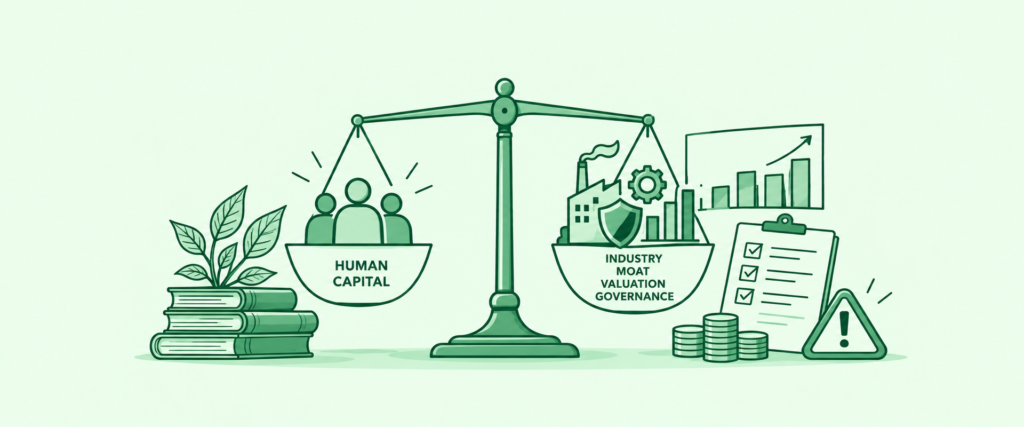
A word of caution belongs here. Strong human capital is necessary for investment success. It isn’t sufficient.
A brilliant team inside a structurally unattractive industry, facing commodity pricing, technological disruption or heavy regulation, will still struggle to create sustained shareholder value. Industry structure matters. Competitive moats matter. Valuation matters.
Some companies with extraordinary cultures have still been poor investments at certain prices. Paying thirty times earnings for a well-run business in a slow-growth sector rarely ends well, regardless of how much respect the management team has earned.
The sound approach treats human capital as one essential dimension inside a broader analysis. A company scores well when the business model holds up, the industry carries structural tailwinds, the valuation is sensible, governance is clean, and the people running it are capable and motivated. Remove any one and the case weakens considerably.
It also demands humility. Reading organisational culture from the outside is genuinely hard, and investors overconfident in their ability to read people can end up just as wrong as those who ignore the question entirely.
The people behind the price
A line often attributed to Warren Buffett captures something worth holding onto: in the long run, it’s hard for a stock to earn a much better return than the business underlying it earns.
If that holds, then a business’s durability ultimately traces back to decisions made by the people running it. Not just the founder or the CEO, but the entire system of talent, culture and management depth beneath them.
Market capitalisation can be inflated by liquidity, sentiment and narrative for a stretch, and can hold at elevated levels for years on momentum alone. Eventually it converges back toward the underlying earning power of the business, and that earning power gets shaped, year after year, by thousands of small decisions. Which customers to prioritise. Which products to build. Which risks to take.
Sustainable market capitalisation tends to rest on sustainable human capital underneath it.
For the long-term investor, that means widening the research process beyond the income statement. Reading annual reports for what management says about people and not just profits. Watching attrition trends alongside margin trends. And asking, for any business under consideration, whether its real competitive advantage lives in its people, and if so, whether those people actually have reason to stay.
The market tends to price what it can measure. That leaves the patient investor with a genuine edge: the ability to notice and value what the spreadsheet can’t capture.
Disclaimer:
This article is for informational and educational purposes only. It is not investment advice, and nothing here is a recommendation to buy or sell any security. Companies are named as illustrations. Research findings are cited as of the dates stated and are subject to revision. Please consult a SEBI-registered investment adviser before making financial decisions.
Sources:
Gallup, State of the Global Workplace 2026; McKinsey research on talent and productivity; SHRM research on turnover cost; LinkedIn Workplace Learning Report; Vuori & Huy, “Distributed Attention and Shared Emotions in the Innovation Process: How Nokia Lost the Smartphone Battle,” Administrative Science Quarterly (2016).