
Learnings from Their Biggest Mistakes
Eleven of the greatest investors alive or dead, and the losses that taught them more than any win.
Every legendary investor has a disaster in their record. What separates them isn’t avoiding mistakes. It’s what they built afterwards, which is usually a system designed to protect them from themselves.
The best teacher nobody wants
Think about the last time you burned your hand on a hot stove. You didn’t need a lecture after that.
Investing is the same. No book, no course, no podcast will teach you as deeply as losing real money on a real trade. The sting of a bad investment lodges itself somewhere no classroom can reach.
The greatest investors who ever lived, the ones who manage billions and write legendary letters and appear on magazine covers, burned their hands too. Many times.
Warren Buffett lost billions on a shoe company. Ray Dalio nearly went bankrupt. Bill Ackman lit billions on fire in front of the entire world. Rakesh Jhunjhunwala made bets that blew up spectacularly before he made the ones that made him a legend.
Warren Buffett: the shoes that cost a fortune
In 1993, Buffett bought Dexter Shoe Company for $433 million. That alone wasn’t unusual. He liked simple, durable businesses.
But he paid for it entirely in Berkshire Hathaway stock.
Within a few years the business was nearly worthless. Cheap foreign competition, mostly from China, crushed Dexter’s competitive advantage. The brand couldn’t survive and the business evaporated.
Meanwhile, the Berkshire shares he handed over kept compounding.
In his 2007 shareholder letter, Buffett wrote that to date Dexter was the worst deal he’d made, describing it as giving away 1.6% of a wonderful business, then valued at roughly $220 billion, to buy a worthless one.
By his 2014 letter, with Berkshire far larger, he put the cost differently: using Berkshire stock made the real cost to shareholders not $400 million but roughly $3.5 billion.
The same mistake, repriced upward by the thing he paid with.
Why did he do it? Buffett thought he understood Dexter’s moat. He was right about the business model in isolation. What he underestimated was the velocity of globalisation. Cheap imported shoes weren’t just competition, they were an extinction event for mid-market domestic shoe brands.
This is overconfidence bias: being more certain about a judgement than the evidence warrants. Even the best investors look at something familiar and assume the future will rhyme with the past.
The lesson: understanding a business isn’t enough. You must understand the forces that could destroy it. And when you’re paying with something as valuable as Berkshire stock, the cost of being wrong compounds for decades.
Buffett and Munger: missing Amazon and Google
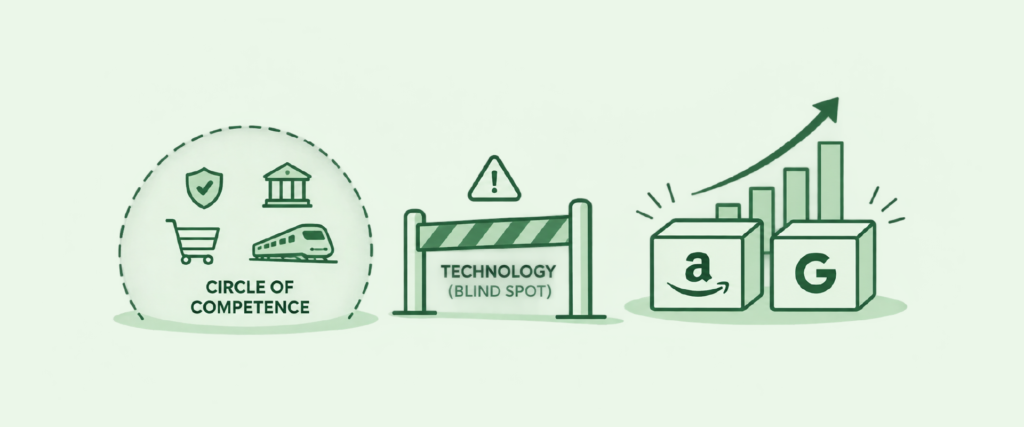
Buffett has repeatedly admitted that he watched Amazon grow from a startup into a trillion-dollar company and did nothing. He read Jeff Bezos’s shareholder letters every year. He admired Bezos openly. He never bought a share, and has said plainly that he was too slow to see what was coming.
Charlie Munger admitted the same about Google. Both men used Google’s advertising services extensively. Munger saw that Google had built one of the most powerful economic engines in history, an advertising business with almost no marginal cost. He knew, and didn’t act.
Why? Both operated with a framework built around circle of competence. They stuck to businesses they understood deeply: insurance, banking, consumer brands, railroads. Technology, in their view, was unpredictable and hard to value.
That caution served them extraordinarily well for decades. It also created a blind spot. The very discipline that made them great became a ceiling that kept them from recognising a new kind of moat: the network effect and data advantage of technology platforms.
Call it framework rigidity, when a mental model that has served you well stops being a tool and becomes a prison.
The lesson: staying within your circle of competence is wise. Refusing to expand that circle when the world changes can be its own kind of mistake. The point isn’t to abandon your framework. It’s to notice when the world has moved and your framework hasn’t.
Ray Dalio: the crash that almost broke everything
Ray Dalio founded Bridgewater Associates in 1975, which grew into the world’s largest hedge fund. His book Principles has sold millions of copies.
In 1982, he nearly lost everything.
In the early 1980s, Dalio became convinced the United States was heading toward a debt crisis. He made loud public predictions of a coming depression. He testified before Congress. He told anyone who would listen. He went all-in.
What actually happened? The economy entered one of the greatest bull markets in American history.
He lost almost all his clients’ money. He had to lay off his entire team. At one point he borrowed $4,000 from his father just to pay his bills. The firm nearly died in its crib.
Dalio has called it the most humbling experience of his life. He was so certain he was right that he never seriously stress-tested the possibility of being wrong.
The psychology is ego. Not arrogance in the shallow sense, Dalio is clearly brilliant. But the confidence that comes from being a contrarian who has been right before can harden into an unwillingness to genuinely consider the opposing view.
From that experience came what he calls radical open-mindedness: the deliberate, systematic effort to seek out people who disagree with you and actually hear them. He built Bridgewater around the idea.
“Pain plus reflection equals progress,” he wrote. That formula came directly from 1982.
Where things stand: Dalio stepped down as CEO in 2017, retired as co-CIO in September 2022, and sold his final stake in Bridgewater in August 2025, leaving the board entirely. The firm now manages roughly $92 to $102 billion, and its flagship Pure Alpha fund returned about 33% in 2025.
The lesson: being contrarian isn’t a strategy. Being right is a strategy. The only way to improve your odds is to actively seek evidence that you’re wrong. Ask: what would have to be true for me to be completely mistaken here?
Benjamin Graham: the father who learned caution the hard way
Benjamin Graham is the godfather of value investing. He taught Buffett. He wrote The Intelligent Investor, which Buffett has called the best book on investing ever written.
But his journey toward those principles was shaped by devastating loss.
Graham was badly hit by the 1929 crash and the Depression that followed. He had been doing well, using leverage and running concentrated positions through a bull market. His account lost roughly 70% of its value between 1929 and 1932. He survived, but it took years to recover.
From that wreckage came his most important ideas:
- Margin of safety: buying stocks well below intrinsic value
- Mr. Market: the metaphor of an irrational market that offers you prices daily, which you should exploit rather than obey
- Treating stocks as ownership in real businesses rather than ticker symbols
The psychology: Graham saw first-hand what happens when euphoria takes over. He saw smart people, himself included, start to believe prices would rise forever. He built an entire investment philosophy designed to protect against the most dangerous thing in investing: yourself.
The lesson: the market will seduce you. It will make you feel clever when prices go up and stupid when they fall. Graham’s gift is the reminder that price and value are not the same thing.
Peter Lynch: too many stocks, too little focus
Peter Lynch ran Fidelity’s Magellan Fund from 1977 to 1990 and averaged a 29.2% annual return, one of the greatest track records in history.
But he has been honest about a pattern he fell into, which he named himself: di-worse-ification. Over-diversification that dilutes returns without meaningfully reducing risk.
At one point Magellan held over 1,400 stocks. Lynch admitted some positions were thin on conviction, bought more from fear of missing something than from genuine research. When you hold 1,400 stocks, it’s mathematically impossible to know each one deeply.
He also admitted to selling winners too early and holding losers too long. That’s the disposition effect: taking profits quickly to feel the pleasure of being right, and delaying losses to avoid the pain of being wrong.
The lesson: know what you own and why. Lynch’s test, can you explain in two minutes, in language a child could understand, why you own this stock, is still one of the most practical filters in investing. If you can’t answer, you probably shouldn’t own it.
Bill Ackman: the trade that defined him and nearly broke him
Bill Ackman runs Pershing Square Capital Management, and his presentations are legendary for their depth and theatricality.
In 2015 he made a massive bet on Valeant Pharmaceuticals. At its peak the position was worth billions. He didn’t just invest, he became one of Valeant’s most vocal public advocates.
The thesis was that Valeant could grow by aggressively acquiring drug companies and raising prices on existing drugs while cutting R&D. A financial engineering story more than a science one.
Then it fell apart. Valeant’s drug pricing attracted Congressional scrutiny. Questions arose about its accounting. The stock collapsed from over $260 to under $11. Ackman exited in March 2017, booking a loss widely reported at around $4 billion.
What’s painful is that Ackman saw warning signs and kept doubling down. He publicly defended the company as problems mounted. He became personally identified with the trade.
This is a sunk cost fallacy combined with confirmation bias. When your ego attaches to a position, it stops being a trade and becomes a personal statement.
Ackman has since said he learned to be more careful about position sizing and about how much personal credibility he puts on the line publicly, because public commitment makes it psychologically harder to change your mind.
The lesson: separate your ego from your positions. A stock doesn’t know you own it. It doesn’t care about your reputation. The moment you need a trade to work for reasons unrelated to fundamentals, you’re no longer investing.
George Soros: the man who knows he’s wrong
Soros famously broke the Bank of England in 1992, making over a billion dollars in a single trade.
He has also made enormous errors. In early 2000, during the dot-com bubble, the Quantum Fund, then run day to day by Stanley Druckenmiller, initially missed the tech rally, tried to catch up, and was caught badly when the bubble broke. The fund reportedly lost billions within months, and Soros restructured his operation afterwards.
What’s remarkable is his framework for his own fallibility. He developed reflexivity: the idea that markets aren’t simply reflections of reality, but that investor perceptions actively shape reality, creating self-reinforcing loops that eventually break.
In practice, Soros always assumes he might be wrong. In The Alchemy of Finance, he describes keeping tight stop-losses not because he lacks conviction but because he fundamentally distrusts his own convictions.
“It’s not whether you’re right or wrong that’s important, but how much money you make when you’re right and how much you lose when you’re wrong.”
The lesson: intellectual humility is a competitive advantage. The investor who says “I might be wrong, so I’ll limit my downside” survives to invest another day.
Howard Marks: the wisdom of not knowing
Howard Marks co-founded Oaktree Capital and writes some of the most respected memos in investment history.
His central intellectual journey was learning that the future is unknowable, and that accepting this rather than fighting it is the key to sound investing.
Early in his career he was tempted to make confident macro forecasts. Over decades he watched those forecasts, his own and others’, fail repeatedly. Not because analysts were stupid, but because the world is genuinely complex and nonlinear.
His mistake, and most investors’ mistake, was confusing the desire for certainty with the ability to achieve it.
Marks’s position is that the future isn’t knowable, but you can know whether assets are overpriced or underpriced relative to their risk. He now focuses almost entirely on positioning for uncertainty: understanding where we are in the cycle, where risk is mispriced, and sizing accordingly.
The lesson: stop trying to predict the future. Start trying to understand the present. If assets are expensive relative to fundamentals, reduce risk. If cheap, take on more. That’s the entire game, and it doesn’t require a crystal ball.
Rakesh Jhunjhunwala: the Big Bull
Rakesh Jhunjhunwala, India’s most celebrated retail investor, started with roughly ₹5,000 and built a fortune worth tens of thousands of crores by his death in August 2022.
He was not immune to mistakes. He made large bets on companies that didn’t pan out, with several positions seeing significant declines after his entry.
But what defined him wasn’t the mistakes. It was his attitude toward them. He spoke openly about risk, saying that if you aren’t willing to lose, you aren’t willing to win. He understood that in equity markets you will be wrong a meaningful percentage of the time. The question is whether your wins are big enough and your framework sound enough to survive the losses.
He was also candid about the psychological temptation of overconfidence after a big win. A big success makes you feel invincible, and that feeling is the most dangerous one in investing. Several of his losses came after long winning streaks.
“I am a big risk-taker,” he once said. “But I understand the risk I am taking.”
The lesson: knowing your risk tolerance isn’t just about numbers, it’s about self-knowledge. Are you taking risk because the opportunity warrants it, or because a run of wins has made you feel you can’t be wrong?
Mohnish Pabrai: the checklist that came from failure
Mohnish Pabrai is a deep value investor, a student of Buffett and Munger, and the author of The Dhandho Investor.
His most instructive story comes from 2008, when his funds lost roughly two-thirds of their value. He had been invested in financial and cyclical businesses far more exposed to the credit crisis than his analysis suggested.
In the aftermath he did something few investors have the discipline to do. He systematically diagnosed every mistake, listed every decision that had gone wrong, and reverse-engineered the reasoning. Then he built a checklist, modelled on aviation’s use of checklists to prevent human error, to ensure those specific mistakes couldn’t recur.
His checklist reportedly runs to over 100 questions. Is this business highly leveraged? Is revenue dependent on a single customer? Am I the last buyer at this price?
Pabrai’s framing is that checklists are a humble admission that our brains aren’t reliable enough to remember everything, especially under stress.
The lesson: diagnosis is the precondition of improvement. After every significant loss, ask what went wrong in your process, not just in the outcome.
Cathie Wood: conviction without humility
Cathie Wood’s ARK Innovation ETF became a phenomenon during the pandemic, returning roughly 153% in 2020 by concentrating heavily in high-growth technology and genomics names.
She became a celebrity investor. Retail money poured in.
Then the rate environment changed. As the Federal Reserve began hiking in 2022, the high-growth, often unprofitable companies ARK held were hit hardest. ARKK fell about 67% in 2022 alone, and roughly 75 to 80% from its February 2021 peak.
Wood doubled down, publicly predicting enormous returns. Her conviction was extraordinary and, to her credit, genuinely held.
And here’s the part most tellings of this story miss. The fund recovered. ARKK returned roughly 68% in 2023, 8% in 2024, and 35% in 2025.
And investors still lost money.
|
Measure |
Result |
|
ARKK return since 2014 inception |
About 13.8% a year, roughly matching the S&P 500 |
|
Five-year annualised return (as of 2026) |
Still negative |
|
Investor wealth created or destroyed, 2014 to 2024 |
Roughly $7 billion destroyed, per Morningstar analysis |
How can a fund roughly match the index over its life while destroying billions for the people in it?
Because the fund’s return and the investors’ return are different numbers. The fund’s performance is measured from inception. Investors’ performance depends on when they bought. Most of the money arrived after the 2020 run and before the 2022 collapse, which means the average dollar invested in ARKK experienced the fall without the rise.
That gap, between time-weighted and dollar-weighted returns, is one of the most underappreciated ideas in investing.
The lesson: a right thesis in the wrong vehicle, or with the wrong time horizon, can still destroy wealth. Concentration amplifies both directions. Know whether your own financial situation can survive the journey to your destination, because the fund’s track record won’t be your track record unless your timing matches.
What every ordinary investor can do with this
You don’t need to manage billions to apply these lessons.
- Write down your thesis before you buy. One paragraph. Why is this a good investment? What would have to happen for you to be wrong? This forces clarity and gives you a benchmark to return to.
- Build a personal checklist. Is the business highly leveraged? Am I buying at a historically expensive valuation? Am I chasing recent performance? Is my conviction based on analysis or on how confident the narrative sounds?
- Size positions for the possibility of being wrong. Even your best ideas shouldn’t be so large that being wrong ends your ability to invest. As Soros understood, how much you lose when you’re wrong matters as much as how much you make when you’re right.
- Separate your ego from your portfolio. Don’t post publicly about trades before they play out. Don’t let a position become part of your identity. The market doesn’t care who you are.
- Build a post-mortem habit. After every exit, win or lose, spend thirty minutes writing down what you got right, what you got wrong, and what you’d do differently. This is the mechanism by which experience becomes wisdom.
Conclusion
There is a line, often attributed to Will Rogers: “Good judgment comes from experience, and a lot of that comes from bad judgment.”
Mistakes in investing are not failures. They are feedback. And feedback, properly processed, is the only thing that makes any of us better.
So the next time a trade goes wrong, and it will, don’t just feel the pain. Understand it. Name it. Write it down. Then come back to the market with one more lesson in your pocket.
Disclaimer:
This article is for informational and educational purposes only. It is not investment advice, and nothing here is a recommendation to buy or sell any security or fund. Descriptions of investors’ decisions are drawn from publicly available statements, letters, interviews and reporting. Performance figures relate to the periods stated and are subject to change. Past performance does not indicate future results. Please consult a SEBI-registered investment adviser before making financial decisions.