
The Curious Case of Kitex Garments
What a decade of questions about one small-cap favourite teaches about reading past the numbers.
Between 2014 and 2016, Kitex Garments posted margins a contract manufacturer arguably shouldn’t be able to earn. Investors who looked closer found a cluster of questions about related parties, cash management and governance. None was ever proven to be wrongdoing. All of it was enough to change how the market priced the company.
Note on scope: the detailed analysis below covers FY12 to FY16, the period when these questions were most actively debated. Section 10 covers what has changed since, including a corporate restructuring currently underway that directly addresses the central concern raised at the time.
What the company actually does
Kitex Garments is based in Kizhakkambalam, Kerala, and manufactures baby and children’s clothing for large international brands. It has supplied names including Gerber, Mothercare, Jockey and Carter’s.
It doesn’t sell under its own label in its core export business. It builds garments for other people’s brands, and those brands take the finished product to customers worldwide.
Around 2015 and 2016, Kitex became one of the most discussed small-cap names on the Indian market. Investors were drawn by very high profit margins, strong return ratios, fast growth, and cash generation that looked almost too good for a business this size. For a stretch, plenty of people were calling it a hidden gem.
Right around that same period, questions started surfacing.
|
Metric |
FY12 |
FY13 |
FY14 |
FY15 |
FY16 |
|
Kitex revenue (₹ cr) |
321.0 |
317.1 |
454.4 |
524.7 |
565.3 |
|
Kitex EBITDA (₹ cr) |
65.7 |
65.8 |
110.2 |
184.1 |
208.5 |
|
Kitex EBITDA margin |
20.5% |
20.8% |
24.3% |
35.1% |
36.9% |
|
Kitex pre-tax ROCE |
34.5% |
32.8% |
51.3% |
75.4% |
81.9% |
|
Page Industries revenue (₹ cr) |
705.7 |
908.1 |
1,252.7 |
1,622.8 |
1,865.9 |
|
Page Industries EBITDA (₹ cr) |
154.8 |
189.1 |
[verify] |
328.6 |
384.4 |
|
Page Industries EBITDA margin |
21.9% |
20.8% |
21.0% |
20.2% |
20.6% |
|
Page Industries pre-tax ROCE |
54.8% |
58.0% |
57.9% |
54.9% |
55.3% |
Look at the margin rows. A contract manufacturer earning nearly double the EBITDA margin of one of India’s strongest branded apparel businesses.
Margins that made no sense for the business
The obvious question: how does a garment manufacturer end up earning margins higher than many branded companies?
Garment manufacturing is normally a low margin trade. Retailers hold most of the bargaining power. Manufacturers compete hard on price. The products aren’t particularly differentiated, and customers can switch suppliers whenever it suits them.
Yet Kitex was posting EBITDA margins in the 25 to 35% range, alongside high ROCE, high ROE and strong free cash flow. Numbers plenty of well-known branded apparel companies couldn’t consistently match.
Manufacturers typically don’t hold pricing power, because they produce for the brands and retailers who own the relationship with the end customer. A contract manufacturer doesn’t control the brand, doesn’t control retail pricing, and doesn’t control end demand. Page Industries, Nike or Adidas can charge a premium precisely because customers recognise their name.
So investors asked the obvious follow-ups. Was the business genuinely this efficient? Were costs being recognised somewhere else?
In fairness to the company, there are legitimate explanations for unusual margins in this industry: deep vertical integration, long-standing customer relationships, specialisation in infant wear where compliance requirements create switching costs, and a low-cost manufacturing base. Kitex has consistently pointed to its integrated operations. The question investors kept returning to wasn’t whether such margins were possible, but whether they were sustainable and fully explained.
The related party problem
The promoters behind Kitex Garments also owned a separate business, Kitex Childrenswear Limited. By most accounts the second company operated in a strikingly similar space: similar products, similar infrastructure, overlapping customers. Some rating agencies assessed the two together, given how closely their operations appeared linked.
That naturally worried investors. Holding shares in a listed company while the same promoters run a private business doing nearly identical work raises a few questions almost automatically:
- Which entity gets the better opportunities?
- Which one ends up more profitable?
- Could costs or benefits shift from one side to the other?
Having the same promoters control both entities creates a structural conflict of interest, and minority shareholders are left wondering whether the listed company captures its fair share of the growth on offer.
Over time the promoter group added more entities: Kitex Infantswear, Kitex Apparels, Kitex Herbals. Most sat outside the listed structure.
A natural question followed. If the underlying opportunity was genuinely this strong, why keep building new ventures inside private companies rather than growing the listed entity?
This is the concern that has since been addressed most directly. See section 9.
The cash pile’s unusual behaviour
Normally when a company sits on a large cash balance, investors expect it to be put to use: paying down debt, cutting interest costs, returning cash through dividends, or reinvesting in growth.
Through this period, Kitex did none of these. Despite carrying a sizable cash reserve, it kept its debt in place and kept paying interest on it.
|
₹ crore |
FY12 |
FY13 |
FY14 |
FY15 |
FY16 |
|
Total debt |
101.5 |
101.2 |
134.2 |
161.2 |
110.1 |
|
Interest cost |
18.8 |
13.1 |
12.3 |
21.1 |
16.1 |
|
Average cost of debt |
17.9% |
12.9% |
10.5% |
14.3% |
11.9% |
|
Cash and equivalents |
36.5 |
41.2 |
103.6 |
203.3 |
254.5 |
|
Interest income |
0.3 |
0.4 |
0.4 |
0.4 |
0.3 |
|
Average interest earned on cash |
1.4% |
1.0% |
0.6% |
0.3% |
0.1% |
Between FY12 and FY16, cash climbed from ₹36.5 crore to ₹254.5 crore while debt stayed meaningful at ₹110.1 crore. Over the same stretch the company was paying 10 to 18% on borrowings while earning 0.1 to 1.4% on the cash it held.
Management’s explanation was that a large portion of the cash sat in US dollars rather than being converted to rupees. The reasoning: if the rupee weakened, converting later would yield more.
It’s a defensible argument on its face. Plenty of investors weren’t convinced. Their counter was straightforward: a garment manufacturer should focus on making and selling garments, not taking positions on currency. Questions were also raised about RBI foreign exchange rules and how long export earnings could sit in foreign currency accounts.
None of this proved anything wrong on its own. Stacked alongside the margins and the related party structure, it added another layer of doubt about capital allocation.
The CFO left without warning
In 2016, Kitex’s CFO resigned suddenly, in the middle of a period when the company was already fielding tough questions about margins, cash management and governance.
Given that backdrop, investors wondered whether something internal had gone wrong.
Management’s position was that this was a normal career move with nothing more to it. Many investors stayed unconvinced, because the resignation landed on top of an already growing pile of unresolved questions.
Worth noting the general principle rather than the specific case: executive departures are ordinary events, and the vast majority have ordinary explanations. They attract attention mainly when they coincide with other unanswered questions, which is what happened here.
A subsidy story
Management had pointed to the government’s Technology Upgradation Fund Scheme as one reason the company wasn’t in a hurry to repay debt, arguing the subsidy brought the effective interest cost down from around 12% to roughly 7%.
Investors checked the numbers.
Over seven years, Kitex reported only about ₹12 crore of TUFS subsidy income in total, most of it between FY10 and FY12. In the three years when the company was generating the bulk of its cash, it received around ₹2 crore.
Of that ₹12 crore reported, only about ₹3.3 crore had actually been collected. The remaining ₹8.7 crore sat on the books as a receivable as of FY16, and for the two preceding years the company hadn’t received anything under the scheme.
That left a pointed question. If TUFS was the reason for keeping debt on the books, why was the money involved so small, and why was most of it still unpaid years later?
Suspiciously fast audits
Something else drew attention: how quickly Kitex published audited results. The company routinely announced final audited numbers within days of the financial year closing.
Auditors normally need time to verify inventory, check assets, review transactions, and obtain confirmations from banks and customers. Wrapping up an audit in that window struck many as unusual.
Kitex’s auditor at the time was a small local firm, whereas companies of comparable scale often engage larger firms that typically take several weeks. Investors also noted that while annual results came remarkably fast, certain regulatory filings ran late.
Fast reporting is not evidence of anything by itself, and some companies genuinely have clean, well-maintained books. It became a question because of what surrounded it.
Too much riding on too few customers
Kitex relied heavily on a small handful of large customers for the bulk of revenue. If even one scaled back orders or switched suppliers, the impact on revenue and margins would be significant.
This is a structural feature of contract manufacturing rather than a governance concern, but it makes the business more fragile and more dependent on a narrow set of relationships. The subsequent bankruptcy of Toys R Us, a customer named in that era, illustrated the risk concretely.
What changed after 2016
A decade is a long time, and the company today looks materially different.
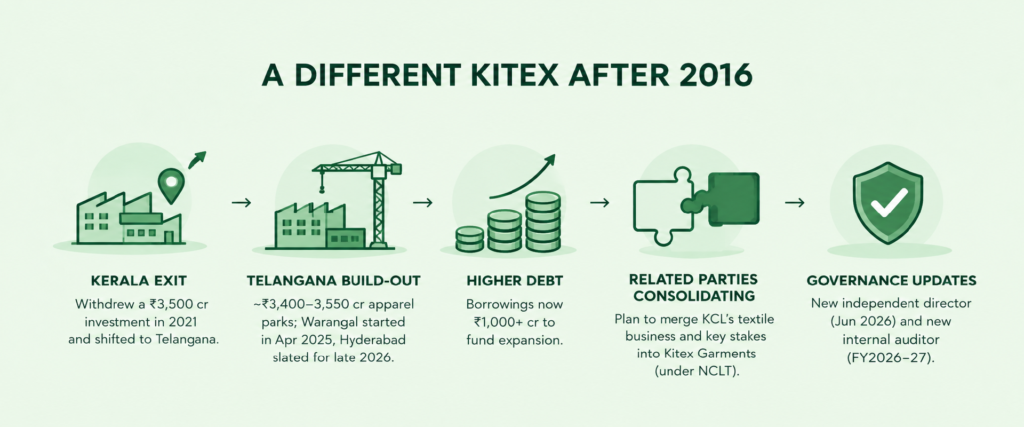
The Kerala exit. In 2021, chairman Sabu Jacob publicly withdrew a proposed ₹3,500 crore investment in Kerala, citing harassment and bureaucratic obstruction, and announced the company would invest in Telangana instead. It became a significant national story about industrial policy and state competitiveness.
The Telangana build-out. Kitex Apparel Parks Limited was incorporated in November 2021, owned 70:30 by Kitex Garments and Kitex Childrenswear, for integrated apparel parks in Warangal and Hyderabad. Investment has been put at roughly ₹3,400 to 3,550 crore. Warangal Phase I commenced commercial production in April 2025, with Hyderabad Phase II slated for late 2026.
The debt question has inverted. Where investors once asked why the company held debt despite a large cash pile, total borrowings have since climbed past ₹1,000 crore to fund this expansion. The question now is whether a project of that scale can generate returns to justify it.
The related party structure is being consolidated. This is the most significant development for anyone reading the concerns above.
In April 2025 the board approved a Scheme of Arrangement to demerge Kitex Childrenswear’s Textile Business Division into Kitex Garments. The scheme, before the NCLT Kochi Bench, brings KCL’s textile business, its 30% stake in Kitex Apparel Parks and its 50% holding in Kitex USA into the listed company. A shareholder meeting on the scheme was held on 24 July 2026. KCL’s holding in Kitex Garments reduces from 15.92% to 10.89%.
If completed as proposed, this moves the overlapping business inside the listed entity, which is precisely what minority shareholders were asking for a decade ago.
Governance and audit changes. The company appointed a new independent director in June 2026 and engaged a new internal auditor for FY2026-27.
The scale is different. Q3 FY25 revenue rose roughly 71% year on year, and the company has been pursuing a domestic brand alongside its export business.
How to read this. Some concerns from 2016 have been addressed structurally. Others have been replaced by new questions appropriate to a company executing a capital-intensive expansion. Whether the current strategy works is a separate question from whether the old concerns were valid, and neither is settled by the other.
What the Kitex story teaches
None of the questions raised in 2015 and 2016 ever resulted in a finding of wrongdoing. That’s worth stating plainly.
What they did was change how the market priced the company, because taken together they were enough to make investors cautious and to chip away at confidence.
That’s the lesson. Not that Kitex did anything wrong, but that a cluster of individually explainable things can collectively shift how a business is valued, regardless of whether any single item is ever proven problematic.
Strong numbers alone are never the whole picture. Understanding the people running a company, how they treat governance, and how they allocate capital matters just as much as anything in the income statement.
In investing, trust tends to disappear a lot faster than profits. And often, the biggest risks are hidden in how a business is being run rather than in what it reports.
Disclaimer:
This article discusses publicly reported concerns raised by investors and analysts regarding Kitex Garments Limited during 2015 and 2016, based on publicly available financial statements and contemporaneous commentary. No regulatory finding of wrongdoing has been made against Kitex Garments Limited or its promoters in connection with the matters described. Where available, the company’s explanations have been included. Financial data relates to the periods stated and subsequent developments are summarised in section 9. This article is for informational and educational purposes only, is not investment advice, and is not a recommendation to buy or sell any security. Please consult a SEBI-registered investment adviser before making financial decisions.