
The Ultimate Dumping Yard
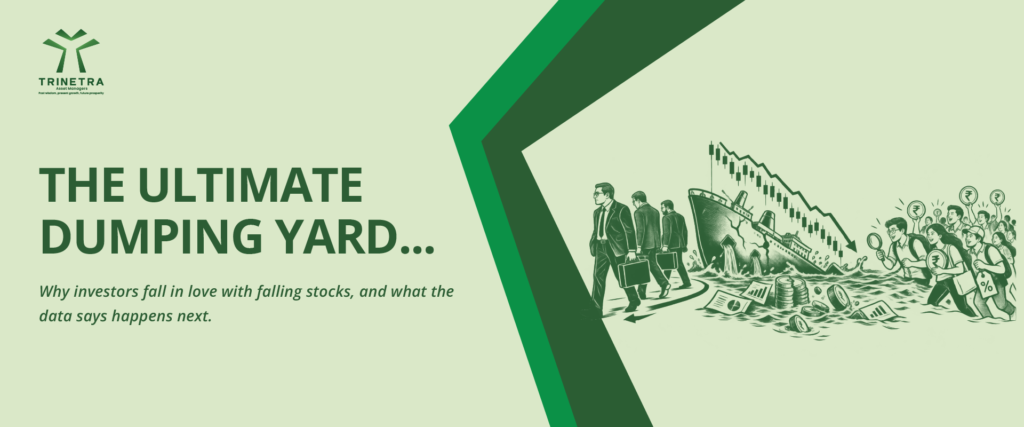
Why investors fall in love with falling stocks, and what the data says happens next.
A falling price feels like a discount. In the market it often means informed holders are leaving and the business is deteriorating. Retail ownership in collapsing stocks tends to rise the whole way down, which is ownership transferring from people who know to people who hope.
A stock falls from ₹500 to ₹300 and nobody pays attention. At ₹150, people start discussing it. At ₹80, everyone thinks they’ve found a great opportunity.
The business underneath might be deteriorating every quarter, yet investor interest keeps climbing the whole way down.
Why does this happen, and why does it cost so many investors real money?
The shopping habit we bring into the market
Walk into a mall, see a shirt priced at ₹2,000, walk past it. A week later the same shirt is ₹800, and suddenly it looks attractive.
The product hasn’t changed at all. The lower price just makes it feel like a bargain.
That logic works fine for clothes, shoes or phones. The stock market runs on different rules.
A stock represents a business, and sometimes a stock falls because the business itself is genuinely getting weaker. Plenty of investors fixate on the discount alone and never ask what’s driving it.
The silent exit
Picture a ship sailing smoothly across open water. From a distance everything looks fine, but a handful of crew members already know water is leaking into the lower decks.
Rather than raising an alarm, they move quietly toward the lifeboats. The passengers don’t notice a thing. Some even see empty deck space opening up and happily move into it.
The ship stays crowded the whole time, even as the people who understand what’s happening are already leaving.
Plenty of stocks follow the same pattern. As informed investors slowly exit, the price falls, and retail investors watching from outside see the lower price and assume they’ve found a bargain. What they often don’t realise is that the shares they’re buying may be the very shares the more experienced investors are trying to offload.
A growing crowd isn’t always a sign of opportunity. Sometimes it’s ownership shifting from informed hands to hopeful ones.
The crowd arrives at the wrong time
One of the odder patterns in markets is how investor interest often peaks only after a stock has already fallen hard.
Nobody wanted the stock at ₹500. Few wanted it at ₹300. Everyone suddenly wants it at ₹50.
But a stock has no memory of where it came from. The market doesn’t care whether it once traded at ₹500, ₹200 or ₹50. What matters is what the underlying business is worth today.
A weak business at ₹50 can still be expensive. A genuinely great business at ₹2,000 can still be cheap.
More shareholders doesn’t mean a better business
Watching the shareholder count climb feels reassuring, as if that many buyers must know something worth knowing.
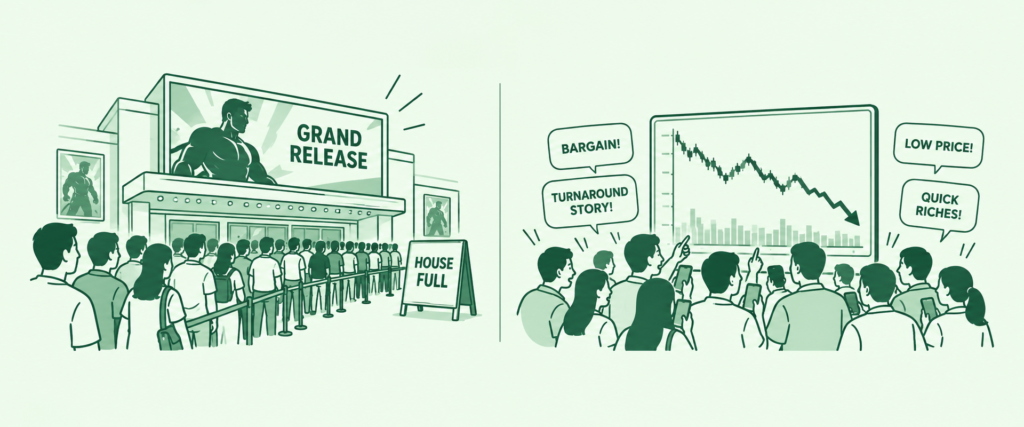
Crowds aren’t always right. Think of a film that arrives with heavy pre-release hype, sells out on opening day, then fades from conversation within a week. The crowd showed up for the excitement, not because the film was good.
Stocks follow the same pattern. People get pulled in by a low price, a turnaround story, or the promise of quick riches, while very few spend time studying the business underneath.
A pattern hidden in plain sight
Consider companies where the share of shareholders holding less than ₹1 lakh worth of stock, typically small retail investors, spiked sharply between 2015 and 2018. Filtering for a major jump in small retail participation turns up 74 companies.
What happened to those stocks after the crowd arrived was brutal.
|
Outcome by December 2018 |
Share of the 74 companies |
|
Lost more than 75% |
42% |
|
Lost 50 to 75% |
26% |
|
Lost 25 to 50% |
18% |
|
Lost 0 to 25% |
5% |
|
Generated positive returns |
9% |
91% of these companies failed to create any wealth for the investors who piled in. Only 9% delivered a positive return.
The more striking part is that these weren’t obscure names. Many were popular stocks drawing significant retail attention at the time.
|
Company |
Price at spike |
Price, Dec 2018 |
Return |
|
Castex Technologies |
₹77.80 |
₹1.30 |
-98% |
|
Videocon Industries |
₹123.25 |
₹4.00 |
-97% |
|
Orchid Pharma |
₹65.05 |
₹5.60 |
-91% |
|
PC Jeweller |
₹460.15 |
₹69.40 |
-85% |
|
Punj Lloyd |
₹37.30 |
₹7.00 |
-81% |
|
DHFL |
₹590.00 |
₹214.50 |
-64% |
|
Jet Airways |
₹835.00 |
₹316.00 |
-62% |
|
Reliance Communications |
₹37.45 |
₹15.50 |
-59% |
Prices as reported at the time and not adjusted for subsequent corporate actions.
Most investors in these names didn’t buy anywhere near the top. They bought after the stock had already fallen sharply, which is exactly what makes the pattern worth paying attention to.
The same pattern, more recently
The dynamic hasn’t gone away. Across the years since, rising retail participation has continued to coincide with falling share prices.
As prices fall, more investors read the stock as a bargain, and retail ownership climbs steadily even as shareholder wealth gets destroyed.
|
Company |
Retail holding, March 2017 |
Retail holding, recent |
Price change over the period |
|
Vakrangee |
29.14% |
55.37% |
-98% |
|
Reliance Communications |
15.13% |
93.97% |
-97% |
|
Yes Bank |
9.85% |
31.74% |
-94% |
|
Sammaan Capital (formerly Indiabulls Housing Finance) |
9.26% |
66.39% |
-82% |
|
PC Jeweller |
6.47% |
43.46% |
-75% |
|
Unitech |
65.47% |
93.37% |
-50% |
Retail holding figures are shareholding-pattern disclosures. Prices are adjusted for corporate actions where applicable, so figures may differ from the table above. Insert the as-of date before publishing.
The pattern is consistent. In every case, the shareholder base got more retail as the price got worse.
Who was actually selling?
Every buyer needs a seller on the other side of the trade.
When thousands of retail investors start buying a stock purely because it looks cheap, somebody else is choosing to exit those same shares. Which raises a fair question: if the stock is genuinely such a good opportunity, why is someone else so willing to walk away from it?
In case after case, rising retail participation coincided directly with a falling share price. Retail investors were drawn in by the lower price and the hope of a turnaround. Institutions, promoters and other informed investors were often reducing exposure precisely because they could see risk building inside the business.
Ownership gradually shifts from informed hands to hopeful ones. By the time the underlying problems become impossible to ignore, most of the informed money has already left, leaving retail investors holding shares that keep destroying value.
Conclusion
The stock market rewards good businesses, not low prices.
Plenty of investors get drawn to stocks that have fallen sharply simply because they look cheap, but a lower price never automatically means a better opportunity sits behind it. The data here makes that fairly plain. Rising retail participation has repeatedly coincided with falling prices and real wealth destruction.
Before buying any stock, the business quality, its earnings and its actual prospects deserve far more attention than how far the price has already fallen.
Often, just as retail investors rush in chasing a bargain, institutions, promoters and other informed participants are quietly heading the other way, handing ownership over on their way out.
Disclaimer:
This article is for informational and educational purposes only. It is not investment advice, and nothing here is a recommendation to buy or sell any security. Companies are named as historical illustrations of a market pattern. Share prices and shareholding data are as of the dates stated and change continuously. Please consult a SEBI-registered investment adviser before making financial decisions.