
What China’s Tech Crackdown Reveals About Risk
Adapted from Aswath Damodaran’s essay, “China’s Tech Crackdown: Market Adjustment or Market Meltdown,” with what happened next.
Between 2020 and 2023, Chinese regulators reshaped entire industries with little warning. The businesses stayed profitable. Investors simply decided that profits earned inside an unpredictable rulebook were worth less. Over a trillion dollars in value disappeared, and the lesson generalises far beyond China.
The apartment building
Picture yourself owning an apartment building. Tenants are content, rent arrives on time, occupancy is close to full, and your income keeps climbing year after year. Anyone looking to buy that building would likely pay a premium, because the future looks stable and easy to predict.
Then the government announces it can cap rents whenever it chooses, decide who’s allowed to live there, and force some units to be leased below market rates.
Nothing about the building itself has changed. The same tenants remain, rent stays the same, the property still generates that income. And the building’s value drops immediately.
The rules around the building have shifted. Investors no longer feel confident that future cash flows will stay under the owner’s control. Even with today’s income fully intact, uncertainty about tomorrow’s income makes the whole asset worth less.
That captures what happened to China’s technology sector in 2020 and 2021. The businesses kept operating. Customers kept using their products. Profits didn’t vanish overnight. But investors saw how the rules changed, and once that understanding spread, valuations across the sector fell sharply.
How China rose in the first place
Before getting into the crackdown, it helps to understand why investors were so drawn to China to begin with.
Over recent decades, China moved from a relatively minor player in the global economy into one of the largest economic powers on the planet. Its share of global GDP climbed dramatically, and the country became one of the biggest engines of global growth.
For a lot of investors, China wasn’t just another market. It was arguably the most important growth story of a generation, and that rise laid the foundation on which China’s tech giants would eventually build.
The golden years of Chinese tech
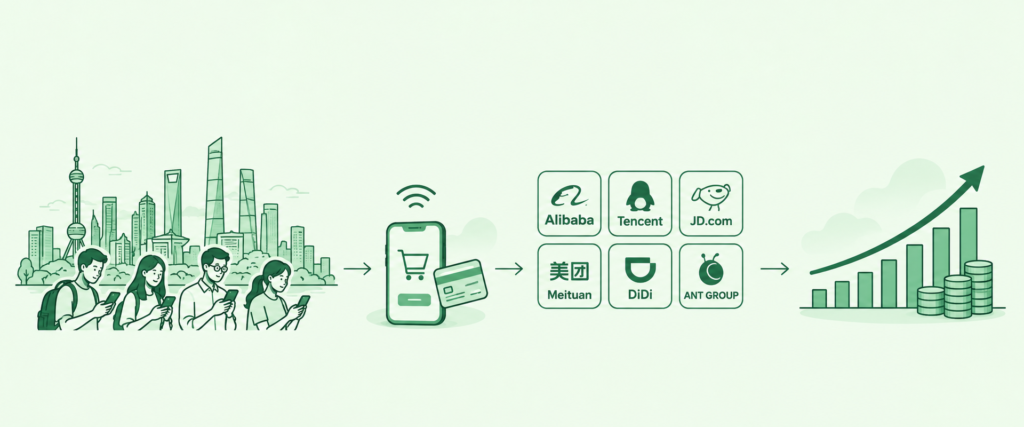
For most of the 2010s, China looked like one of the best growth stories anywhere in the world. Rising incomes, expanding internet access, near-universal smartphone adoption and a rapid shift toward digital payments and online shopping created enormous openings for businesses of every kind.
At the centre sat Alibaba, Tencent, JD.com, Meituan, Didi and Ant Group. Each rode China’s expanding digital economy and became woven deeply into the daily habits of hundreds of millions of consumers.
Year after year, these companies added users, processed more transactions, posted higher revenues and reported stronger profits. As the growth compounded, investors grew increasingly confident it would carry on, and that confidence showed up clearly in soaring share prices.
By the end of the decade, China’s tech giants were widely seen as some of the most attractive growth investments anywhere in the world.
When success breeds blind spots
Success builds confidence, and too much of it quietly tips into overconfidence. This happens in investing more often than most people realise. When a company keeps growing year after year, investors gradually stop asking the harder questions. Instead of probing what could go wrong, attention drifts toward every reason growth might continue indefinitely.
That’s roughly what happened across Chinese tech. Conversations centred almost entirely on revenue growth, user numbers, market opportunity, profitability and innovation, while political risk, regulatory risk and the possibility of direct government intervention received far less attention than they deserved.
The underlying assumption seemed reasonable at the time. China wanted economic growth, these companies were clearly delivering it, so investors assumed the government would keep backing them.
It was a widely shared belief, right up until events proved otherwise.
The timeline: five shocks in nine months
|
Event |
Date |
Impact |
|
Ant IPO suspended |
November 2020 |
What would have been a record $37 billion listing, cancelled days before it priced |
|
Alibaba antitrust fine |
April 2021 |
Roughly $2.8 billion, about 4% of 2019 domestic revenue |
|
Didi investigation |
July 2021 |
Cybersecurity probe days after its US listing; app pulled from stores |
|
Education crackdown |
July 2021 |
Private tutoring industry restructured; sector valuations collapsed |
|
Gaming restrictions |
August 2021 |
Limits on minors’ playing time, tighter oversight, growth expectations cut |
Ant Group was the first real jolt. The offering was heavily oversubscribed and everything pointed toward a record-breaking listing. Then, days before, regulators pulled the plug. The surprise wasn’t that regulators stepped in, since governments regulate businesses everywhere. What shocked investors was how sudden and unpredictable the move was.
Alibaba’s fine landed next, among the largest antitrust penalties ever handed to a technology company. At first, many investors weren’t alarmed. Antitrust actions against dominant tech firms had already become routine in the US and Europe. Had the story ended there, markets would likely have treated it as an isolated event.
Didi changed the conversation. The company completed a major US listing in June 2021, initially read as a sign of strength. Within days, regulators launched a cybersecurity investigation, its app disappeared from app stores, and its stock fell sharply. The concern was no longer about one company facing a fine. If a company could complete a major IPO and still face swift regulatory action days later, could the same happen to anyone?
Education and gaming made the scope clear. Tutoring companies could no longer operate the way investors had expected, and names like New Oriental and TAL Education lost the bulk of their value almost overnight. The reasoning centred on educational inequality and financial strain on families. Policymakers chose social goals over shareholder interests, explicitly.
Together these measures showed that government policy could reshape entire industries overnight, regardless of how successful those industries looked from a purely business standpoint.
What investors first assumed was happening
When Alibaba was fined, most investors weren’t much worried. The explanation seemed straightforward: China was doing what plenty of other governments were already doing. Europe had fined major tech firms before, and US regulators were tightening scrutiny on Google, Meta and Amazon.
Given that backdrop, investors largely read the situation as being about competition and market power. Companies would pay their fines, adjust a few practices, and carry on much as before.
But as more actions followed, one after another, investors began to sense the story ran deeper. The questions they asked started to change, and so did their view of the risks tied to owning Chinese companies.
The overlooked risk in the ownership structure
Most foreign investors believed they were buying shares directly in companies like Alibaba, Tencent or Baidu. It was more complicated than that.
Because China restricts foreign ownership in certain industries, many Chinese companies relied on a structure called a Variable Interest Entity, or VIE. Rather than owning shares in the actual Chinese operating company, foreign investors owned shares in a separate entity, usually registered somewhere like the Cayman Islands. That offshore entity held contractual agreements entitling it to a share of the profits generated by the underlying Chinese business.
For years the arrangement drew little scrutiny because it appeared to work. Companies grew, profits flowed through as expected, shareholders benefited.
The crackdown changed that. Investors began asking a basic but important question: what happens if the government decides to challenge or reinterpret these contractual arrangements?
Even with a strong underlying business, an investor’s actual claim depended entirely on legal agreements operating inside China’s regulatory framework. Owning these shares meant relying on a legal and political system to protect your rights.
Once that sank in, many investors started demanding higher returns to compensate.
Worth noting, with hindsight: the VIE structure has not been dismantled or directly challenged to date. The risk was real and correctly identified. It simply hasn’t materialised, which is its own lesson about the difference between a risk existing and a risk arriving.
Business risk and political risk are not the same
Every investment carries risk, but not all risk looks alike.
|
Business risk |
Political risk |
|
|
Where it comes from |
Competition, shifting customer tastes, weak management, slowing growth |
Government policy, regulation, national priorities |
|
How it arrives |
Gradually, usually visible in advance |
Suddenly, often with no warning |
|
Can the company adapt? |
Usually, over time |
Often very little room to respond |
|
Where investors spend their time |
Most of it |
Far too little |
What unfolded across China’s tech sector reminded investors that even the strongest businesses remain vulnerable once the rules of the game change unexpectedly.
How this squeezes valuations. When investors buy shares, they’re not only buying today’s profits. They’re buying an expectation of future profits, and that expectation depends on the stability of the environment the business operates within. As political risk climbs, investors demand a higher return to compensate, and a higher required return pushes valuations lower even when nothing about the underlying business has deteriorated.
That’s the whole mechanism. Not worse businesses. A higher discount rate applied to the same businesses.
Two ways of reading the crackdown
The market adjustment view: the reaction had gone too far. The underlying businesses remained strong, products were still widely used, profits hadn’t disappeared. Fines and new rules were painful but not fatal. Similar episodes had played out elsewhere, where large companies faced regulatory pressure and eventually recovered. Chinese tech stocks were simply working through a correction after years of strong performance and rich valuations.
The market meltdown view: the problem ran deeper. Dismantling the private education industry showed the government would reshape entire sectors whenever broader social goals demanded it. Political considerations could weigh heavily on business outcomes, and similar moves might target other industries later. The risks investors had brushed aside were far larger than assumed.
Put plainly: one camp believed the market was overreacting to a temporary regulatory push, the other believed investors were finally waking up to a much higher baseline of political risk.
How it actually resolved
Damodaran posed that question in 2021. We now have the answer, and it’s that both camps got something right.
The crackdown did end. It ran roughly 32 months. The closing act came in July 2023, when financial regulators fined Ant Group 7.12 billion yuan, around $984 million, wrapping up more than two years of probes. Investors read it as drawing a line under the whole campaign, and Alibaba shares rose on the news. Didi had returned to app stores in January 2023, though it was forced to delist from the US. Jack Ma ceded control of Ant the same month, retaining roughly 6.2% of voting rights.
The symbolic close came in February 2025, when Xi Jinping hosted a closed-door symposium with Jack Ma, Huawei’s Ren Zhengfei, BYD’s Wang Chuanfu, Xiaomi’s Lei Jun and Tencent’s Pony Ma, telling entrepreneurs it was time to showcase their talents. Analysts described it as a major course correction. It was Ma’s first public appearance with Xi since 2020.
But the repricing stuck. More than $1 trillion was wiped from Chinese tech stocks over the campaign. And despite a meaningful recovery since, Alibaba and Tencent have not regained their pre-crackdown market values. The higher risk premium investors started demanding in 2021 did not go away when the enforcement did.
And the scrutiny came back. Through 2026, Beijing opened a formal antitrust probe into Trip.com and summoned around a dozen tech giants, including Alibaba, Tencent, Douyin, Baidu, JD.com and Meituan, over aggressive price competition, as part of its anti-involution push. Analysts say a repeat of 2021 is unlikely. But the episode shows that the baseline of regulatory attention reset permanently higher.
So the adjustment camp was right that the campaign was finite. The meltdown camp was right that the risk premium was permanent. The businesses recovered. The multiples didn’t, fully.
That is what repricing looks like when it’s genuine rather than a panic.
Political risk is everywhere, not just in China
One of the biggest mistakes investors make is assuming political risk only exists in certain countries.
Every country carries it in some form. It just shows up differently depending on where you look. In some places it arrives through strict regulation, in others through new laws, taxes or policy shifts that ripple across entire industries.
The question isn’t whether political risk exists in a given market. It’s whether an investor has properly accounted for it when deciding what a business is worth and what price makes sense to pay.
And one misreading worth correcting. A common take on the crackdown is that investors suddenly decided Chinese tech companies had become bad businesses. They hadn’t. Alibaba, Tencent and Meituan still commanded enormous user bases, held strong market positions and ran profitable operations. What changed was investors’ perception of the risk attached to those profits.
Investors were repricing risk, not rewriting the business.
The bigger lesson
The China tech crackdown stands as one of the more vivid investing case studies of the past decade, because it played out so quickly and so dramatically.
Markets aren’t just collections of businesses. They’re businesses operating inside systems: legal systems, political systems, regulatory systems. When those systems remain stable and protective of investor rights, businesses can reasonably be valued generously. When those systems turn unpredictable and willing to override investor interests in pursuit of other goals, businesses need to be valued with far more caution.
The question isn’t only whether it’s a great business.
It’s whether it’s a great business operating inside an environment where you can actually benefit from its success.
Disclaimer:
This article is for informational and educational purposes only. It is not investment advice, and nothing here is a recommendation to buy or sell any security. Companies are named as historical illustrations. Market conditions referenced are as of the publication date and change continuously. Please consult a SEBI-registered investment adviser before making financial decisions.
Source:
Adapted from Aswath Damodaran, “China’s Tech Crackdown: Market Adjustment or Market Meltdown?” (2021). Post-2021 developments sourced from contemporaneous reporting.