Bootstrapping or Fundraising: How Founders Actually Choose
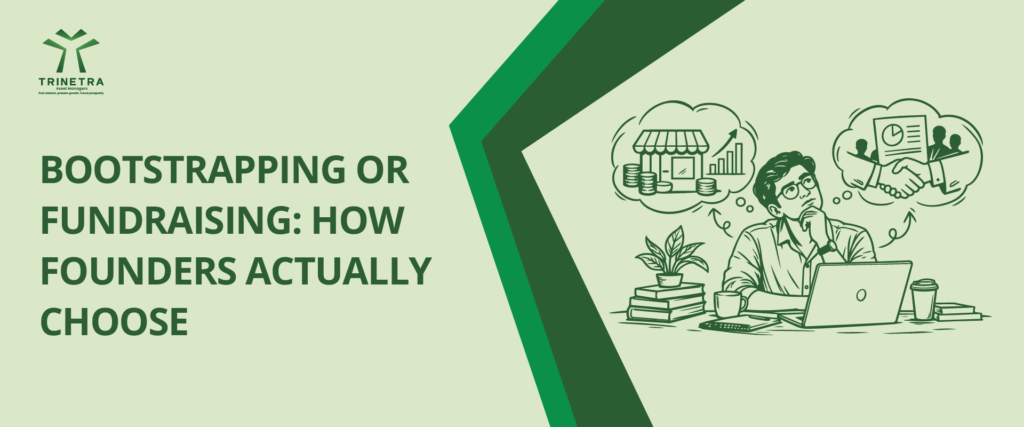
Two ways to fund a company, two very different outcomes. Here’s how to tell which one fits.
Bootstrapping means funding the business from your own money and its own revenue, keeping full ownership but growing at the speed your profits allow. Fundraising means selling equity for capital, which buys speed and expertise but costs ownership and control. Neither is better. The right answer depends on how capital-hungry your business is and how fast your market is moving.
What a startup actually is
You’ve probably seen founders on YouTube or in the news talking up their latest funding round. It can start to feel like every startup in India is chasing a cheque from investors.
So before getting into why, it’s worth asking a simpler question. What is a startup, really?
In plain terms, a startup is a new business built around a big idea. An app, a food delivery service, an online store, even a new way to help farmers sell their produce. Startups usually begin small, but they’re built on the hope of growing fast and growing large.
To grow, a business needs money. There are really only two paths to get it. You fund the business yourself, or you bring in outside money. The first is bootstrapping. The second is fundraising.
Two paths, one lemonade stall
Picture a small lemonade stall. You use your own pocket money to buy lemons, sugar and cups, sell your lemonade, and use whatever you earn to restock the next day. Nobody lent you anything, and nobody owns a piece of your stall.
That’s bootstrapping in miniature. Building a business on your own savings, maybe with some help from family, and whatever the business itself brings in.
Now a different scenario. You want to open a restaurant, but you only have a lakh of rupees. A friend offers you four lakhs more in exchange for 40% ownership. Suddenly you have five lakhs to work with, enough for better furniture, more staff and proper advertising.
Your friend won’t be running the place day to day. But if the restaurant is eventually worth a crore, their 40% stake is worth forty lakhs.
That’s fundraising in essence. You bring in investors willing to give you money in exchange for a slice of ownership.
The core difference comes down to this. Bootstrapping lets you keep every bit of ownership. Fundraising means giving some of it away.
What each path costs you
|
Bootstrapping |
Fundraising |
|
|
Ownership |
You keep 100% |
Diluted at every round |
|
Speed |
Limited to what the business earns |
Can expand across cities at once |
|
Control |
Nobody dictates your decisions |
Investors have expectations and often board seats |
|
Risk |
Personal savings on the line |
Investor money on the line, but your stake shrinks |
|
Outside help |
Whatever you can find yourself |
Advice, networks, customer and partner introductions |
|
Pressure |
Self-imposed |
Growth targets on someone else’s timeline |
|
Main danger |
A funded rival takes your market first |
Growth expectations that don’t match reality |
Bootstrapping’s biggest advantage is freedom. Nobody dictates how fast you grow or what decisions you make, and you keep 100% of the company. If the business ever becomes valuable enough to sell, every rupee lands in your pocket. Mailchimp in the United States is the clearest proof that this path can end enormously: it never raised venture capital and sold to Intuit for about $12 billion in 2021.
That freedom comes at a cost. Growth can only move as fast as the business itself earns money. Wanting to open offices or franchises across five cities means waiting until the savings exist, and that can take years. There’s real personal financial pressure too, since a business that doesn’t work out can mean losing your own savings with it.
And while you’re being careful and building slowly, a well-funded competitor might be spending aggressively and capturing the very market you were hoping to win. Bootstrapping isn’t without its own risks. Section 7 shows exactly what that looks like when it happens.
Fundraising’s biggest advantage is speed. A startup with serious investor backing can hire faster, spend more on advertising and expand into many cities almost at once. Zomato (now Eternal) leaned heavily on investor capital to expand its footprint across India in a remarkably short window.
Investors bring more than money. Good ones offer business advice, share hard-won experience, and open doors to important customers or partners, sometimes steering founders away from costly mistakes before they happen.
But fundraising has strings. Every round means giving away another slice, and founders who raise repeatedly can end up owning a surprisingly small share of the business they built. Investors also come with expectations, usually centred on fast, aggressive growth, and that pressure can push founders toward decisions that aren’t good for the company’s long-term health. If growth doesn’t arrive on the timeline investors expected, things get complicated fast.
Why so many startups raise money today
The race to grow fast comes first. Picture a food delivery startup. If it had to save patiently and expand city by city over five years, a well-funded competitor could cover fifty cities within a single year. Once customers get comfortable using one app, switching becomes hard. By the time the bootstrapped startup is ready to scale, the market may already belong to someone else.
Investors themselves are built to want speed. Venture capital firms aren’t hunting for slow, steady businesses. They back many startups at once, knowing most will fail, betting that the rare huge success generates enough return to cover every loss. This model naturally pushes founders to grow fast, spend heavily on marketing, hire aggressively and expand quickly. That culture of speed has become the default across most funded startups.
The tax angle nobody explains properly
There’s also a meaningful tax reason behind the preference, and it’s rarely laid out clearly.
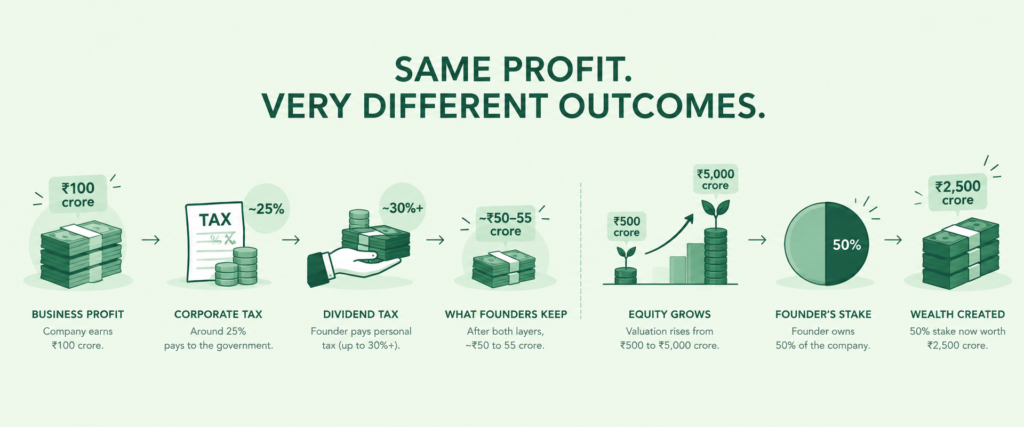
Say a company earns ₹100 crore in profit. It first pays roughly 25% in corporate tax. If the founder then takes the remaining amount out as dividends, personal income tax follows on top, at slab rates that reach 30% plus surcharge and cess. After both layers, a founder might keep somewhere around ₹50 to 55 crore.
Many funded startups take a different route. Rather than pulling large profits out along the way, they pour everything back into growth, and as the company scales, its valuation climbs.
Say a startup’s valuation grows from ₹500 crore to ₹5,000 crore across several rounds, and the founder owns half. That 50% stake, once worth ₹250 crore, is now worth ₹2,500 crore. Wealth created entirely through equity ownership rather than salary or dividends.
The key detail is timing. Founders don’t owe tax the moment their company’s valuation rises. Tax generally comes due only when they actually sell.
And the rate differs sharply. Long-term capital gains on unlisted shares, held more than 24 months, are taxed at a flat 12.5% without indexation under the Finance Act 2024 changes. Compare that with up to 30% plus surcharge and cess on salary or dividend income, and the structural incentive becomes obvious.
Tax rules change and individual situations differ. Treat this as the shape of the argument, not as advice for your own circumstances.
So which path should you actually take?
Neither path is universally better. Both carry real advantages, and the right choice depends on the kind of business you’re building and what you personally want from it.
A small software company can often grow steadily on its own profits, since it doesn’t need much capital to start. Food delivery or ecommerce is a different story: delivery networks, marketing spend and warehousing all demand serious capital upfront, which makes outside funding far more useful.
Fundraising tends to make sense when:
- The industry moves fast and speed genuinely matters
- The idea needs significant capital from day one
- Winning means dominating a large market quickly
- The founder is comfortable sharing ownership in exchange for reach
Bootstrapping tends to work best when:
- The business can generate revenue early
- Starting doesn’t require a large upfront investment
- The founder values control and independence over the fastest growth curve
- There’s no land-grab race for the market
The pace may be slower, but there’s a certain peace of mind in having no outside pressure to answer to.
In practice, plenty of startups blend both. Many begin by bootstrapping, using their own money to prove the model works, and only turn to investors once that proof exists.
When bootstrapping gets overtaken: the Zerodha and Groww story
The clearest live example of this whole trade-off is sitting in Indian broking right now.
Zerodha was built without a single rupee of venture funding. Strong product, sound decisions, disciplined spending. It overtook ICICI Securities to become India’s largest retail stockbroker by active clients in 2019, and held that position for roughly five years. It remains famously profitable, and its founders built enormous wealth without ever selling equity.
Then Groww arrived. Venture-backed, consumer-app simple, aimed squarely at first-time investors. By September 2026, NSE data showed Groww with over 1.3 crore active clients against Zerodha’s roughly 68 lakh. Groww is now India’s largest broker by active clients. Zerodha is second.
Both outcomes are genuinely good. Zerodha’s founders own their company outright and answer to nobody. Groww raised, scaled faster, and won the client-count race.
But the lesson is honest rather than comfortable: bootstrapping worked, and it still got outpaced. Zerodha’s business was profitable almost from the start, which made the bootstrapped path considerably easier to walk than it is for most founders. Even with that advantage, a funded competitor moving faster at the top of the funnel took the lead on scale.
That is the real trade-off, not the sanitised version. Bootstrapping buys you ownership and independence. It does not buy you immunity from someone with more capital and more urgency.
In the end, there’s no single right answer. The best funding path is the one that fits your business, your goals and your own temperament as a founder.
Disclaimer:
This article is for informational and educational purposes only. It is not financial, tax or legal advice. Tax rules and company data referenced are as of the publication date and change over time. Please consult a qualified professional before making funding or tax decisions for your business.