
Bhav Bhagwan Che: Price Is God
Why the price you pay decides your returns more than the company you buy.
A great business bought at the wrong price is a bad investment. Not a slower one, a bad one. Wipro, the Nifty Fifty, the Nikkei and half a dozen blue-chip Indian names all tell the same story. Quality is easy to see. Price is the discipline that keeps your admiration honest.
Warren Buffett once told his shareholders that price is what you pay and value is what you get. Long before that letter was written, traders in Gujarat and Mumbai had already compressed the same idea into three words. Bhav Bhagwan Che. The price is God.
Why we fall for companies and forget the price tag
People are natural storytellers. The moment we come across a strong business, one with capable management, rising revenue and a commanding position in its market, the mind starts building a story around it. Once that story takes hold, the price attached to it starts to feel like a minor detail.
It looks expensive, but this one is different. The growth runway is huge, so the valuation will justify itself eventually. You are paying for quality, and quality earns a premium.
None of these thoughts is unreasonable on its own. But they all dodge the same question: how much of tomorrow’s growth has already been baked into today’s price?
This is exactly where the old saying earns its place. What you pay today largely decides what you will earn tomorrow. A company can compound revenue at 25% a year for a decade and an investor can still lose money, if the entry price was rich enough.
A good company is not automatically a good investment
Indian market history offers a well-known example.
In February 2000, near the peak of the dot com boom, Wipro was one of the most exciting technology names in the country and traded at valuations to match. Then the bubble burst.
Here is the cleanest public marker of what followed. In January 2019, Business Standard reported that Wipro, then trading around ₹353, had reached its highest level since 8 March 2000. Nineteen years, just to revisit a price.
On a bonus and split-adjusted basis, the pattern looks like this. A buyer at roughly ₹200 in early February 2000 did not see that price again until 2013. A buyer a week later, near ₹264, waited until 2019. Anyone who bought near the February peak of around ₹334 waited until late 2020 to simply get their capital back.
(Adjusted prices vary by data source depending on how bonus issues and splits are treated. Figures here are on a consistent adjusted basis; check your own data provider before quoting them.)
None of this happened because Wipro was a poor company. It paid dividends dozens of times over those years, issued several bonus shares, kept growing revenue, and never stopped functioning as a strong business. Investors who bought at the wrong price still waited the better part of a generation to recover their money.
This is precisely what Buffett meant when he warned that overpaying for an excellent company can erase the benefit of a full decade of good business performance afterward.
Why smart people keep overpaying
Fear of missing out is the obvious driver. When a stock has already climbed 80% in a year, every extra day of waiting feels like a missed opportunity, and that pressure feeds on itself.
Recency bias does similar work, making a recent run of strong performance feel like the new normal, even though three or four good years rarely continue indefinitely.
Narrative is the most powerful distortion of all. Stories about India’s digital shift, rising consumer spending or the move toward clean energy are genuine and important, but they are not the same thing as a valuation case. A convincing story can make almost any price feel acceptable. That is the problem, not the feature.
And there is a simpler trap underneath all of it: popularity itself becomes risk. Once everyone agrees a company is excellent, that opinion is already in the price. You are joining a room that is already full.
The blunt arithmetic of entry price
The maths is not complicated.
Suppose an investor buys a stock at 60 times earnings, and the company grows earnings at 15% annually for ten years. That is a genuinely impressive run.
For that investor to earn 15% a year, the market has to be willing to pay 60 times earnings again a decade later. If instead the market settles the stock at a more ordinary 25 times, the investor’s annual return falls to somewhere around 3 or 4%.
|
What you pay |
What the business does |
What the market pays later |
Roughly what you earn |
|
60x earnings |
15% EPS growth for 10 years |
Still 60x |
About 15% a year |
|
60x earnings |
15% EPS growth for 10 years |
25x |
About 3 to 4% a year |
That gap is multiple compression, and it is the single most underrated risk in equity investing.
The same arithmetic works in reverse. A perfectly average business bought at a genuinely low valuation can generate outstanding returns simply because the starting point was so depressed.
Research from firms such as Vanguard and Morningstar consistently shows that the valuation at which an index starts is among the strongest available predictors of its returns over the following decade. Expensive markets tend to deliver weak long-term returns and cheap markets tend to deliver strong ones. The relationship is not exact, but the direction has held up remarkably well.
A warning from the 1970s: the Nifty Fifty
The most studied episode of valuation excess took place in the United States in the late 1960s and early 1970s, around a group of large growth companies. Polaroid, Xerox, McDonald’s, Avon, Coca-Cola, IBM and Disney all belonged to this club.
These were established businesses with genuine earnings and strong growth records. Yet by the end of 1972 the average price to earnings multiple across the group had reached 41.9, against 18.9 for the S&P 500. More than a fifth of them traded above 50 times earnings. Polaroid sat at roughly 95 times.
When the bear market of 1973 and 1974 arrived, the damage was severe. Polaroid lost more than 90% of its value. Avon and Xerox suffered enormous declines of their own. Investors who had bought these so-called one-decision stocks near their peaks were left nursing serious losses.
Here is the more nuanced part. Jeremy Siegel went back and checked in 1998. An equal-weighted basket of all fifty stocks, bought at the December 1972 peak and held through August 1998, returned about 12.5% a year, roughly matching the broader market over that stretch.
The businesses themselves were fine in the end. What investors actually lost was time, roughly a decade of underperformance, plus the emotional toll of watching it play out. Many gave up near the bottom rather than holding on.
Time is the price you pay for overpaying, and most investors are not built to pay it patiently.
The Indian evidence: what happens when the Nifty P/E crosses 22
Sanjay Bakshi, one of India’s most respected voices on investing, produced a finding that carries real weight for anyone investing in Indian equities. Whenever the Nifty’s price to earnings ratio has moved above 22, average returns over the following three years have tended to turn negative.
Nifty data going back to 1999 shows the pattern. The index touched a P/E close to 28 before the 2008 crash, then fell to around 11 during the worst of that crisis. During the stimulus rally of 2020 and 2021 it spiked past 40 on a standalone basis, an all-time high. Over more than two decades the median has generally sat somewhere between 20 and 22.
Work covering Nifty data from 1990 through 2024 found that periods where the P/E sat below 13 carried essentially no chance of loss across any multi-year holding period tested. Periods above 27 produced unstable outcomes and much longer stretches before investors broke even.
The company-level evidence is just as plain:
|
Company |
Bought around |
Flat or negative for |
|
Reliance Industries |
2007 highs |
A full decade |
|
Hindustan Unilever |
1999 |
Through to 2010 |
|
Larsen & Toubro |
2007 to 2008 |
Over twelve years |
|
ITC |
2013 |
Through to 2021 |
Every one of these companies is fundamentally sound and well run. What separated the outcomes was the price paid at entry, not the quality of the underlying business.
Three reasons strong businesses still burn investors
Multiple compression. Paying 80 times earnings and watching the market settle the stock back to 30 times will hurt returns for years, even while earnings keep growing.
Unrealistic expectations baked into the price. A stock at 60 times earnings implicitly assumes a very specific future: sustained high growth, stable margins, no meaningful competitive threat. The moment reality falls even slightly short of that script, the stock re-rates sharply lower.
The unwinding of a narrative. Markets are remarkably good at pricing in optimism. When sentiment turns, whether through macroeconomic pressure, industry disruption or simply the passage of time, the premium attached to the story disappears quickly. The business underneath may not have changed at all.
The dot com period showed all three at once. Even businesses that genuinely reshaped the world, including Amazon and the search companies that preceded Google, saw their share prices fall 70 to 90% from their peaks before eventually recovering. Companies with weaker fundamentals never came back at all.
The psychology behind the mistake
Understanding why intelligent people keep overpaying requires an honest look at behaviour rather than spreadsheets.
Herd behaviour is a strong pull. Watching everyone around you buy the same stocks and profit from it makes sitting on the sidelines feel almost irrational, and few people tolerate that discomfort for long.
Confirmation bias compounds it. Once a stock is owned, investors seek out supporting information and downplay anything that challenges it, often growing more confident the higher the valuation climbs, as though the price itself were proof of being right.
Overconfidence adds another layer. Most investors tell themselves they will exit before any correction arrives. Almost nobody does.
And storytelling remains the most dangerous force of all. A compelling narrative about India’s growing middle class, digital adoption or infrastructure expansion can make nearly any price feel justified. The story can be entirely true and still not justify any price someone is willing to pay.
Howard Marks of Oaktree Capital put it well when he argued that the single most important factor shaping investment risk is the price paid to acquire something, since high prices carry high risk and low prices carry low risk. This cuts against instinct. Most people associate risk with volatility or with uncertainty about the business. Marks argues, convincingly, that overpaying is itself the primary risk.
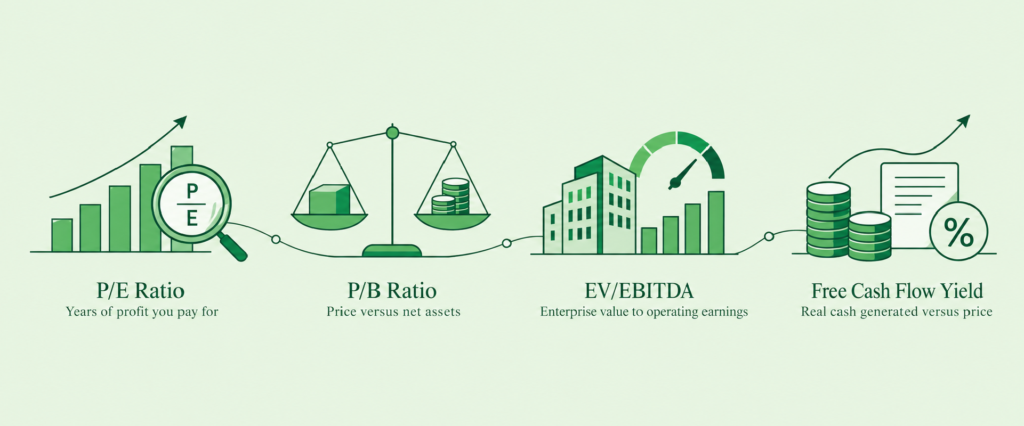
Using simple valuation metrics
|
Metric |
What it tells you |
Quick read |
|
P/E ratio |
How many years of current profit you are paying upfront |
A P/E of 25 means paying for 25 years of today’s earnings in advance |
|
P/B ratio |
Price against the company’s net asset value |
A P/B of 5 means paying five times accounting value |
|
EV/EBITDA |
Enterprise value against operating earnings |
Useful for comparing across different capital structures and industries |
|
Free cash flow yield |
What share of your purchase price the business generates in real cash each year |
A 2% FCF yield when a fixed deposit pays 7% is a signal worth taking seriously |
None of these tells you exactly what to do next. What they do is show where a stock sits on the spectrum between cheap and expensive, and that context matters a great deal.
When paying more is actually justified
It would be a mistake to conclude that cheap is always better. Some businesses genuinely earn a premium.
A company with a durable competitive moat, whether built on brand loyalty, switching costs, network effects or regulatory protection, can sustain high returns on capital far longer than an average business. For such companies, a richer entry multiple is partly offset by the compounding power of those sustained returns.
The real question is how durable the advantage actually is. A business capable of genuinely compounding at 25% on invested capital for fifteen or twenty years might well justify paying 40 times earnings. If that growth realistically lasts five years before competitors close the gap, the same multiple becomes a costly mistake.
The line between a sensible premium and an irrational one comes down to one honest question: can the business realistically deliver the growth the current price already assumes?
Answering that requires clear-eyed analysis, not hopeful thinking. As Buffett put it in his 1989 letter, drawing on Charlie Munger’s influence, it is far better to buy a wonderful company at a fair price than a fair company at a wonderful price.
A practical framework for avoiding valuation traps
On the analytical side:
Start by judging the quality of the business itself: return on equity over five to ten years, consistency of earnings, free cash flow generation, competitive standing. This establishes what kind of company you are actually looking at.
From there, estimate what growth rate the current price genuinely requires, and ask whether that pace is historically unusual and how many years it would need to hold.
Insist on a margin of safety, Benjamin Graham’s idea: a purchase price meaningfully below a fair estimate of intrinsic value, because assumptions can and do go wrong.
Finally, consider a range of outcomes rather than a single best case. What happens if earnings grow at half the expected pace, or if margins come under pressure? An investment that only works under an optimistic scenario is fragile by construction.
On the behavioural side:
Keep a clear line between admiring a business and buying its stock at any price. These are genuinely different decisions.
Write down the specific growth rate and multiple you are assuming. Making assumptions explicit often exposes how unrealistic they are.
And revisit the thesis whenever the price moves sharply. A 50% rally with no real change in the underlying business means the stock has become 50% less attractive. It sounds obvious. It is routinely ignored.
Patience as a genuine advantage
One of the most underrated parts of disciplined investing is simply being willing to wait.
Markets move in cycles. Expensive stocks eventually become cheap, and ignored sectors eventually attract attention. An investor who holds firm on valuation has a real edge over one who feels obligated to stay fully invested at all times.
That approach means accepting that you will sometimes appear to miss out, watching others profit from stocks that seemed too expensive to buy. That is genuinely uncomfortable. Still, the discomfort of watching unrealised gains pass by is almost always easier to live with than sitting through a 60% loss for ten years.
Japan offers the most extreme version of this lesson. The Nikkei reached roughly 39,000 in December 1989, at a time when Japanese equities traded at extraordinary levels, with some estimates putting the average P/E on the Tokyo Stock Exchange above 60. The index then fell for the better part of two decades and did not return to its 1989 peak until February 2024, thirty four years later.
Even a genuinely strong national economy can produce dismal stock market returns if the starting valuation was pushed high enough.
Six questions before buying any stock
- What has the five-year return on equity been? This speaks to business quality.
- Is the balance sheet conservative? This speaks to financial resilience.
- What growth rate does the current P/E genuinely require? This tests whether expectations are reasonable.
- How does today’s valuation compare with its own five-year history? This gauges relative expensiveness.
- What is the free cash flow yield, against safer alternatives available right now?
- What happens to the investment case if growth simply disappoints?
And one that matters more than the other six combined: am I buying because of the story, or because of the price?
Some of the costliest mistakes in investing were made by people who had done careful analysis but were ultimately won over by the narrative instead of being held back by the valuation.
Closing thoughts
Bhav Bhagwan Che, understood properly, is a lesson in humility. No matter how strong a company may be, the price the market places on it already encodes a set of expectations. When those expectations run too high, even an outstanding business turns into a poor investment.
Market history across the world confirms this again and again. Japan’s bubble in the late 1980s, the dot com mania of 1999 and 2000, and repeated bouts of excess in Indian markets all tell essentially the same story. Overpaying has consequences, and those consequences are typically measured in years, sometimes decades, of waiting.
Valuation is not the only thing that matters. A cheap stock in a dying industry can be just as poor an investment as an expensive one in a thriving industry. The strongest results tend to come from combining genuine business quality with a sensible entry price, which is the Buffett approach distilled to its core.
Of the two, quality and price, it is price that investors most consistently underweight. Quality is easy to see, easy to admire, and easy to use as justification. Price is the discipline that keeps that admiration grounded in reality.
The old traders of Gujarat understood this instinctively. In three simple words they captured something that decades of academic research and repeated market history have only confirmed since.
The price you pay is not merely important. It is what decides almost everything.
Disclaimer:
This article is for informational and educational purposes only. It is not investment advice, and nothing here is a recommendation to buy or sell any security. Companies are named as historical illustrations, not recommendations. Past performance does not indicate future results. Please consult a SEBI-registered investment adviser before making financial decisions.