The Bear Who Gave Up
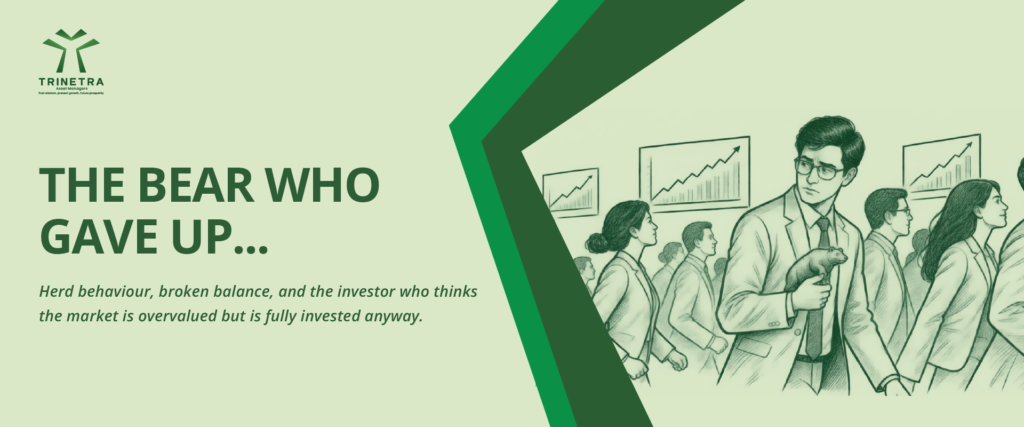
Herd behaviour, broken balance, and the investor who thinks the market is overvalued but is fully invested anyway.
Crowds make good decisions when their members think independently and disagree with each other. Markets work the same way. When even the skeptics capitulate and buy, the disagreement that made the market smart has gone, and the pool of future buyers has gone with it.
Two neighbours and an expensive habit
Let me tell you about two neighbours who have not spoken properly in decades, spend a combined fortune on weapons they will likely never use, and sit on some of the most resource-rich land in the world, while their people watch in disbelief and wonder where all the money went.
Algeria and Morocco have every ingredient for prosperity. Oil and gas, long coastlines, natural resources. In practice it is not all rosy. In 2025 the two spent a combined $31.7 billion on defence. Algeria alone accounted for $25.4 billion, which works out to 8.8% of its GDP, the second-highest military burden in the world after Ukraine. Its defence budget now exceeds what it spends on education and health put together.
Similarly, Greece and Turkey have been NATO allies since 1952 and neighbours since long before that. They also spend more on defence than they probably should, driven almost entirely by suspicion of each other. Meanwhile both have struggled with economic crises, debt restructuring and youth unemployment.
A pattern emerges. Two groups of decision-makers, watching each other, reacting to each other, compounding expensive choices that assume the worst about the other side.
It is a costly way to run a country. It is also, surprisingly, how a lot of people run their stock portfolio.
Guess the weight
At a West of England livestock fair in 1906, Francis Galton collected nearly 800 guesses on the weight of a large ox. Most of the guessers had no livestock expertise at all. He expected the crowd to be badly wrong.
They weren’t. Galton published the result in Nature the following year. The middle of the crowd landed at 1,207 pounds; the average of all the guesses worked out to 1,197. The ox weighed 1,198.
James Surowiecki built a book around this idea, The Wisdom of Crowds. Aggregate enough opinions and the collective result beats almost any individual, however expert.
He sets out several conditions for it to work. Two matter most here. Diversity, meaning people need genuinely different views so errors cancel out. And independence, meaning people need to decide using their own information rather than copying each other.
The moment everyone starts copying everyone else, you no longer have a thousand independent opinions. You have one opinion, held a thousand times.
In Galton’s fair the errors were random. Some guessed too high, some too low, and they cancelled out. That is the magic. But imagine if every person had first glanced at what their neighbour wrote. The wisdom would have evaporated, and you would be left with a crowd agreeing on the wrong number, very confidently.
Which is exactly what Algeria and Morocco show us. A small closed group, reinforcing the same thinking, reaching the same expensive conclusion, year after year.
When markets lose their independence
Markets thrive on diversity. Bulls and bears, momentum traders and value investors, short sellers and long-only funds. The disagreement is built into the ecosystem.
Independence is harder than we hope.
Think about what happens in a good bull run. A stock goes up 20%, then another 15%. Financial channels flash it. Social media noise climbs. Your friend who knows nothing about markets mentions he bought it three months ago and has already doubled his money. At some point the FOMO arrives, and when the crowd becomes your preferred input, independence quietly leaves the group chat.
For decades two types of investor balanced each other out. Trend followers who bought as prices climbed, and fundamentalists who bought on valuation. They kept each other honest. Corrections happened, but they were measured.
That balance has shifted. Fundamentalists increasingly ask not “is this worth buying?” but “is this cheaper than that other stock?” It’s all relative, you know. Valuations become a state of mind, usually right before they blow up in your face.
When that happens, markets take bigger swings. In early 2020 the market fell about a third in roughly a month, then recovered almost vertically, in a sequence with no real precedent. That is what it looks like when trend followers and fundamentalists stop balancing each other and start chasing the same signal at the same time.
The fully invested bear
Which brings us to the most absurd and most common character in any long bull market.
A bear is someone who believes stocks are expensive and expects prices to fall. In a rational world such an investor sits on cash, waits for better valuations, and watches the party from the pavement.
But markets are not rational, and neither are investors. As prices keep climbing, patience starts carrying a painful opportunity cost. Friends are making money. The contrarian starts to doubt himself, decides the others must know something he doesn’t, and goes shopping for whatever is hot.
He is now fully invested. He is still bearish somewhere at the back of his mind, but his portfolio says otherwise.
That is the fully invested bear, a phrase that has floated around market commentary for years precisely because the character keeps reappearing. And when even the sceptics have joined the herd, the question worth asking is simple. Who is left to buy?
Who is left to buy?
Markets rise because buyers outnumber sellers. As long as fresh money keeps arriving, prices can keep climbing. But once the bears have capitulated, the pool of potential new buyers has shrunk badly. Future gains now depend on convincing people who have not yet bought to buy at prices higher than before.
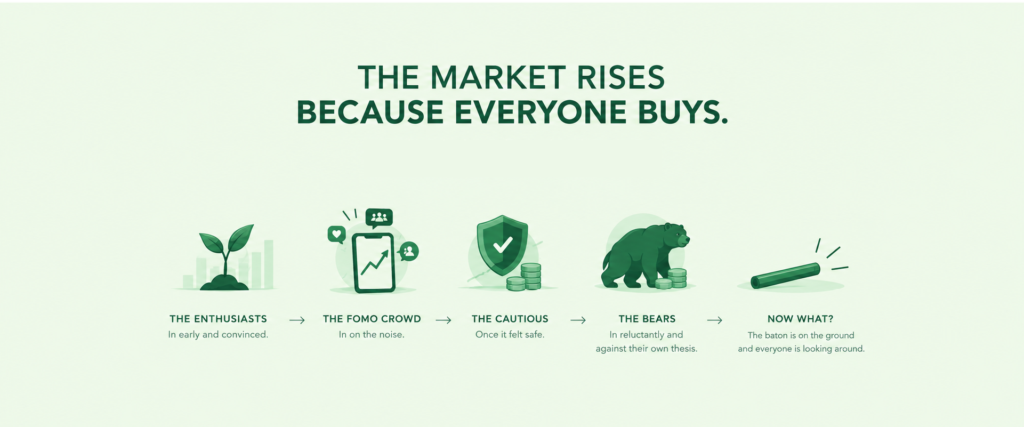
Think of it as a relay race where each successive runner gets harder to find.
|
Leg |
Who ran it |
|
First |
The enthusiasts, in early and convinced |
|
Second |
The FOMO crowd, in on the noise |
|
Third |
The cautious, in once it felt safe |
|
Fourth |
The bears, in reluctantly and against their own thesis |
Now the baton is on the ground and everyone is looking around wondering who picks it up next.
The big question
This is really about what oils the market machinery and what makes it prone to breakdown.
Crowds are smart when they are diverse and independent. They get less smart and far less predictable when everyone is reading the same projections, following the same narratives, and arriving at the same conclusions.
The fully invested bear is a small indicator of something larger. The doubters, the contrarians, the sceptics have joined the herd too. The diversity that made collective judgment work is no longer there, and the risk should be weighed accordingly. Markets over time tend to reward those who are patient.
History’s most expensive periods for investors were the ones where everyone agreed on the direction, warnings were treated as background noise, and caution was mistaken for ignorance. Worth keeping somewhere at the back of your mind, right next to your bear thesis.
So at any given moment, it is worth asking how much of your confidence in the market is genuinely your own, built from your own reading of valuations, earnings and risk, and how much of it has quietly been borrowed from the crowd around you.
The two feel identical on the surface. They rarely produce identical outcomes.
Disclaimer:
This article is for informational and educational purposes only. It is not investment advice and nothing here is a recommendation to buy or sell any security. Please consult a SEBI-registered investment adviser before making financial decisions.
Photo Source: Russell Investments