
What Matters Most in Investing?

The two forces behind every stock return: earnings growth and valuation re-rating, explained for Indian investors.
Stock returns come from two engines. The company grows its earnings, and the market changes what it pays for each rupee of those earnings. Almost everything else you read about markets is noise layered on top of those two. Learn to separate them and you can tell whether a stock compounded or simply got popular.
Written for people who already invest and want to understand why their stocks move. If you are still deciding whether to start investing at all, SEBI’s investor portal is the better place to begin.
Why most investors watch the wrong things
The market produces an endless stream of information. Interest rates, FII flows, valuation ratios, economic forecasts, quarterly guidance. All of it influences businesses and sentiment in some way, which is exactly what makes it a trap.
After the pandemic rally, social media filled up with people explaining the formula behind their picks. Some were genuinely skilled. Many had simply been invested during a bull market and mistook the tide for seamanship. Telling those two apart, in others and in yourself, is most of what this article is about.
For an individual investor the goal is simple enough: grow capital over time. Reaching it means spending your attention on the few things that actually drive long-term returns rather than everything that happens to be available to read.
Plenty of variables move prices in the short run. Only two create wealth over the long run.
The formula in one line
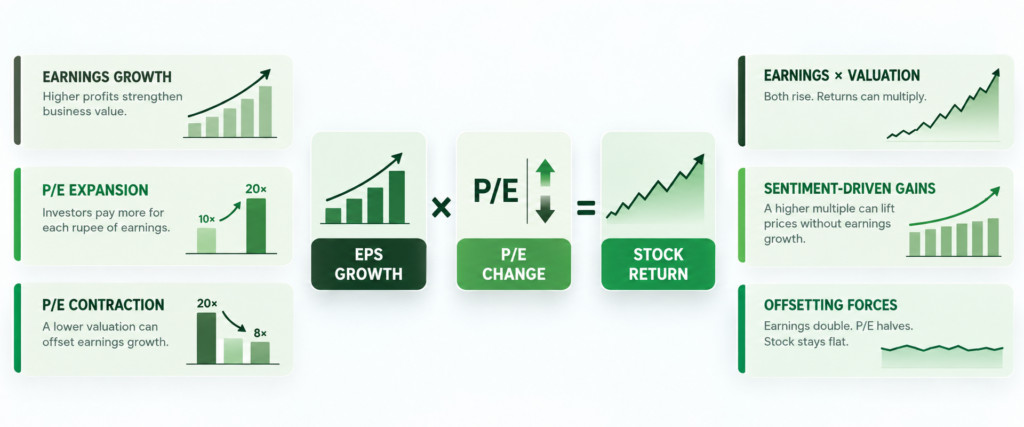
Stock return ≈ Earnings growth × Change in P/E multiple
A stock that doubles its earnings and keeps the same multiple roughly doubles. A stock that doubles its earnings while the multiple also doubles goes up around four times. A stock that doubles its earnings while the multiple halves goes nowhere at all.
|
What happened to EPS |
What happened to P/E |
Roughly what the stock did |
|
Doubled |
Unchanged |
Doubled |
|
Doubled |
Doubled |
Up about 4x |
|
Doubled |
Halved |
Flat |
|
Flat |
Doubled |
Doubled, on sentiment alone |
|
Halved |
Halved |
Down about 75% |
That table is the whole article. Everything below is how to read each column before it happens rather than after.
Engine one: earnings growth
A share is ownership of a business. When the business earns more each year, the share is worth more. That is the entire mechanism, and it is why earnings growth does the durable work.
A company can have a compelling founder, a loud investor following, and a sector everyone is excited about. If profits do not grow, the returns eventually do not either, however good the story sounds.
Take a company earning ₹10 EPS today that grows to ₹40 over five years. Even if the market values it at exactly the same multiple throughout, the stock is worth four times more, because the business is. Prices wander in the short run. Earnings are what pull them back.
The real job is not identifying growth. It is identifying growth the market has not priced in yet. Prices follow earnings with a lag, and that lag is the opportunity. By the time strong growth is obvious to everyone, most of it is already in the price.
Where future earnings growth actually comes from
Six places worth checking, roughly in the order they show up:
Market expansion. Is the addressable market growing, or is the company fighting for share in a flat one? A business inside an expanding market gets a tailwind for free.
Management quality. Two companies in the same industry can diverge completely. One keeps launching and entering. The other defends an ageing lineup. Read five years of annual reports and check whether management did what it said it would.
Product and behaviour shifts. One change in consumer behaviour can rewrite a company’s trajectory. The move from feature phones to smartphones made some suppliers and ruined others, and the signal was visible well before it reached the P&L.
Consolidation. Earnings can grow because rivals exit rather than because the market grew. An industry going from ten serious players to three leaves the survivors with pricing power and better margins.
Capacity expansion. Companies do not spend hundreds of crores on new plants unless they expect demand to justify it. Capex is not a guarantee, but it is management putting money behind a forecast, and it appears in the cash flow statement long before it appears in profit.
Sector-wide demand. Sometimes a company does nothing unusual and the whole sector lifts. Defence, railways, data centres and electronics manufacturing have each had stretches like this in India. The catch is that sector tailwinds reverse, and earnings go with them when they do.
Engine two: valuation re-rating
This is where most retail investors get caught out. Strong profit growth does not automatically produce strong returns, because the market prices businesses on expectations, not performance alone.
Two companies can grow earnings identically and deliver completely different returns, purely because the market decided to pay more for one of them.
When the market starts paying a higher multiple for the same rupee of earnings, that is re-rating. It usually happens for structural reasons: more analysts begin covering the stock, institutions build positions, liquidity improves, or the sector becomes a theme investors want exposure to.
Run the maths on two companies, both taking EPS from ₹10 to ₹20:
- Company A stays at 10x earnings. Stock goes ₹100 to ₹200. Doubled.
- Company B re-rates from 10x to 25x. Stock goes ₹100 to ₹500. Up 5x.
Identical business performance. The entire difference came from perception. Earnings growth creates value. Re-rating multiplies it.
Themes are the usual trigger. Digital payments, renewable energy, defence manufacturing, railways, specialty chemicals and China plus one supply chain shift have all played this role in Indian markets at different points.
When both engines fire together
The outsized winners happen when both fire at once. A company grows profits steadily, which draws attention. Attention pushes the multiple up. A higher price draws more attention and more capital. That loop, business performance and market perception moving the same way at the same time, is how most multibaggers are actually made.
It is also why they are hard to catch late. By the time the loop is visible in headlines, most of the re-rating has already happened and you are buying the second engine at full price.
The engine nobody talks about: de-rating
Re-rating runs in reverse, and almost every article on this subject leaves this part out.
A company can grow earnings 20% in a year and still lose you money, if the market decides the sector is no longer interesting and the multiple compresses from 40x to 25x. The business did its job. The crowd changed its mind.
This matters most in exactly the places re-rating is most exciting:
- Theme stocks bought late. You are paying for a multiple that has already expanded, so your downside is both engines reversing together.
- Cyclicals at peak earnings. High EPS plus a high multiple is the dangerous combination, because both fall at once.
- Anything where the P/E rose much faster than profits. If a stock is up 150% and earnings are up 50%, roughly two-thirds of your gain is sentiment. Sentiment is rented, not owned.
The practical rule: before you buy, split the stock’s past return into the two engines. If nearly all of it came from re-rating, you are late.
A two-question checklist before you buy
- Can this company’s earnings realistically grow over the next three to five years, and why? You should be able to answer in one sentence that names a mechanism, not a mood.
- Is the market paying a low, fair or excited multiple for those earnings today? If it is already excited, engine one has to do all the work from here.
Both answers are positive and genuine candidates. Growth at an excited multiple is a hold-your-nose decision. An excited multiple with no growth is a trade, not an investment.
How to screen for this yourself
You can run this entire framework on Screener.in or any free Indian screener.
|
What you’re testing |
Filter to use |
Why |
|
Engine one is real |
Sales growth 5yr above 20% |
Separates genuine growth from one good quarter |
|
Growth is profitable |
Operating margin stable or rising |
Revenue growth with collapsing margins destroys value |
|
Capital efficiency |
Return on equity above 20% |
Suggests a real advantage, not just scale |
|
Balance sheet survives a bad year |
Debt to equity below 0.5 |
Non-financials only; lenders carry debt by design |
|
How much re-rating is already priced in |
Current P/E vs its own 5-year median |
Far above its own history means engine two has already fired |
|
Promoter conviction |
Holding stable or rising, pledging low |
Falling holding or high pledging is a warning regardless of growth |
The second-last row is the one most people skip, and it is the one that tells you whether you are early or late.
Investing gets described as a technical exercise built on models and forecasts. Most of the biggest winners trace back to something much plainer than that. Businesses create wealth by growing their earnings, and markets then multiply that wealth by deciding to pay more for it.
Know which of the two is moving your stock, and you will know what you actually own.
Disclaimer:
This article is for informational and educational purposes only. It is not investment advice and nothing here is a recommendation to buy or sell any security. All examples are illustrative. Past performance does not indicate future results. Please consult a SEBI-registered investment adviser before making financial decisions.